

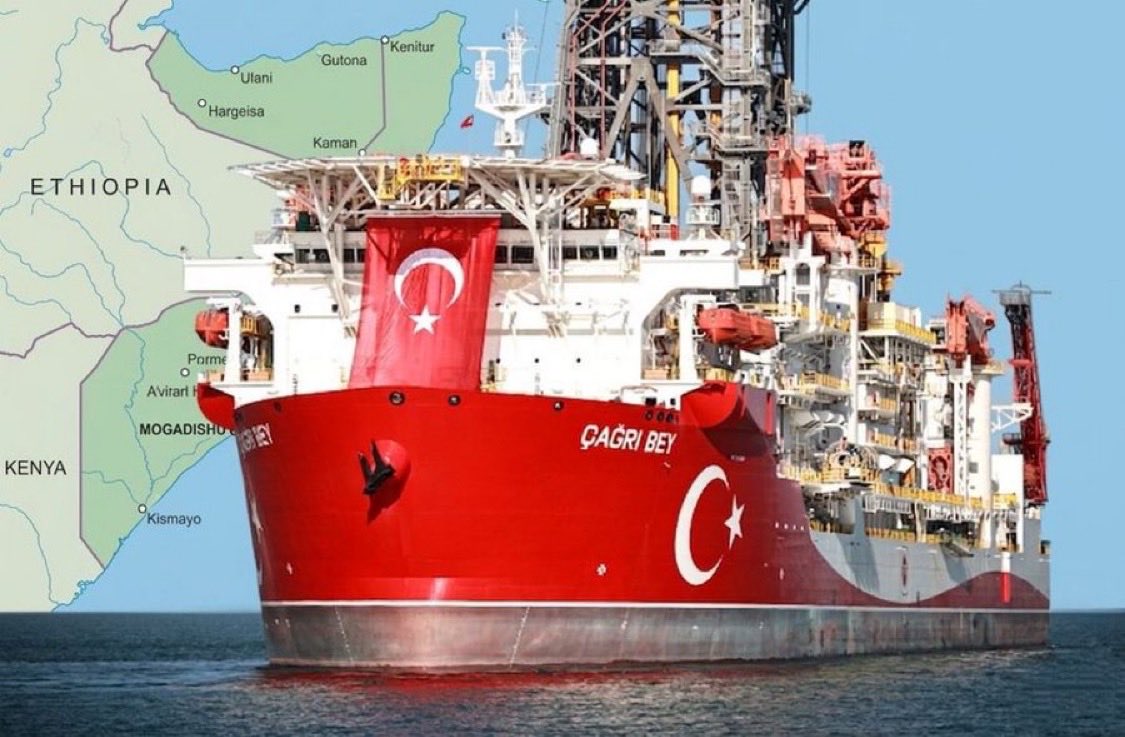
Türkiye’s bold decision to deploy its ultra-deepwater drilling vessel, Çağrı Bey, into Somali waters is more than just an energy exploration mission it is a historic convergence of geopolitics, economic ambition, and long-standing diplomatic ties that could fundamentally reshape the trajectory of Somalia while reinforcing Türkiye as an emerging global energy actor.
The planned drilling of the so called in Somali word Curad-1( meaning the first born) offshore well, following a 45-day journey from Mersin, signals the beginning of Somalia’s first serious offshore oil campaign, an effort that has lingered in uncertainty for decades due to instability, legal ambiguity, and limited technical capacity.
At the center of this unfolding story is a partnership that did not begin in oil fields or boardrooms, but in humanitarian urgency. When Recep Tayyip Erdoğan visited Mogadishu in 2011 during a devastating famine, it marked a turning point in Somalia’s international relations.
Türkiye did not simply send aid it aligned itself within Somalia’s reconstruction process building roads, hospitals, schools, and later establishing one of its largest overseas military bases.
This long-term engagement created a foundation of trust and influence that now extends into one of the most strategic sectors in the world: energy.
For Somalia, the promise of offshore oil has always existed more as a possibility than a reality. Geological surveys over the years have suggested that the country’s coastline one of the longest in Africa may hold significant hydrocarbon reserves beneath the Indian Ocean.
Yet, for decades, insecurity, weak governance structures, and disputes over legal frameworks discouraged major investment. It was only after Somalia began developing its petroleum laws and regulatory systems that the environment slowly became conducive for international partnerships.
Even then, the risks remained high, and few countries were willing to take the first decisive step.
Türkiye’s entry into this space is therefore both strategic and calculated. Under the stewardship of Energy Minister Alparslan Bayraktar, Ankara has pursued an aggressive policy aimed at reducing its dependence on imported energy while expanding its footprint in global energy markets. From exploration activities in the Eastern Mediterranean to investments across Africa, Türkiye has made it clear that energy security is central to its national strategy.
The Somali offshore project fits seamlessly into this broader vision, offering not only the potential for resource discovery but also a chance to solidify political alliances in a region of growing importance.
The journey of the Çağrı Bey from Mersin to Somali waters is symbolic of a deeper transformation. It represents Somalia’s shift from decades of instability toward cautious economic optimism. It also reflects Türkiye’s evolution from a regional power into a country willing to project its capabilities far beyond its borders.
Each stage of this mission from the planning and agreements to the technical deployment carries layers of significance that go beyond the immediate objective of drilling a single well.
Economically, the stakes could not be higher for Somalia. The discovery of commercially viable oil reserves would mark a turning point in a country that has long relied on foreign aid, remittances, and limited domestic revenue streams.
Oil revenues could provide the government with the resources needed to invest in critical sectors such as infrastructure, healthcare, education, and security.
It could also strengthen Somalia’s position in regional and global economic systems, transforming it from a fragile state into an emerging energy player.
However, this potential transformation is accompanied by equally significant risks. The experience of many resource-rich countries has shown that oil wealth can be a double-edged sword. Without strong institutions, transparent governance, and effective management, resource revenues can fuel corruption, deepen inequality, and even trigger conflict.
For Somalia, a country still navigating complex political and clan dynamics, the challenge will be to build systems that ensure equitable distribution of any future wealth while maintaining stability.
Beyond economics, the geopolitical implications of this development are profound. The Horn of Africa is one of the most strategically important regions in the world, sitting along key maritime routes that connect Europe, Asia, and the Middle East.
Global powers including the United States, China, and Gulf nations have all sought to expand their influence in the region through military bases, infrastructure investments, and diplomatic engagement. Türkiye’s growing presence, now extending into the energy sector, adds a new dimension to this competition.
By initiating offshore drilling in Somalia, Türkiye is not only positioning itself as a partner in development but also as a key stakeholder in the region’s future. This move enhances Ankara’s strategic leverage, allowing it to play a more influential role in regional affairs while securing potential energy resources that could reduce its reliance on imports.
It also sends a broader message about Türkiye’s ambitions to be a country that shapes global energy dynamics rather than merely reacting to them.
For Somalia, the partnership with Türkiye offers both opportunity and responsibility. On one hand, it provides access to technical expertise, investment, and international networks that are essential for developing a complex industry like offshore oil.
On the other hand, it places the country at the center of global attention, where every decision regarding resource management, revenue sharing, and environmental protection will be closely scrutinized.
The environmental dimension of offshore drilling is another critical aspect that cannot be ignored. The Indian Ocean ecosystem is vital for Somalia’s fishing communities, which depend heavily on marine resources for their livelihoods. Any drilling activity carries risks, including oil spills and ecological disruption. Ensuring that strict environmental safeguards are in place will be essential to balancing economic ambitions with sustainability.
As the Çağrı Bey prepares to begin operations at the Curad-1 well, the world will be watching closely. The success or failure of this initial drilling campaign will have far-reaching implications. A successful discovery could trigger a wave of investment, attracting other international energy companies and accelerating Somalia’s entry into the global oil market.
Conversely, if the exploration does not yield commercially viable results, it may delay further efforts and reinforce perceptions of risk associated with the country.
Looking ahead, several scenarios could unfold. In the most optimistic case, Somalia discovers significant oil reserves, establishes strong governance frameworks, and uses its new wealth to drive inclusive development. In a more cautious scenario, progress is gradual, with challenges related to infrastructure, capacity, and political dynamics slowing down the pace of transformation.
In the worst-case scenario, mismanagement and external pressures could undermine the potential benefits, turning opportunity into instability.
What remains clear is that this moment represents a critical juncture in Somalia’s history. The arrival of Türkiye’s drilling vessel is not just about oil it is about the possibility of redefining a nation’s future. It is about whether Somalia can move beyond decades of hardship to build a sustainable and prosperous economy.
It is also about how global partnerships, when rooted in long-term engagement and mutual interest, can evolve into transformative ventures.
In the end the story of Türkiye’s offshore drilling mission in Somalia is still being written. It is a story of ambition, risk, and potential a narrative that stretches from the shores of Mogadishu to the depths of the Indian Ocean, and from the corridors of Ankara’s power to the aspirations of millions of Somalis.
Whether it becomes a tale of success or a lesson in missed opportunity will depend not only on what lies beneath the ocean floor, but on the decisions made above it in the months and years to come.