

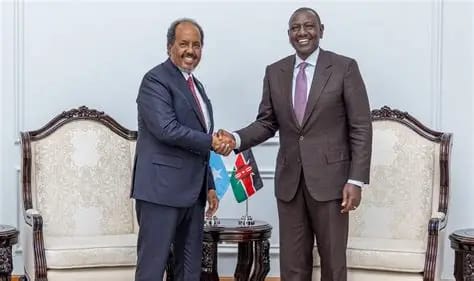
Kenyan President William Ruto has announced that the planned reopening of the Kenya–Somalia border will not proceed as earlier expected, citing growing insecurity, political uncertainty in Somalia, and deteriorating relations between Somalia’s Federal Government and regional administrations.
The announcement marks a major shift from earlier optimism expressed by the Kenyan government regarding cross-border movement between the two neighboring countries. For months, Nairobi had indicated that security conditions along the border were improving and that reopening key crossing points would help revive trade, reconnect divided communities, and strengthen diplomatic cooperation between Kenya and Somalia.
However, recent developments inside Somalia and along the border region appear to have forced Kenya to reconsider the move.
Speaking during an interview with France 24 on the sidelines of the Africa Forward Summit in Nairobi, President William Ruto explained why Kenya had decided to postpone the reopening process. According to Ruto, the security and political situation in Somalia had significantly worsened in recent months, making it impossible for Kenya to move forward with the plan at this time.
Ruto said:
“We were moving very well until there was a huge disagreement between the government in Mogadishu and the states.”
The statement was a direct reference to the growing tensions between Somalia’s Federal Government and several Federal Member States, particularly over governance, elections, constitutional amendments, and security arrangements.
For months, Somalia’s political landscape has remained deeply divided. Relations between Mogadishu and some regional administrations have become increasingly strained, with disagreements over power-sharing, electoral systems, and the future structure of governance in the country.
Ruto’s remarks suggest that Kenya had initially been satisfied with the progress made in stabilizing the border region. Nairobi had earlier believed that improved security cooperation and military operations against extremist groups had created a favorable environment for reopening border crossings.
But according to the Kenyan president, those gains were interrupted by internal political disputes inside Somalia.
By saying “we were moving very well,” Ruto implied that preparations for reopening the border were already advancing positively before the disagreements escalated. The “huge disagreement” he referred to highlights Kenya’s concern that instability within Somalia’s political leadership directly affects security along the shared border.
The Kenya–Somalia border has remained a highly sensitive security zone for years, largely due to threats posed by the militant group Al-Shabaab, cross-border attacks, smuggling networks, and clan-related conflicts.
The border closure itself was originally implemented as part of Kenya’s counterterrorism measures following repeated deadly attacks linked to Al-Shabaab militants operating from Somalia.
Although discussions on reopening had intensified in recent months, the renewed instability appears to have convinced Kenya that conditions are not yet stable enough.
President Ruto further revealed that clashes between Somali federal forces and regional administrations had created serious security concerns near the border areas.
He stated:
“In fact, at that point, some of the Somali National Army were actually pushed into Kenya. We had to support members of the Somali National Army, fly them, assist them, so that we could pacify and reduce the war.”
This statement provides rare insight into the seriousness of the fighting that occurred near Kenya’s border. According to Ruto, some soldiers from the Somali National Army crossed into Kenyan territory during clashes, forcing Kenya to intervene in order to stabilize the situation.
His comments suggest that Kenya was not merely observing the conflict from a distance but was actively involved in preventing the violence from escalating further along its frontier.
The phrase “pushed into Kenya” indicates the intensity of the confrontations between Somali federal troops and regional forces. It also demonstrates how Somalia’s internal conflicts can quickly spill across borders and affect neighboring countries.
Ruto’s claim that Kenya had to “support members of the Somali National Army” and assist them through air transport highlights Nairobi’s broader security role in the Horn of Africa.
The president also stated further saying that Somalia’s future is uncertain and he tried to mediate alongside Ethiopia and Djibouti but no efforts was made.
“Somalia’s future is uncertain the president’s term has expired,and parliament’s mandate has also ended.I tried to mediate alongside Ethiopia and Djibouti, but none of our efforts seem to be working. ”
Kenya has long been heavily involved in Somalia’s security affairs, particularly through its participation in the African Union peacekeeping mission and joint counterterrorism operations against Al-Shabaab.
His remarks also reflect Kenya’s concern that continued instability inside Somalia could create a security vacuum that extremist groups might exploit.
Apart from political tensions, security incidents in the border region have continued to raise alarm.
Just days before Ruto’s interview, six civilians were killed after clan militants ambushed a minibus traveling from Mandera to Arabia in northeastern Kenya.
The attack shocked local residents and further intensified fears over deteriorating security conditions near the Somalia border.
Clan-related conflicts in the region have historically contributed to instability alongside terrorist threats. Such attacks often disrupt transportation, trade, and movement of civilians while increasing pressure on local authorities and security agencies.
Following the deadly ambush, leaders and residents in Mandera raised concerns about the presence of Jubbaland security forces inside parts of Mandera and surrounding areas.
Some local officials reportedly called on the Kenyan government to remove Jubbaland forces from the region within 72 hours, warning that local communities could take action themselves if the government failed to intervene.
The demands reflected growing tensions and fears among local communities over foreign armed presence near Kenyan territory.
The situation has further complicated already fragile relations between Somalia’s Federal Government, Jubbaland regional authorities, and neighboring Kenya.
Ruto also linked Kenya’s decision to broader political uncertainty in Somalia, especially regarding the future of Somalia’s national leadership and institutions.
The Kenyan president stated:
“Today, we have even a much more complicated situation because the term of parliament there expired. The term of the president is expiring, and nobody knows where it is going.”
This statement points directly to Kenya’s concerns over Somalia’s constitutional and electoral future.
Somalia has faced recurring disputes over election timelines, constitutional reforms, and extensions of political mandates for years.
Ruto’s remarks suggest that Kenya fears the uncertainty surrounding Somalia’s leadership transition could further destabilize the country at a time when security conditions are already fragile.
By saying “nobody knows where it is going,” Ruto appeared to express concern that Somalia’s political future remains unpredictable, making it risky for Kenya to proceed with sensitive border decisions.
Kenya shares a long and porous border with Somalia stretching more than 680 kilometers. Any instability inside Somalia often has immediate consequences for Kenyan border counties such as Mandera, Wajir, and Garissa.
Security experts have repeatedly warned that political crises inside Somalia can create opportunities for militant groups, arms trafficking networks, and clan militias to expand their operations across the border.
Ruto ultimately confirmed that Kenya would maintain the closure of the border until the situation becomes more stable.
He concluded:
“So the border for the time being is not open.”
The statement effectively ends speculation that Kenya would reopen the frontier in the immediate future.
For thousands of traders, transport operators, and families living along the border, the decision is likely to bring disappointment.
Many local businesses had hoped that reopening the border would revive economic activities severely affected by years of restrictions and insecurity.
Cross-border trade between Kenya and Somalia plays a major role in supporting local economies in northeastern Kenya and southern Somalia. The closure has affected movement of goods, livestock trade, and family connections between communities living on both sides of the border.
Despite the economic importance of reopening the border, Kenya now appears determined to prioritize security concerns over economic considerations.
Ruto’s interview reflects Nairobi’s broader view that stability in Somalia remains essential before major cross-border policies can be implemented safely.
The remarks also demonstrate how deeply interconnected the security and political futures of Kenya and Somalia remain.
Any escalation in Somalia’s internal conflicts, whether political or military, immediately affects Kenya’s national security calculations.
As tensions continue between Mogadishu and regional administrations and uncertainty surrounds Somalia’s political future, Kenya’s decision signals growing concern that the Horn of Africa could face another period of heightened instability.
For now, the Kenya–Somalia border remains closed, with Nairobi making clear that security and political stability in Somalia will determine when or if the reopening process can resume.