

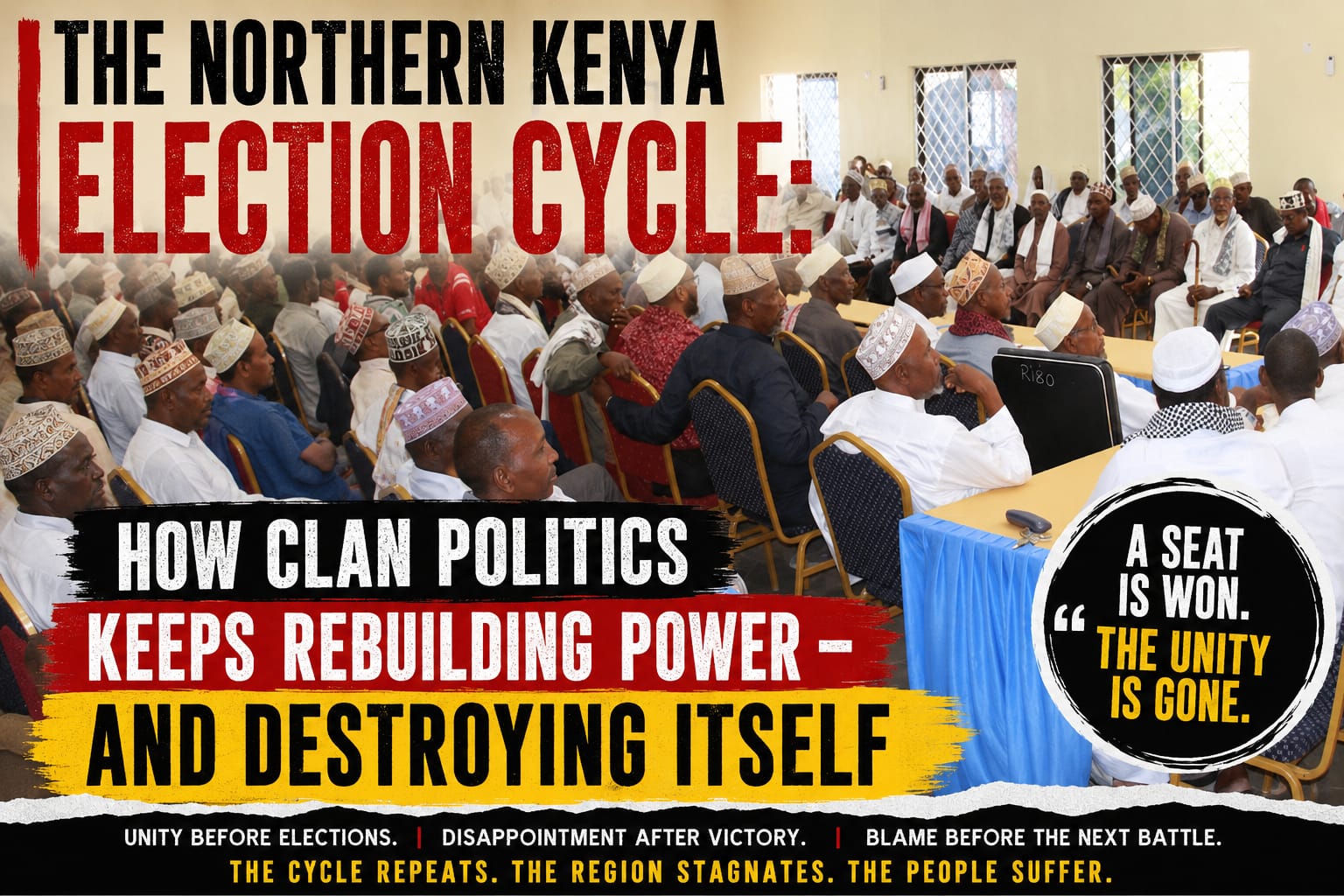
In Northern Kenya, elections are rarely just elections.
They are moments of survival, identity, emotion, memory, revenge, and collective mobilisation. They are seasons when entire communities awaken from political silence and suddenly rediscover unity. Villages become campaign centers. Elders become strategists. Youth become mobilisers. WhatsApp groups become command rooms. Tea discussions become political briefings. Every household becomes emotionally invested in one single message:
“We must defend our seat.”
And once that phrase is spoken, the machinery begins moving.
Money starts flowing. Delegations travel from village to village. Clan elders hold closed-door meetings. Religious leaders quietly influence opinion. Businessmen fund mobilisation. Diaspora communities contribute resources from abroad. Young people flood social media spaces defending “their candidate” with unmatched energy.
In North Eastern Kenya, elections are not merely contests between individuals. They are collective clan projects.
That is the reality.
And perhaps the most dangerous part is this: everyone knows the cycle, everyone complains about the cycle, yet everyone still participates in the cycle.
As Kenya slowly moves toward another election period, the signs are already visible across North Eastern Kenya. Meetings are intensifying. Informal endorsements are happening quietly. Political calculations are being made long before official campaigns begin. Elders are beginning to “consult.” Communities are slowly reorganising themselves politically.
The region is once again entering its most familiar season.
The election season.
And with it comes the same old cycle that has defined North Eastern politics for decades.
To understand North Eastern Kenya politics, one must first understand one painful truth: politics in the region is fundamentally built around clan arithmetic.
At the national level, Kenyan politics has often revolved around tribal numbers a “head count” politics where communities calculate voting blocs, regional strength, and ethnic alliances. But in North Eastern Kenya, this logic becomes even more concentrated and localised.
Here, clan identity becomes the primary political currency.
Development records matter less. Manifestos matter less. Policy debates matter less.
What matters most is often: Whose turn is it? Which clan controls the seat? Can our numbers secure victory? Will another clan dominate us if we lose?
This creates a political environment driven more by communal fear and protection than ideology.
Communities fear exclusion. Fear losing access to resources. Fear political irrelevance. Fear marginalisation. Fear losing symbolic power.
And because of that fear, elections become existential.
The seat is no longer viewed as an office for public service. It becomes a symbol of communal survival.
That is why mobilisation in Northern Kenya becomes so intense.
Entire communities move as one political body during elections. Differences disappear temporarily. Internal conflicts are suspended. Even long-standing rivalries within clans are buried for one purpose: securing victory.
For a moment, unity becomes real.
But only for a moment.
No political structure in North Eastern Kenya is stronger than collective clan mobilisation.
Political parties are weak. Ideological movements barely exist. Issue-based politics struggles to survive.
But clan mobilisation?
That remains undefeated.
It is organised. Emotionally powerful. Financially supported. Socially enforced. And culturally protected.
The mobilisation process itself is almost ritualistic.
- First come the consultations.
- Then come the endorsements.
- Then community pressure intensifies.
Neutrality becomes difficult. Criticism becomes dangerous. Questioning leadership decisions becomes interpreted as betrayal.
Young people are told to “stand with the community.” Business people are expected to contribute. Women mobilise families. Religious influence quietly enters the conversation.
Then the campaign transforms into a collective mission.
Suddenly, everyone is united around one goal.
And usually, it works.
Seats are won.
Governors are elected. MPs secure positions. Senators celebrate victories. Ward representatives emerge through massive clan-backed waves.
Victory celebrations erupt across towns and villages.
Communities feel empowered again.
People believe they have defended their dignity.
But this is where the cycle begins collapsing.
Because after elections, reality changes completely.
The greatest weakness of North Eastern Kenya politics is not mobilisation.
It is sustainability.
The same unity that delivers victory often begins disintegrating immediately after power is secured.
Why? Because election unity is frequently built on emotion rather than long-term political vision.
Once the seat is won, expectations explode. Everyone expects rewards.
Those who funded campaigns expect returns. Youth mobilisers expect jobs. Elders expect influence. Businessmen expect tenders. Political allies expect appointments. Families expect access. Supporters expect direct benefits.
Suddenly, the elected leader becomes trapped between impossible expectations and limited political reality.
And this is where clan unity begins cracking.
The candidate who symbolised collective hope slowly transforms into an individual politician navigating personal survival.
The politics changes from “our seat” to “my position.”
That transition destroys trust.
Communities begin realising that political victory did not automatically solve unemployment, poverty, underdevelopment, insecurity, drought, or marginalisation.
Disappointments slowly grow.
People who once defended leaders passionately begin criticising them privately.
Internal divisions re-emerge.
Sub-clans begin fighting over appointments. Political camps start forming. Former allies become enemies. Rumours spread. Accusations rise.
The same unity that looked unbreakable during elections starts collapsing quietly.
- And eventually, silence returns.
- The mobilisation disappears.
- The energy disappears.
- The collective spirit disappears.
- Everyone retreats back into their own corner.
WHEN CLAN UNITY BECOMES TEMPORARY POWER
This is perhaps the most tragic political reality in North Eastern Kenya:
The region repeatedly demonstrates enormous organisational strength during elections but fails to transform that strength into long-term institutional development.
The mobilisation capacity is extraordinary.
Imagine if the same unity used during elections was redirected toward: education, economic investment, regional lobbying, infrastructure advocacy, youth employment, business development, or policy influence.
North Eastern Kenya would transform rapidly. But instead, unity often exists only during political competition.
After victory, collective purpose weakens.
And because institutions remain weak, politics becomes personality-driven and clan-centered rather than development-driven.
That is why every election cycle feels emotionally exhausting.
Communities invest everything emotionally into politics, only to experience disappointment afterward.
Then political fatigue sets in. People stop caring. Meetings reduce. Community coordination disappears.
Until another election approaches.
Then suddenly, the entire process starts again.
Emergency meetings return. Elders become active again. Mobilisation resumes again. Communities rediscover unity again.
The same slogans return: “We must unite.” “We cannot lose this seat.” “This election is important for our future.”
And once again, emotions overpower reflection.
The cycle repeats.
Some defend clan politics by arguing that it is simply the reality of African societies and communal representation.
And indeed, representation matters.
Communities everywhere naturally want leaders who understand their struggles and realities.
But the danger emerges when clan identity completely replaces accountability.
Because once elections become purely communal contests, competence becomes secondary.
Leaders stop being evaluated based on: performance, vision, integrity, or service delivery.
Instead, political protection increases.
Failure becomes tolerated as long as “our clan” still controls the seat.
This weakens democratic accountability.
And over time, it creates political stagnation.
North Eastern Kenya has immense potential: a strategic geographic location, a young population, strong business networks, diaspora influence, entrepreneurial culture, and growing urban centers.
Yet many parts of the region continue struggling with: poor infrastructure, water shortages, limited healthcare, youth unemployment, weak educational outcomes, and chronic underdevelopment.
The painful contradiction is this:
The region has mastered election mobilisation better than development mobilisation.
That is the crisis.
Clan elders remain among the most influential political actors in North Eastern Kenya.
Historically, elders played critical roles in: conflict resolution, social cohesion, peace negotiations, and cultural preservation.
In many cases, their leadership prevented violence and maintained communal order.
But modern electoral politics has transformed their role significantly.
Today, elders increasingly function as political negotiators and kingmakers.
Endorsements matter enormously. Political blessings influence voter behaviour. Candidates spend enormous energy securing elder support before approaching ordinary citizens.
Supporters argue that elders help prevent chaotic competition and preserve unity.
Critics argue the opposite.
They say elder-driven politics sometimes suppresses merit, excludes young leadership, and concentrates power within small political networks.
Young educated professionals often struggle entering politics without clan establishment approval.
Independent political thinking becomes risky.
In some cases, democracy becomes negotiated internally before citizens even vote.
This creates frustration among younger generations who increasingly want issue-based politics instead of predetermined clan arrangements.
And yet, despite criticism, the elder system remains deeply influential because it is connected to culture, identity, and social legitimacy.
Removing it entirely is unrealistic.
But reforming how it influences politics may become necessary.
No group is more politically mobilised during elections than youth.
Young people design campaign strategies. Create online narratives. Defend candidates aggressively. Organise rallies. Mobilise communities. Spread political messaging faster than anyone else.
Yet after elections, youth often become the most forgotten group.
Unemployment remains high. Economic opportunities remain limited. Political access remains controlled by older elites.
Many young people eventually realise they were used as political foot soldiers rather than genuine stakeholders.
This has created growing political frustration across the region.
A new generation is slowly emerging one that is beginning to question inherited political traditions.
Not entirely rejecting clan identity. But questioning whether clan loyalty alone can build sustainable development.
That conversation is still small.
But it is growing.
CAN THIS CYCLE EVER BE DEFEATED?
This is the biggest question facing North Eastern Kenya today.
Can the region move beyond repetitive clan mobilisation politics?
Or is this cycle now permanently embedded within the political culture?
The answer is complicated.
Clan identity itself will not disappear.
Nor should people be expected to erase communal belonging. Identity is deeply rooted in history, culture, protection systems, and social organisation. In many ways, clan structures have helped communities survive difficult historical realities including marginalisation, insecurity, drought, and state neglect.
The real issue is not the existence of clans.
The issue is when clan loyalty becomes stronger than public accountability.
The issue is when elections become emotional censuses rather than evaluations of leadership.
The issue is when communities unite only to win power but fail to unite to govern, develop, or transform society afterward.
Breaking this cycle will require something far more difficult than winning elections.
It will require political maturity.
It will require communities willing to ask uncomfortable questions: What did our leaders achieve? Did our lives improve? Did development reach ordinary people? Did institutions become stronger? Did youth gain opportunities? Did politics solve problems or simply redistribute power?
Most importantly, it will require redefining what victory means.
Because perhaps the greatest tragedy in North Eastern Kenya politics is this:
Communities often win seats but lose development.
They celebrate political control while remaining trapped in the same socioeconomic struggles year after year.
And until that contradiction is confronted honestly, the cycle may continue repeating itself endlessly.
Election after election. Mobilisation after mobilisation. Victory after victory. Disappointment after disappointment.
A region united temporarily by politics but still searching for permanent transformation.