

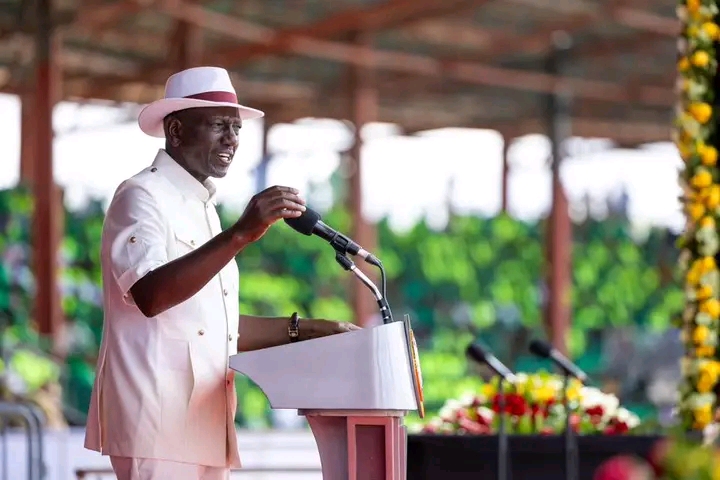
Livestock, long regarded as the backbone of life in Northern Kenya, took centre stage during President William Ruto’s Madaraka Day address in Wajir, where he unveiled a major plan aimed at transforming the pastoral economy into a structured, investment-driven sector.
In Wajir, Mandera and Garissa counties, livestock is more than an economic activity. It pays school fees, supports families during drought, drives local trade and defines community survival. Yet for decades, the sector has remained underdeveloped, with limited access to financing, markets and value addition.
President Ruto acknowledged this imbalance in his speech.
“For decades, pastoralism was regarded as one of Kenya’s most valuable economic assets while receiving limited support in animal health, markets, infrastructure, and financing,” he said.
He argued that this historical neglect must now be corrected through targeted investment and structural reforms.
The President reframed livestock not as subsistence, but as a major economic driver capable of generating wealth and exports.
“We see livestock and see enterprise. We see exports. We see jobs. We see wealth,” he said.
At the centre of this new approach is a KSh5 billion County Livestock Investment Company initiative designed to reorganise pastoral production and give communities ownership of livestock-based enterprises.
President Ruto explained the model clearly:
“That is why we are establishing a KSh5 billion County Livestock Investment Company initiative to support more than 350,000 pastoralists across 21 ASAL counties to form and own livestock investment companies.”
The initiative seeks to move pastoralists from individual livestock ownership to collective investment structures capable of accessing markets, insurance, financing and value addition opportunities.
To illustrate the model, the President compared it to existing agricultural systems in Kenya.
“Just as tea farmers own their factories through KTDA and dairy farmers own their cooperatives, pastoralists too must own and control the businesses built around their livestock.”
If successfully implemented, the model could allow pastoral communities to participate more directly in meat processing, leather production and dairy value chains, increasing income beyond the sale of live animals.
The President said the programme would ultimately improve livelihoods for more than two million household members across arid and semi-arid counties.
Beyond structural reforms, the government is also investing in livestock health and resilience. Ruto noted that more than 10 million animals have been vaccinated under national programmes, while vaccine production capacity has been expanded.
He also highlighted investments in feedlots, hay storage facilities and rangeland restoration efforts aimed at reducing vulnerability to drought.
“We have restored more than 305,000 hectares of degraded rangelands, expanded breeding programmes, and strengthened livestock training and market infrastructure,” he said.
These interventions are intended to stabilise pastoral livelihoods in a region frequently affected by climate shocks.
Early results, according to the President, are already visible in trade performance.
“Meat exports have increased by 84 percent, from KSh8.9 billion in 2022 to KSh16.4 billion in 2025,” he said.
Milk production has also risen, alongside a sharp increase in dairy exports, signalling gradual growth in the livestock value chain.
However, the President emphasised that Kenya must move beyond exporting live animals and instead focus on higher-value products.
“We must move beyond live animal exports to higher-value products such as meat, leather, and dairy,” he said.
To support this transition, the government plans to operationalise the Livestock Enterprise Development Fund, establish a National Strategic Fodder Reserve, strengthen pastoral cooperatives and roll out a national animal identification and traceability system.
The reforms are intended to improve productivity, ensure compliance with export standards and expand access to international markets.
In addition, the government is deploying 2,000 agripreneurs across ASAL counties to provide technical support, market linkages and climate-smart agricultural advice.
“We are deploying agripreneurs who will provide last-mile agricultural advisory services and connect pastoralist communities to markets and finance,” the President said.
Together with 5,000 already active, the programme brings the total to 7,000 agripreneurs supporting agricultural transformation nationwide.
For Northern Kenya, where livestock defines both culture and economy, the proposed reforms represent a shift in how pastoralism is viewed.
From survival to enterprise, from subsistence to investment, and from isolation to integration the message from Wajir was clear.
If fully implemented, the plan could reshape the livestock economy of Northern Kenya and position pastoral communities as key players in regional and global markets.