

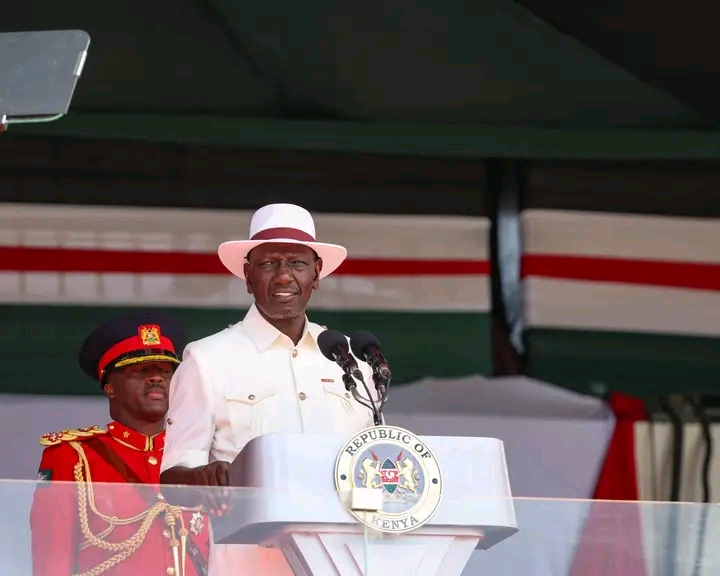
Among the many announcements made during the historic Madaraka Day celebrations in Wajir, none carried as much political and emotional significance as President William Ruto’s defence of reforms to the registration and issuance of national identity cards in Northern Kenya.
For decades, the process of acquiring an identity card in counties such as Wajir, Mandera and Garissa has remained one of the most contentious issues in the region. Many residents have long argued that they were subjected to additional vetting procedures not experienced by citizens in other parts of the country, often leading to delays, frustration and feelings of exclusion.
Standing before thousands at Wajir Stadium, President Ruto used his Madaraka Day address to reaffirm his administration’s commitment to ending what he described as a discriminatory system while maintaining safeguards to protect national security.
“The Constitution of Kenya says clearly: Every Kenyan, regardless of ethnicity, religion or geography, deserves equal protection, equal dignity and equal treatment under the law,” the President said.
The remarks formed a central pillar of a speech that focused heavily on inclusion, citizenship and national belonging.
For many residents of Northern Kenya, the issue of identity cards goes beyond documentation. It touches on questions of recognition, opportunity and participation in national life.
An identity card is required to access employment, higher education, banking services, government programmes and voting rights. Without it, many young people find themselves unable to fully participate in society despite being Kenyan citizens.
President Ruto reminded the audience that it was in Wajir where he signed the Presidential Proclamation on the Registration and Issuance of IDs and Birth Certificates in Northern Kenya and other border counties in February 2025.
“That is why, in February 2025, right here at Orahey Grounds in Wajir Town, I signed the Presidential Proclamation on the Registration and Issuance of IDs and Birth Certificates in Northern Kenya and other border counties, ending that system of discrimination.”
The proclamation marked a major policy shift by removing extra vetting requirements that had long been criticised by human rights groups, local leaders and residents.
Supporters of the reform argued that many Kenyan citizens from Northern Kenya had for years faced unnecessary hurdles when applying for identification documents.
The President used personal stories to illustrate the impact of those policies.
One of the most emotional moments of his speech came when he narrated the story of Bakaja Ibrahim Osman, a man born in Wajir East whose parents were also born in Kenya.
According to the President, despite being a Kenyan citizen, Osman repeatedly struggled to obtain an identity card.
“Every time Osman went to apply for an identity card the most basic document of citizenship he was treated not as a Kenyan but as a suspect, an illegal alien.”
The story resonated with many in attendance because similar experiences have been reported by numerous residents across the region over the years.
For generations, additional screening procedures often required applicants to produce extra documents, appear before vetting committees or wait extended periods before receiving approval.
Critics argued that such procedures unfairly targeted communities based on ethnicity and geography.
President Ruto said Osman’s experience represented a broader reality faced by many citizens.
“Osman was not alone. For more than six decades, this was the lived experience of hundreds of thousands of Kenyans in Northern Kenya.”
The President argued that the system undermined the aspirations of many young people by creating barriers to opportunities available elsewhere in the country.
The reforms introduced by his administration, he said, are already producing results.
He cited the examples of Abdirahman Ali Osman and Maryam Isaak Mohamed, both born in 2007 in Wajir County, who were among thousands of young people able to receive identity cards after turning 18.
“No extra hurdles. No extra documentation. No discrimination. No humiliation. Just their rightful document, in their hands, on time.”
For residents and leaders who have campaigned for years against discriminatory vetting procedures, the statement reflected a significant change in government policy.
Citizenship, Security and the Debate Over Verification
While defending the reforms, President Ruto also addressed criticism from those who feared that removing vetting procedures could weaken border security or allow non-citizens to acquire Kenyan documents.
Northern Kenya shares borders with Somalia and Ethiopia, making questions of citizenship and national security particularly sensitive.
The President sought to reassure critics that the reforms were not intended to compromise security measures.
“But let me be direct about what that decision was not. It was not an invitation for foreigners to acquire Kenyan documents illegally.”
He stressed that Kenyan identity cards would continue to be issued only to legitimate citizens.
“Kenyan identity cards will only be issued to legitimate citizens of this Republic.”
The statement reflected an attempt to strike a balance between inclusion and security, two issues that have often been presented as competing priorities in discussions about Northern Kenya.
President Ruto rejected the idea that the country must choose between the two.
“We did not abolish the verification of citizenship. We abolished the discrimination.”
That line quickly emerged as one of the defining messages of the Madaraka Day celebrations.
The President argued that citizenship verification remains necessary and legitimate, but that entire communities should not be subjected to suspicion solely because of where they live or the ethnic groups to which they belong.
“A strong nation does not choose between security and justice. A strong nation protects both.”
The remarks highlighted a broader philosophical argument underpinning the reforms: that equality before the law strengthens rather than weakens national unity.
For decades, debates surrounding identity card issuance in Northern Kenya have reflected larger questions about belonging and citizenship.
Many residents have argued that repeated demands to prove their nationality fostered feelings of exclusion and reinforced perceptions that some communities were viewed differently from others.
President Ruto suggested that ending discriminatory practices was not merely an administrative reform but an effort to restore dignity.
“Today, people like Osman and Maryam no longer feel like strangers in their own country. They feel seen and heard. They feel recognised. They matter, and they belong.”
Those words echoed one of the central themes of the entire Madaraka Day address: inclusion.
Throughout the speech, the President repeatedly argued that freedom, dignity and opportunity must be available to every Kenyan regardless of geography, religion or ethnicity.
The issue of identity cards became a powerful symbol of that broader vision.
As Kenya marked 63 years of self-rule, the debate over citizenship and documentation took centre stage in Wajir. For supporters of the reforms, the changes represent a long-overdue correction of historical injustices. For critics, questions remain about implementation and security safeguards.
What is clear, however, is that the conversation has fundamentally shifted.
By placing the issue at the heart of a national celebration and defending it before the country, President Ruto elevated identity card reforms from a regional concern to a national discussion about equality, citizenship and belonging.
Whether the reforms ultimately transform the experiences of future generations will depend on their implementation. But for many residents of Northern Kenya, Madaraka Day 2026 marked a moment when their long-standing concerns were acknowledged from the highest office in the land.
And in Wajir, where the President first announced the reforms and later defended them before the nation, the message was unmistakable: citizenship should unite Kenyans, not divide them.