

When President William Ruto rallied East African leaders behind a new funding formula for the East African Community (EAC), he was pushing for more than a budget adjustment. He was seeking to reform a system that had increasingly become a source of financial strain for one of Africa’s most ambitious regional blocs.
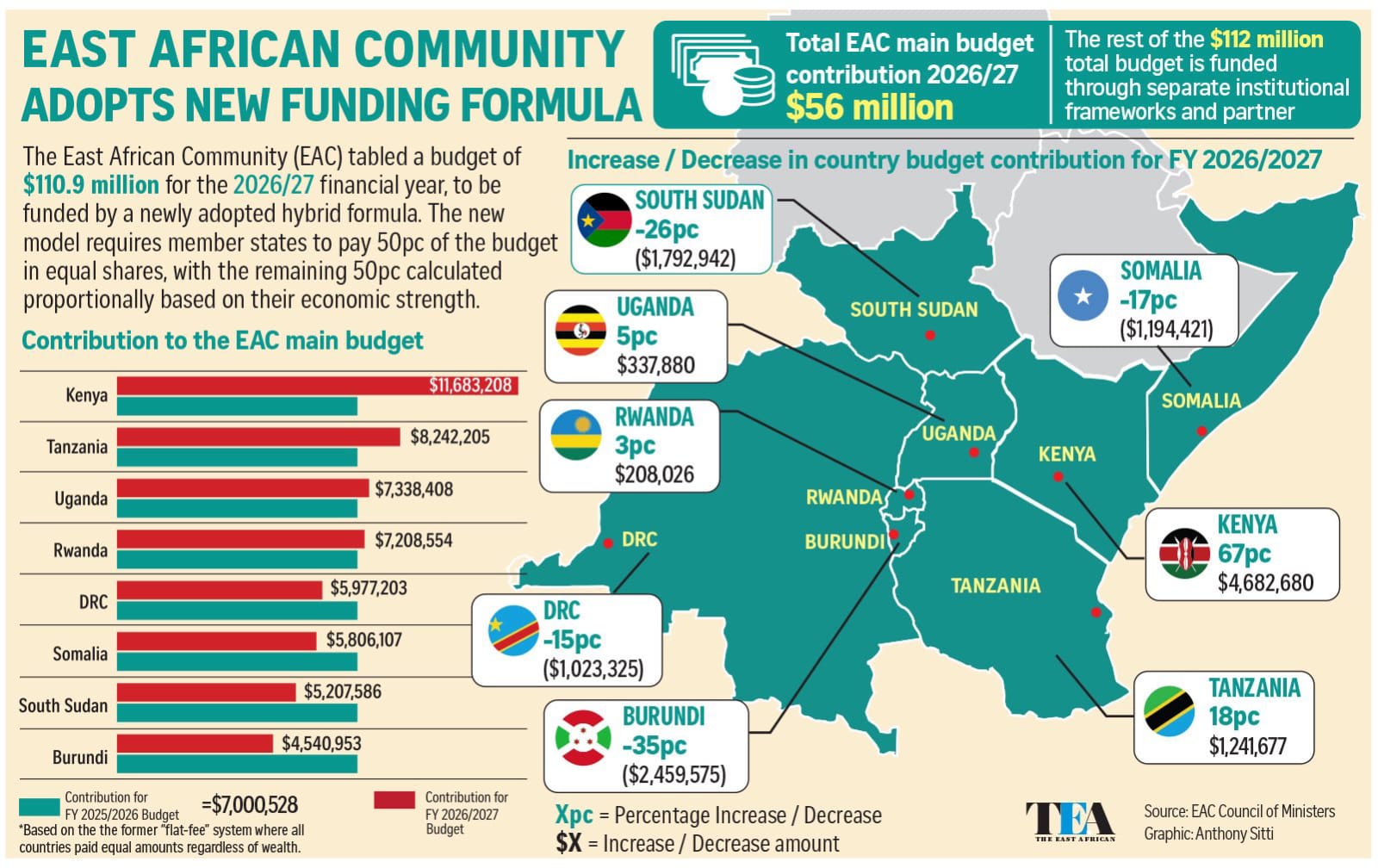
The decision, adopted by EAC Heads of State during their summit in Arusha, Tanzania, will see Kenya’s annual contribution to the Community rise sharply from $7 million to $11.6 million in the next financial year, representing a 67 percent increase. While the move means Kenya will shoulder a larger share of the bloc’s operational costs, it also signals a fundamental shift in how East Africa intends to finance its future.
For years, the EAC operated on a relatively straightforward principle. Member states made equal or near-equal contributions to the regional budget regardless of the size of their economies. The arrangement was rooted in the idea that all partner states were equal stakeholders in the integration project and should therefore share the financial burden equally.
However, as the Community expanded and its ambitions grew, the limitations of the model became increasingly apparent.
The East African Community of today is vastly different from the one that existed two decades ago. What began as a regional bloc comprising Kenya, Uganda and Tanzania has expanded to include Rwanda, Burundi, South Sudan, the Democratic Republic of Congo and most recently Somalia. The enlarged Community now represents a market of more than 330 million people and stretches from the Indian Ocean to Central Africa.
As membership expanded, so too did the responsibilities of the EAC. The organization oversees regional trade integration, customs administration, infrastructure coordination, peace and security cooperation, public health programmes, legislative institutions and preparations for deeper economic integration, including the long-term goal of a monetary union.
Yet despite this expansion, the financing model remained largely unchanged.
The result was a growing mismatch between the Community’s responsibilities and its resources. Several member states repeatedly struggled to meet their obligations, leading to a build-up of arrears estimated at tens of millions of dollars. Budget shortfalls became a recurring challenge, delaying programmes and limiting the effectiveness of regional institutions.
It was against this backdrop that President Ruto emerged as one of the strongest advocates for reform.
During discussions on the future of EAC financing, Ruto argued that the contribution model should reflect economic realities rather than a strict equal-sharing principle. His position was that countries with larger economies possess greater capacity to contribute and often derive greater benefits from regional integration. Consequently, they should assume a larger share of the financial responsibility required to sustain the bloc.
The proposal eventually gained the support of fellow Heads of State and was adopted as the new funding framework for the Community.
Under the new formula, Kenya’s contribution rises from $7 million to $11.6 million. While official budget documents provide the detailed distribution among member states, the broader principle behind the formula is clear: wealthier economies will contribute more, while countries facing greater fiscal constraints will contribute less.
This marks a significant departure from the previous arrangement.
For smaller economies such as Burundi, South Sudan and Somalia, the new model is expected to ease pressure on national budgets and improve compliance with contribution requirements. Under the old system, some countries found it difficult to consistently meet their obligations because the equal-contribution model did not adequately account for differences in economic strength and government revenue.
For Kenya, Tanzania and Uganda, the changes mean larger financial commitments. However, proponents argue that stronger economies stand to benefit the most from a well-functioning regional bloc.
Kenya’s economy remains the largest within the EAC. The country serves as the region’s commercial hub, hosts numerous regional institutions, operates the busiest port in East Africa through Mombasa and acts as a key transit corridor for several landlocked neighbours.
Kenyan banks, insurance firms, manufacturers, logistics companies and telecommunications firms have established a significant presence across East Africa. Regional integration has enabled Kenyan businesses to access larger markets, expand investments and move goods more efficiently across borders.
From this perspective, supporters of the reform argue that Kenya’s increased contribution should not be viewed simply as an expense but as an investment in a system from which the country derives substantial economic returns.
The reform also carries important political implications.
In international and regional organizations, financial contributions often translate into influence. While formal voting structures may remain unchanged, countries that contribute more to an institution’s operations typically command greater authority in shaping priorities, setting agendas and driving reforms.
By becoming the largest financial contributor to the EAC budget, Kenya is likely to strengthen its position within regional decision-making processes. Nairobi’s voice on issues ranging from trade policy and infrastructure development to security cooperation and institutional reform may carry even greater weight.
For President Ruto, the successful adoption of the formula represents a notable diplomatic achievement.
Since assuming office, Ruto has sought to position Kenya as a leading voice on regional and continental affairs. Whether advocating reforms in global financial institutions, pushing for climate financing reforms or promoting intra-African trade, he has consistently presented himself as a leader willing to challenge existing systems in pursuit of long-term solutions.
The EAC funding reform reflects the same philosophy.
Convincing member states to embrace a model that requires some countries to contribute more while allowing others to contribute less was never going to be politically straightforward. The fact that the proposal received the backing of regional leaders demonstrates significant diplomatic engagement and consensus-building efforts behind the scenes.
The reform therefore strengthens Ruto’s credentials as a regional statesman capable of driving structural change beyond Kenya’s borders.
However, the increased contribution is also likely to generate domestic scrutiny.
Kenyan taxpayers may ask whether a 67 percent increase in contributions is justified at a time when the country continues to face economic pressures and competing development priorities. Questions may arise over whether the additional resources could have been directed toward domestic programmes instead.
These concerns highlight the central challenge facing the government: demonstrating that stronger regional integration delivers tangible benefits to ordinary Kenyans.
Supporters of the reform contend that the returns are already evident. Increased regional trade creates jobs, expanded markets benefit businesses, improved transport corridors lower the cost of commerce and stronger regional institutions contribute to stability and economic growth.
In this view, Kenya’s additional contribution is not merely supporting the EAC bureaucracy; it is helping sustain the economic ecosystem upon which much of East Africa’s future prosperity depends.
The timing of the reform is equally significant.
The admission of Somalia and the Democratic Republic of Congo has transformed the EAC into one of Africa’s largest regional economic communities. Together, the member states represent a vast market with enormous potential for trade, investment and industrial growth.
Yet ambitions alone cannot sustain integration. Effective institutions require reliable financing, and regional projects require predictable funding streams. Without a sustainable financial model, the EAC risks becoming an organization with impressive aspirations but insufficient capacity to implement them.
The new contribution formula is therefore about more than balancing budgets. It is an attempt to create a stable foundation upon which the next phase of East African integration can be built.
Whether the reform ultimately succeeds will depend on implementation. Member states must honour their obligations, accountability mechanisms must ensure efficient use of funds and citizens across the region must see measurable benefits from the investments being made.
What is clear, however, is that the decision marks one of the most important institutional reforms in the recent history of the East African Community.
By abandoning a funding model based largely on equal contributions and replacing it with one grounded in economic capacity, East African leaders have acknowledged a simple reality: successful integration requires sustainable financing.
For Kenya, the decision means paying more. For President William Ruto, it represents a significant diplomatic and policy victory. And for the East African Community, it could become the financial reset that determines whether the bloc’s ambitious vision for regional integration succeeds or struggles in the years ahead.