

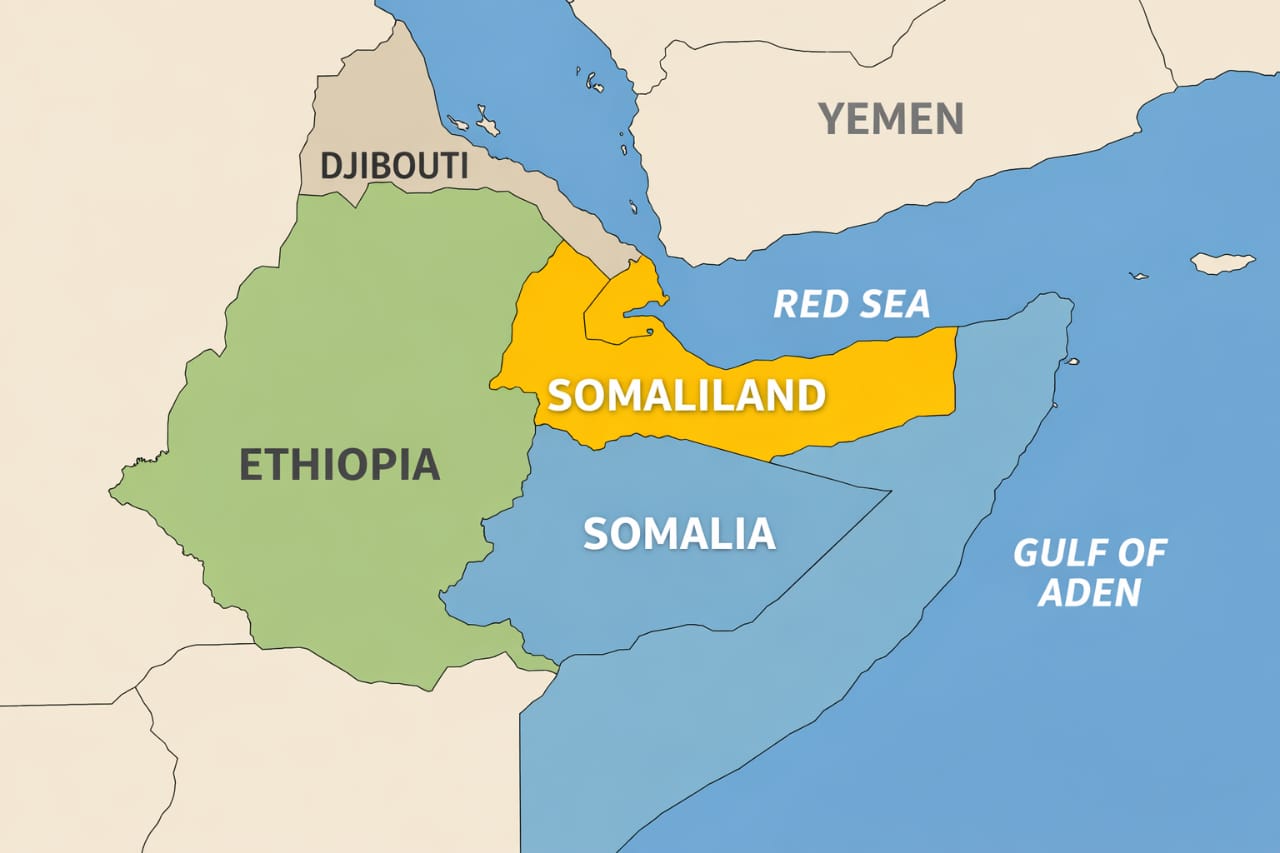
What began as a little-noticed political dispute in the early 1990s has now evolved into one of the most sensitive geopolitical developments in the Horn of Africa. The self-declared Republic of Somaliland has operated as a de-facto independent region since 1991 yet internationally, Somalia remains recognised as a single sovereign state.
Recent developments from Ethiopia’s controversial Memorandum of Understanding (MoU) with Somaliland, to Israel’s recognition of Somaliland, to growing instability in northern Somalia have now pulled global powers, regional blocs, and the UN Security Council directly into the dispute.
This article traces the story from Somaliland’s breakaway to today’s global diplomatic confrontation.
A Brief Historical Context: Somaliland’s Breakaway
In 1991, after the collapse of Somalia’s central government, political leaders in the northwest declared the re-establishment of the Republic of Somaliland, referring to the former British Somaliland Protectorate that united with Italian Somaliland in 1960 to form the Somali Republic.
Since then, Somaliland has developed:
Its own government and security forces
A multi-party political system
Administrative control over much of the northwest
But the world’s position has remained consistent:
✔ Somalia is one sovereign state
✔ Recognition must come through dialogue, not unilateral action
Somaliland remains unrecognised internationally.
A New Phase of Internal Tensions: Las Anod & Awdal
The political map shifted again in 2023, when clashes erupted in Las Anod between Somaliland security forces and local clan militias. The fighting led to:
- Hundreds of civilian casualties
- Mass displacement
- The collapse of Somaliland’s control over the city
Las Anod leaders later withdrew allegiance to Somaliland, aligning politically with the Federal Government of Somalia. The move exposed fractures within Somaliland’s claimed territory and weakened its claim of unified governance.
At the same time, tensions rose in the Awdal region, where some local political figures and community leaders began calling for separation from Somaliland’s administration, citing political and economic marginalisation.
These developments undermined the perception of a cohesive Somaliland state a fact Somalia highlighted in diplomatic forums.
The Turning Point: Ethiopia’s MoU with Somaliland
The dispute escalated sharply when Ethiopian Prime Minister Abiy Ahmed signed an MoU with Somaliland’s then-president Muse Bihi Abdi. The deal reportedly offered:
✔ Ethiopian access to the Red Sea/Gulf of Aden
✔ Possible recognition of Somaliland’s independence in return
Somalia condemned the agreement as:
A violation of sovereignty
A breach of international law
A threat to regional stability
African and global institutions, including the African Union, Arab League, and OIC reaffirmed support for Somalia’s unity.
The issue was no longer bilateral it had become international.
A New Shock: Israel Recognises Somaliland
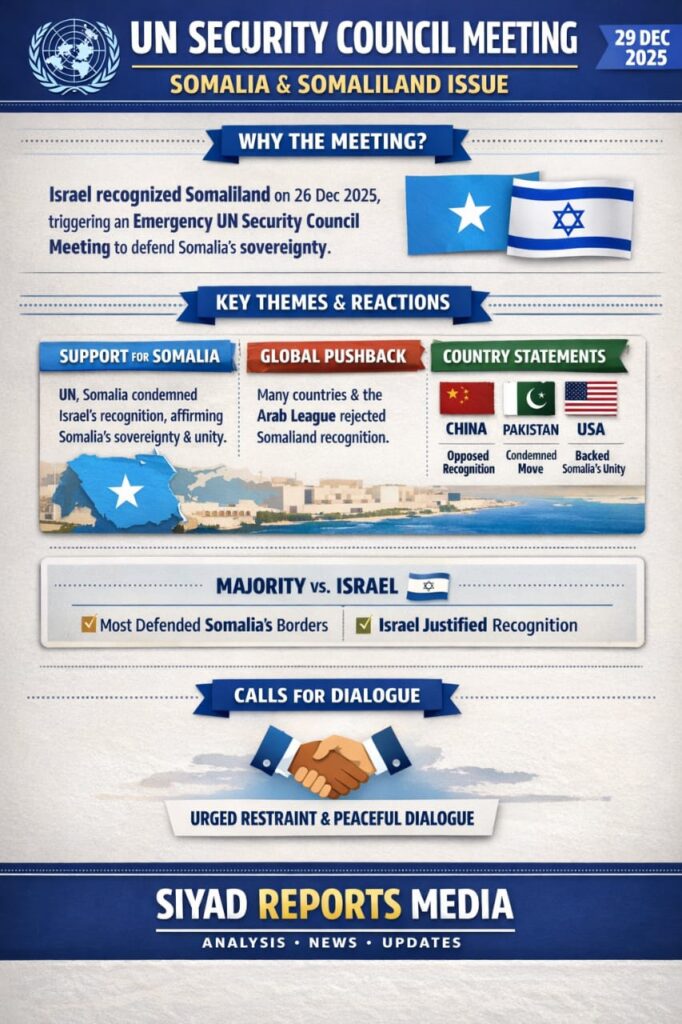
The situation intensified when Israel formally recognised Somaliland, amid rising regional tensions across the Red Sea corridor.
Reactions were immediate:
Somalia condemned the recognition
South Africa warned it threatened regional stability
Denmark opposed the move
France, the UK, and the U.S. reaffirmed Somalia’s sovereignty
Turkey stressed support for Somalia
Even inside Israel, opposition leader Yair Lapid warned the decision risked fuelling instability.
Meanwhile, the Houthi movement in Yemen declared any Israeli presence in Somaliland a military target raising the stakes in the already-volatile Red Sea.
Somalia’s Message to the UN Security Council
At the latest UN Security Council session, Somalia emphasised:
Somalia is one indivisible nation
Somaliland remains part of Somalia’s territory
Attempts at unilateral recognition set a dangerous precedent
Regional security — including counter-terrorism — could be harmed
- Somalia also highlighted:
Only two regions historically formed British Somaliland
Roughly 45% of Somaliland’s claimed territory is under Somali federal influence
Las Anod and parts of Awdal no longer accept Somaliland authority
Most Security Council members backed Somalia’s unity, signalling strong diplomatic support.
Where Major Powers Stand
United States
Supports Somalia’s unity and sovereignty.
No policy change despite Israel’s recognition.
United Kingdom
Backs Somalia’s independence and unity.
Calls for dialogue.
France
Supports Somalia under international law.
Denmark
Warns recognition risks regional instability.
Turkey
Firmly supports Somalia’s unity.
South Africa
Says the move threatens peace in the Horn of Africa.
Somalia’s diplomatic momentum is strong.
Why the Horn of Africa Matters
The region is:
- A gateway to the Suez Canal
- Central to global shipping
- A base for multinational military operations
- A theatre of Gulf and Middle East rivalries
Unilateral recognition could:
⚠ Encourage separatist movements across Africa
⚠ Trigger proxy competition
⚠ Escalate security tensions especially with Houthi threats
⚠ Undermine African Union principles
At the same time, Somaliland argues:
✔ It has built credible institutions
✔ It has historical grounds for statehood
✔ Its people overwhelmingly support independence
The result is a high-stakes geopolitical test case.
What Happens Next?
Key questions remain:
Can Mogadishu and Hargeisa return to talks?
Will other states follow Israel?
Will Ethiopia formalise recognition?
Can regional blocs mediate?
Will internal Somaliland divisions deepen?
The UN and AU are expected to play leading roles.
From Somaliland’s 1991 declaration to today’s UN Security Council debate, the Somalia–Somaliland question has evolved into a defining challenge for African diplomacy, international law, and Red Sea security.
With Las Anod’s realignment, Awdal’s rising tensions, and increasing global involvement, the dispute now goes far beyond local politics shaping the future of sovereignty and recognition in Africa and the wider world.