

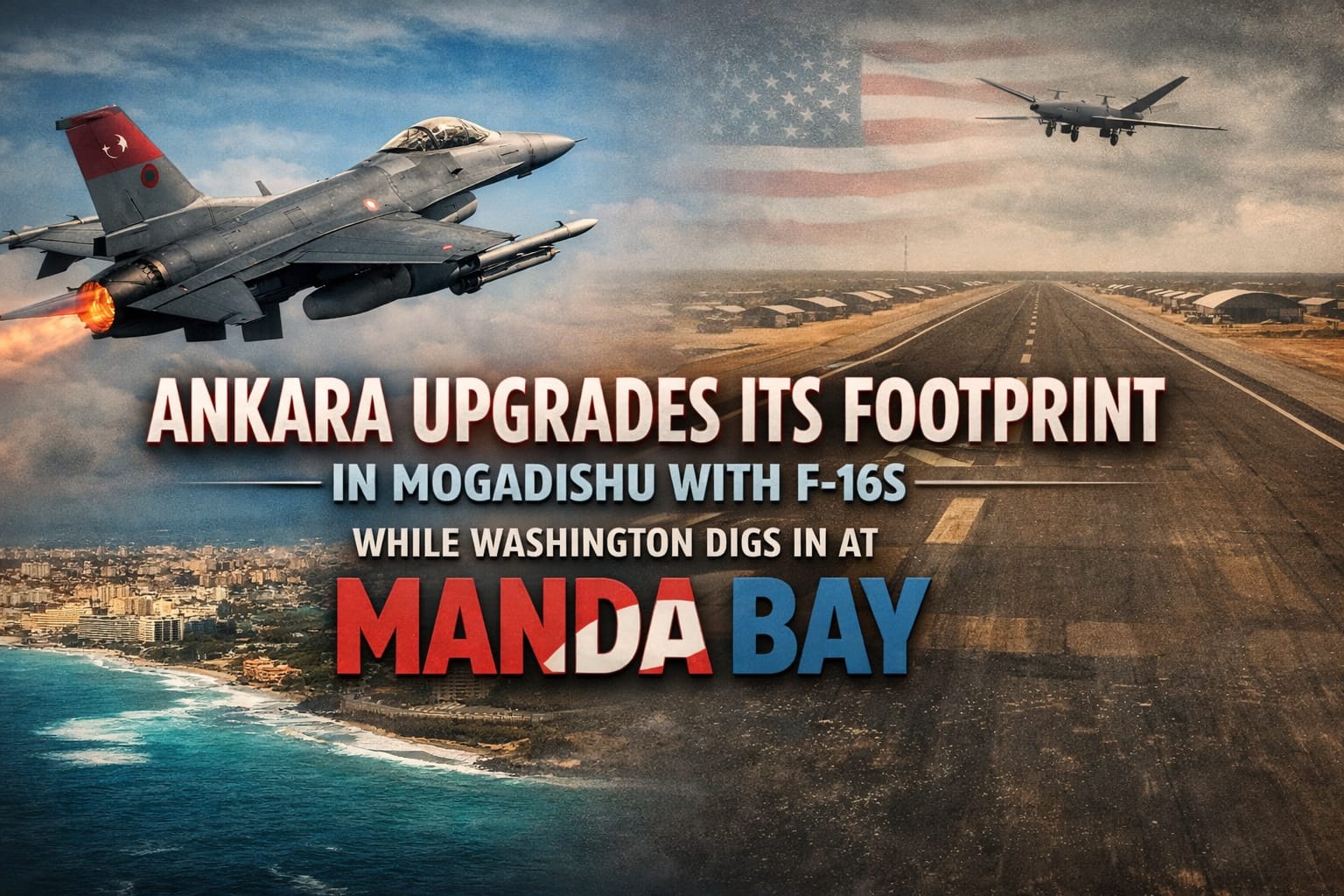
In recent years, the Horn of Africa has increasingly become a focal point of strategic military competition and geopolitical positioning among global powers. Once largely characterized by internal security challenges and humanitarian crises, the region is now witnessing a marked increase in external military engagement particularly by the United States and Turkey. While Washington reinforces its longstanding counter‑terrorism posture from Kenya’s Manda Bay Airbase, Ankara has significantly expanded its presence in Somalia’s capital, Mogadishu, deploying advanced F‑16 fighter jets and deepening security cooperation with Somalia’s federal government. These developments reflect not only the evolving security landscape of East Africa but also broader global strategic shifts that are transforming the region into one of the world’s most densely contested military theatres.
At the heart of this growing geopolitical complexity lies the overlapping interests of Washington and Ankara, each pursuing its own strategic objectives. For the United States, the Horn remains central to its global counter‑terrorism architecture especially in the fight against extremist groups such as Al‑Shabaab. For Turkey, expanding influence in Somalia offers both strategic depth in the Red Sea–Gulf of Aden corridor and a platform to project diplomatic and military power across East Africa. As these powers strengthen their footprints, local actors including national governments and regional institutions increasingly find themselves navigating a complex web of partnerships, expectations, and pressures.
Washington’s Reinforcement at Manda Bay
In late 2025, the United States officially broke ground on a $70‑million expansion of the runway at Manda Bay Airbase in Lamu County, Kenya a project that signals a renewed and deepened commitment to counter‑terrorism efforts in the Horn of Africa. Located near the border with Somalia, Manda Bay has been a cornerstone of US Africa Command’s (AFRICOM) regional strategy for over a decade. The base serves as a critical hub for intelligence, surveillance, reconnaissance (ISR) missions, aerial refueling, and rapid deployment of forces targeting extremist networks, particularly Al‑Shabaab, which continues to wage a deadly insurgency across Somalia and neighboring states.
The expansion project focused on reinforcing the runway to accommodate heavier and more frequent aircraft operations was championed by US Deputy Secretary of State Christopher Landau during a high‑profile groundbreaking ceremony attended by Kenyan officials. Landau described the project as “a very tangible commitment to joint defence,” emphasizing that the enhanced infrastructure would enable more sustained and effective operations. He added that the modernization efforts send “a strong message to adversaries” that the partnership between the United States and Kenya remains resilient and forward‑looking.
The decision to upgrade Manda Bay comes at a time when regional security dynamics are shifting rapidly. Although Al‑Shabaab has suffered significant territorial losses over the past decade, the group remains adaptive and lethal. Its capacity to strike across the Horn including high-profile attacks inside Kenya has compelled both Nairobi and Washington to maintain an agile and persistent security presence. The 2020 assault on Manda Bay itself, in which at least three American service members were killed, underscored the base’s vulnerability and strategic importance. The latest expansion therefore not only strengthens operational capability but also serves as a symbolic reaffirmation of enduring US commitment in the region.
From a Kenyan perspective, the enhanced American presence brings mixed sentiments. On one hand, Kenya has welcomed robust support in its fight against cross‑border terrorism and organized criminal networks. Joint operations, intelligence sharing, and capacity building have been central to reducing the frequency and scale of attacks emanating from Somalia.
On the other hand, the increased militarization of Kenyan territory raises concerns about sovereignty, potential blowback, and the long-term implications of hosting foreign military infrastructure. Nonetheless, Kenyan officials have publicly expressed support for the runway expansion, highlighting the mutual benefits of shared security interests. For Nairobi, deeper collaboration with the United States enhances its deterrence capabilities and signals its strategic significance to Western allies at a time of rising global competition.
Ankara’s Strategic Ascent in Somalia
While Washington fortifies its base in Kenya, Turkey has emerged as a major security partner for Somalia, carving out its own space in the Horn of Africa. Over the past decade, Ankara has invested heavily in diplomatic, economic, and military engagement with Mogadishu a strategy that has now culminated in the deployment of F‑16 fighter jets and expanded security cooperation agreements with the Federal Government of Somalia.
Turkey’s engagement with Somalia began with high-profile humanitarian and reconstruction projects. In the aftermath of drought and famine in the early 2010s, Turkish aid agencies and government teams delivered significant relief assistance. This initial goodwill was later institutionalized through diplomatic missions, economic investment, and infrastructure development most notably the construction and operation of Somalia’s new national hospital in Mogadishu, which has become a symbol of Turkey’s public diplomacy.
However, Ankara’s ambitions did not stop at development aid. Over time, Turkey has fortified its military cooperation with Mogadishu, providing training, equipment, and advisory support to the Somali National Army (SNA). Most recently, this cooperation has taken on a more advanced and strategic character with the deployment of F‑16 fighter jets to Somali airspace. Although details regarding the exact number of aircraft or terms of deployment remain diplomatically sensitive, the move represents a significant shift in Ankara’s role from provider of security assistance to a direct security partner capable of contributing aerial capabilities.
The introduction of F‑16s serves multiple Turkish strategic objectives. First, it elevates bilateral defence cooperation with Somalia from advisory and logistical support to a full spectrum security partnership. Second, it positions Ankara as a key player in shaping Somalia’s defence architecture at a time when international attention particularly from Western allies has been uneven. Finally, Turkey’s presence in Mogadishu enables it to exert influence in the wider Red Sea and Indian Ocean littoral regions of strategic maritime importance for global trade and naval operations. Somalia, for its part, has welcomed Turkish engagement as part of broader efforts to rebuild its security institutions after decades of conflict and instability. Ankara’s investments in military training and infrastructure have been framed by Somali leaders as essential components of national defence and state-building.
However, this deepening relationship inevitably carries geopolitical implications, especially as it unfolds alongside growing American military engagement in the region.
A Crowded Security Theatre
The simultaneous expansion of US military infrastructure in Kenya and Turkish defence engagement in Somalia underscores a broader reality: the Horn of Africa is quickly becoming one of the world’s most crowded security theatres. What were once largely localized security concerns linked to insurgency and state fragility are now arenas of great-power competition. This shift reflects the strategic importance of the Horn in global geopolitics from its proximity to key maritime chokepoints like the Bab el‑Mandeb Strait to its role in regional trade corridors connecting Africa, the Middle East, and Asia.
For Washington, the Horn remains indispensable in the global campaign against terrorism. The US presence in Manda Bay along with limited footprint operations in other parts of East Africa enables rapid deployment, intelligence gathering, and coordination with regional partners. These capabilities are viewed as crucial not only for counter-extremism but also for protecting broader Western interests in Africa and beyond.
Turkey’s expanding footprint, by contrast, reflects Ankara’s desire to position itself as a pivotal external actor in Africa. In recent years, Turkey has pursued a more assertive foreign policy in Africa, bolstering economic ties, advocating for political partnerships, and deepening military cooperation with states such as Somalia, Sudan, and others. The deployment of advanced military assets like F‑16s signals that Ankara is prepared to back its diplomatic ambitions with tangible defence commitments.
The increasing presence of external powers raises important questions for regional stability. While partnerships with Kenya and Somalia bring logistical and operational benefits, they also complicate internal political dynamics. Local governments must balance competing interests, manage public perceptions of foreign military presence, and navigate tensions that arise when partner nations pursue different strategic goals. There is also the risk of unintended consequences. As external military assets become more prominent, so too does the potential for miscommunication, escalation, and proxy competition. Extremist groups like Al‑Shabaab are already adept at exploiting grievances tied to foreign military involvement, using such narratives to recruit and radicalize. In this context, the very forces that external powers seek to suppress could adapt, recalibrate, and prolong conflict in new ways.
Sustainable security outcomes in the Horn will therefore depend on Somali and Kenyan leadership strengthening governance institutions, accountability mechanisms, and inclusive security frameworks that can withstand external pressures. External actors, meanwhile, must ensure clearer communication channels and strategic coordination to guarantee that their efforts are complementary rather than competitive or counterproductive. At the same time, regional organizations such as the Intergovernmental Authority on Development (IGAD) and the African Union have crucial roles in mediating partnerships and aligning external support with regional priorities. Beyond military measures, addressing terrorism and instability requires integrated approaches that combine defence capabilities with socio-economic development, job creation, and political reconciliation.
Ultimately, the expanding footprints of Ankara and Washington in the Horn of Africa reflect broader shifts in global geopolitics. These developments offer both opportunities and challenges for regional states. On the one hand, increased international attention and investment can strengthen local capacities and deter violent extremist threats. On the other, they introduce complex dynamics that require careful diplomacy, strategic foresight, and a deep commitment to regional leadership.
In the years ahead, the strategic choices made by local governments, external partners, and regional institutions will determine whether the Horn becomes a model of collaboration and stability or a battleground of competing interests. What is certain is that the Horn’s strategic significance has never been greater, and the world will be watching closely.