

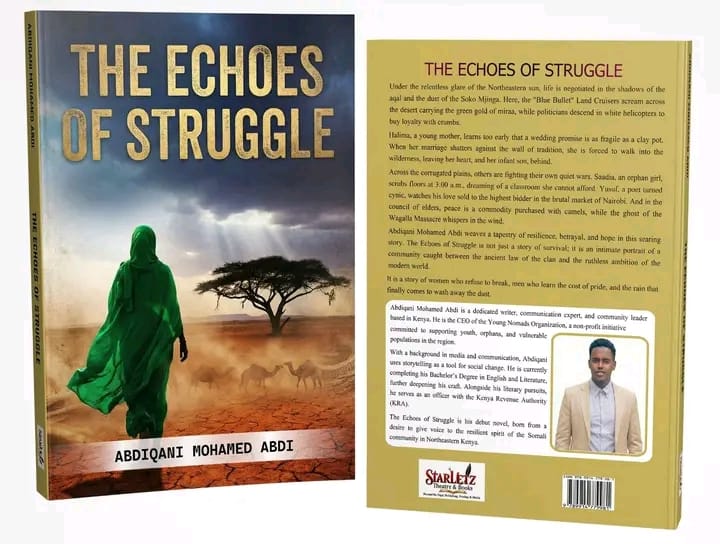
Under the scorching sun of Northeastern Kenya, where survival is often negotiated between tradition and modernity, a new literary voice has emerged with courage, clarity, and conviction. Abdiqani Mohamed Abdi is not just another author adding a title to the shelves. He is a storyteller rooted in community, a leader committed to social transformation, and a man determined to ensure that the struggles, resilience, and dignity of his people are documented with honesty and power. His debut novel, “The Echoes of Struggle”, is more than fiction it is a mirror reflecting the lived realities of a region too often misunderstood, misrepresented or ignored.
In a literary landscape where stories from marginalized communities are frequently filtered through external lenses, Abdiqani writes from within. He captures the rhythm of the desert winds, the silence of broken promises, the weight of clan expectations, and the quiet endurance of women and youth navigating hardship. The Echoes of Struggle plunges readers into a world shaped by social pressures, political maneuvering, poverty, hope, betrayal and resilience. It is a narrative grounded in place in the aqal, the dusty marketplaces the contested plains, and the long roads where Land Cruisers speed past communities yearning for opportunity.

The novel introduces characters who feel real because they are inspired by real struggles. Halima, a young mother whose marriage collapses under the burden of tradition, represents countless women whose dreams are sacrificed at the altar of societal expectations. Saadia, the orphan girl scrubbing floors before dawn while longing for education, embodies the silent ambitions of vulnerable children who only need opportunity to transform their futures.
Yusuf, the poet turned cynic, reflects the disillusionment of youth caught between aspiration and economic reality. Through these lives, Abdiqani explores themes that are deeply relevant not only to Northeastern Kenya but to societies across Africa the tension between tradition and change, the politics of survival, the cost of pride, and the enduring power of hope.
What makes The Echoes of Struggle stand out is its emotional honesty. Abdiqani does not romanticize hardship, nor does he reduce his characters to victims. Instead, he portrays them as complex human beings shaped by circumstances but not defined by them. His storytelling acknowledges pain while insisting on dignity. The novel’s references to historical wounds, including the lingering memory of the Wagalla tragedy, demonstrate his willingness to confront uncomfortable truths while still advocating for healing and progress.
But Abdiqani Mohamed Abdi’s influence extends far beyond the pages of his book. He is also the CEO of Young Nomads Organization, a non-profit initiative committed to supporting youth, orphans, and vulnerable populations in his region.
This dual role as writer and community leader is not coincidental. It reflects a consistent philosophy, storytelling and service are intertwined. Through Young Nomads Organization, he works directly with the very communities his novel represents young people searching for mentorship, orphans in need of educational support, and families striving for stability.
His leadership in the non-profit sector demonstrates that his commitment to social change is not symbolic. It is practical, structured, and ongoing. By focusing on youth empowerment and support for vulnerable populations, he addresses the root issues that often form the backdrop of his fiction poverty, lack of access to education, and limited economic opportunities. In this way, his work in literature and his work in community development complement one another. The book raises awareness, the organization provides action.
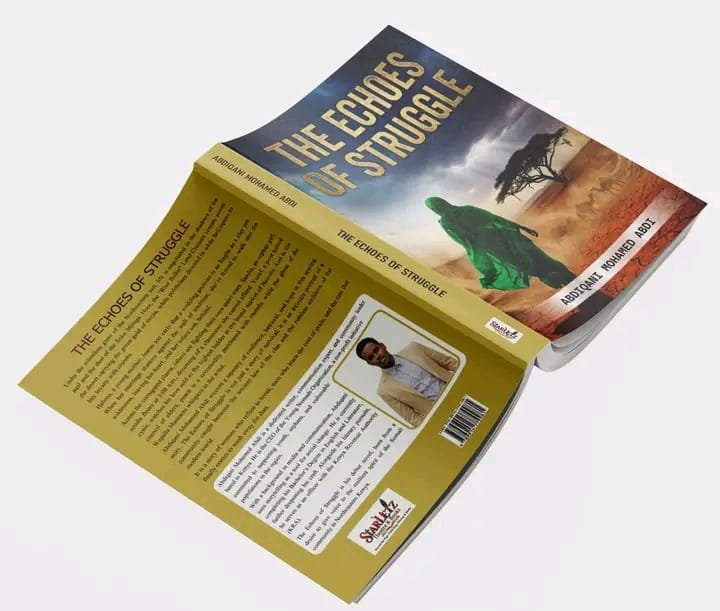
Abdiqani’s background in media and communication further sharpens his voice. He understands narrative power how stories shape perception, influence policy conversations, and inspire collective reflection. His academic pursuit of a Bachelor’s Degree in English and Literature reflects his dedication to refining his craft and deepening his intellectual foundation. Writing for him is not a hobby; it is a disciplined practice grounded in study, observation, and lived experience.
In many ways, The Echoes of Struggle can be seen as both a personal and communal milestone. For the Somali community in Northeastern Kenya, representation in mainstream literature has often been limited or stereotyped. Abdiqani challenges that pattern by offering nuance. He writes about clan dynamics without sensationalism. He explores politics without propaganda. He presents women not as background figures but as central pillars of strength. He allows youth to be dreamers, thinkers, and agents of change rather than statistics.
The imagery in his novel the desert dust, the mirage-like promises of politicians, the fragile clay pot symbolizing broken vows creates a vivid atmosphere that draws readers into the emotional landscape of the region. His language carries both poetic undertones and journalistic clarity, perhaps reflecting his communication background. It is this balance that makes the book accessible while still profound.
Beyond literary achievement, Abdiqani’s journey itself sends a powerful message to young writers in marginalized regions, your story matters. Too often, aspiring authors from remote or underserved communities feel that their narratives are too local or too insignificant for broader audiences. The Echoes of Struggle proves the opposite.
The more authentic the story, the more universal its resonance. Struggle, hope, betrayal, love and resilience these are not regional themes, They are human themes.
As Kenya’s literary scene continues to evolve, voices like Abdiqani’s are essential. They expand the map of storytelling beyond urban centers and elite circles.
They remind readers that powerful narratives are found in villages, in pastoral communities, in small towns where history and modernity collide daily. By writing his debut novel, Abdiqani has carved a space not only for himself but for others who will follow.
His work also raises important questions about the relationship between leadership and storytelling. Can literature influence social change? Can fiction spark conversations that lead to reform? Abdiqani appears to believe so. His life suggests that stories are not separate from development work they are part of it.
When communities see themselves reflected in literature with dignity and complexity, it strengthens identity and inspires dialogue.
Ultimately, The Echoes of Struggle is both a narrative of hardship and a declaration of endurance. And Abdiqani Mohamed Abdi stands as both its author and its embodiment a man navigating multiple roles, committed to education, leadership, and creative expression. In documenting the struggles of his community, he has ensured that their echoes will not fade into silence.
From the dusty plains of Northeastern Kenya to the wider literary world, Abdiqani’s voice is rising. And if his debut is any indication, this is only the beginning of a long and impactful journey one where words become bridges, stories become catalysts, and struggle transforms into legacy.