

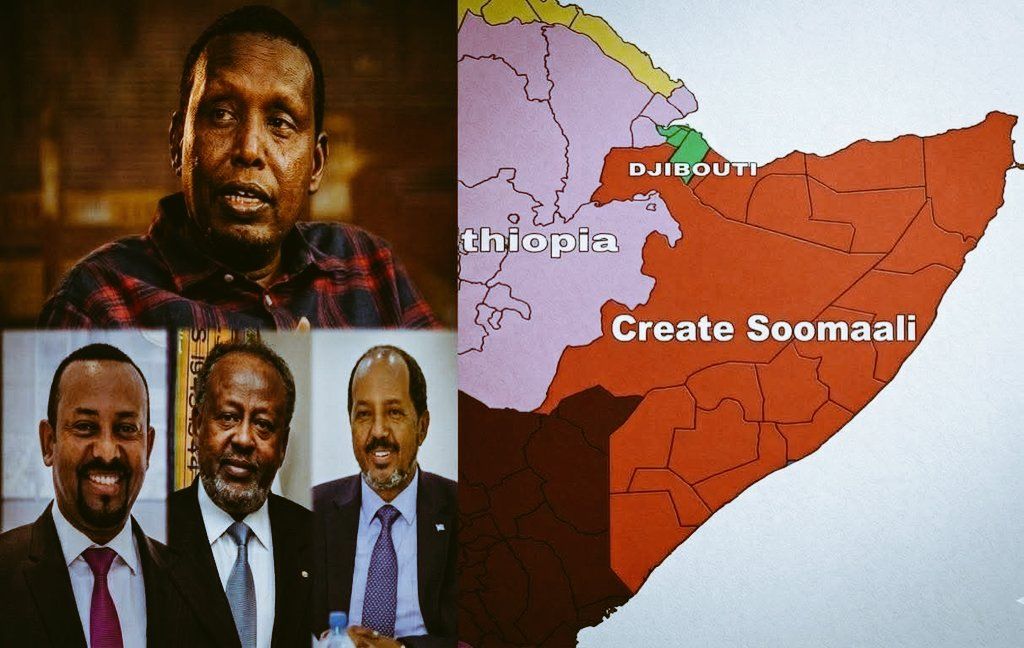
In a region where borders were drawn by colonial hands but defended by post-independence blood and diplomacy, even the suggestion of redrawing them is enough to shake capitals, ignite speculation, and provoke deep political anxiety. The recent high-level meeting in Djibouti bringing together Ismaïl Omar Guelleh, Abiy Ahmed, and Hassan Sheikh Mohamud has triggered exactly that kind of reaction.
What might otherwise have been interpreted as routine regional diplomacy has now been reframed by a striking and controversial claim: that the leaders discussed a sweeping territorial reconfiguration across the Horn of Africa.
At the centre of the debate is an explosive assertion by Horn of Africa analyst Abdiwahab Sheikh Abdisamad, who framed the alleged proposal in dramatic terms:
“Djibouti would transform into a fully Somali state by incorporating territories from Diridawa, Sitti, Harawo, Djibouti city and Awdal region of Somalia, effectively bringing together all Issa and Gadabuursi regions under new Djibouti state. Ethiopia, in turn, would gain control of the Afar regions currently within Djibouti, thereby securing direct access to the Red Sea.
Additionally, the entire Somali state of Ethiopia would be transferred to Somali Republic, potentially reshaping political, ethnic, and economic dynamics across the region in a profound and lasting solution.”
If taken at face value, this is not just a proposal it is a geopolitical earthquake. It touches on identity, sovereignty, economics, security, and history, all at once. But before accepting or dismissing it, it is necessary to unpack every layer, what this claim really means, whether it is remotely realistic, what would be required for it to happen, and what the implications would be for each country and the wider region.
The first thing to confront is the sheer scale of what is being suggested. This is not a minor border adjustment or a technical demarcation. It is a wholesale restructuring of three sovereign states. Djibouti, currently a small but strategically vital nation at the mouth of the Red Sea, would essentially be transformed into a larger Somali-majority state absorbing territories across borders.
Ethiopia, a landlocked giant with over 120 million people, would gain direct access to the Red Sea by absorbing Afar regions from Djibouti. Somalia, long struggling with internal fragmentation, would absorb the Somali-inhabited regions of Ethiopia effectively realising, in part, the long-standing concept of “Greater Somalia.”
Each of these components alone would be historically unprecedented. Combined, they represent a radical reimagining of the Horn of Africa.
To understand whether such a scenario is realistic, one must begin with the political incentives and constraints facing each leader. For Abiy Ahmed, access to the sea has become a defining strategic priority.
Ethiopia has been landlocked since Eritrea’s independence in 1993, and the economic cost of relying on foreign ports primarily Djibouti has been enormous. Abiy has repeatedly signalled that Ethiopia’s long-term stability and growth require sovereign or guaranteed maritime access. In that sense, any proposal that offers Ethiopia direct access to the Red Sea would align with a core national interest.
However, the method matters. Gaining access through negotiated territorial exchange is very different from unilateral action or coercion. The proposal described by Abdiwahab suggests a negotiated settlement where Ethiopia receives Afar territories in exchange for relinquishing Somali-inhabited regions.
On paper, this might appear like a balancing act each side gains something tied to ethnic or geographic logic. But in reality, Ethiopia’s internal structure complicates this enormously. Ethiopia is a federal state built on ethnic regions, and any attempt to cede territory especially the Somali Region would trigger constitutional, political, and likely military resistance. The Somali Region is not just land; it is a recognised federal unit with its own government and population of millions.
Transferring it would require not only federal approval but also local consent, something that is highly unlikely given the complexity of Ethiopian internal politics.
For Hassan Sheikh Mohamud, the idea of incorporating Somali-inhabited territories from Ethiopia might resonate with nationalist aspirations. The concept of uniting Somali people across borders has deep historical roots, dating back to independence movements in the 1960s and conflicts like the Ogaden War.
However, Somalia today faces its own internal challenges, federal tensions, security threats from groups like Al-Shabaab, and the unresolved status of Somaliland. Taking on the integration of a vast and complex region from Ethiopia would require a level of state capacity that Somalia is still working to build.
Moreover, accepting a deal that simultaneously strengthens Djibouti into a larger Somali state could create new political dynamics. Djibouti, under Ismaïl Omar Guelleh, has maintained a delicate balance between ethnic groups, particularly the Issa Somali and Afar communities.
Transforming Djibouti into a “fully Somali state” would fundamentally alter that balance and likely provoke resistance from Afar populations, both within Djibouti and in neighbouring regions.
Djibouti’s position is perhaps the most paradoxical in this proposal. On one hand, expanding its territory and consolidating Somali-majority regions could strengthen its demographic and political identity. On the other hand, it would involve relinquishing significant land reportedly up to 80% of its territory to Ethiopia. That is not just a concession; it is an existential transformation.
Djibouti’s current geopolitical importance stems not from its size but from its location and stability. It hosts military bases from global powers including the United States, China, and France, and serves as a critical maritime hub. Any drastic territorial reconfiguration would raise questions about the status of these bases, existing treaties, and international commitments.
Beyond the national interests of the three countries, there is the broader principle that underpins African geopolitics: the sanctity of colonial borders. Since the formation of the African Union (and its predecessor, the Organization of African Unity), African states have largely agreed not to redraw borders, even if those borders are arbitrary.
This principle has been a cornerstone of regional stability, preventing a cascade of territorial disputes. Breaking it in such a dramatic way would set a precedent that could reverberate across the continent.
One must also consider the logistical and legal dimensions of such a proposal. Redrawing borders on this scale would require constitutional amendments in all three countries, referendums in affected regions, international recognition, and likely mediation by regional and global actors.
It would involve questions of citizenship, property rights, resource ownership, and governance structures. Entire populations would need to be integrated into new administrative systems. The potential for displacement, conflict, and economic disruption would be enormous.
Then there is the question of whether this proposal was actually discussed in the way it is being presented. High-level meetings often involve broad strategic discussions, including hypothetical scenarios and long-term visions.
It is possible that the Djibouti meeting touched on issues like economic integration, port access, and regional cooperation, which were later interpreted or misinterpreted as a concrete plan for territorial exchange. In the absence of official statements confirming such a proposal, caution is necessary.
What is more likely is that the meeting focused on practical cooperation: trade corridors, security coordination, and infrastructure development. Ethiopia has been actively seeking diversified access to ports, including negotiations with Somaliland and Eritrea.
Somalia has been working to assert its sovereignty and strengthen federal governance. Djibouti continues to position itself as a regional hub. These overlapping interests create space for dialogue, but not necessarily for radical border changes.
Still, the fact that such a proposal is being discussed even hypothetically reveals deeper currents in the region. It reflects unresolved questions about identity and statehood, the pressures of economic development, and the strategic importance of geography. It also highlights the growing assertiveness of regional leaders in shaping their own destinies, rather than simply reacting to external forces.
If one were to imagine a pathway however unlikely for such a proposal to move forward, it would require an extraordinary alignment of political will, public support, and international backing. It would likely begin with smaller steps: joint economic zones, shared infrastructure projects, and increased cross-border cooperation.
Over time, these could build trust and create conditions for deeper integration. But even in such a scenario, full territorial reconfiguration would remain a distant and uncertain prospect.
The risks, however, are immediate. Speculation about border changes can inflame nationalist sentiments, create suspicion between communities, and destabilise fragile political balances.
In regions like the Somali Region of Ethiopia or the Afar areas of Djibouti, even rumours of territorial transfer could trigger unrest. Leaders must therefore manage not only the substance of their discussions but also the narratives that emerge from them.
What happens next will depend largely on how the governments involved respond to these claims. If they choose to clarify and reaffirm existing borders, the story may fade into the background. If they remain silent, speculation will continue to grow.
And if any elements of the proposal are pursued even in modified form it could mark the beginning of a new chapter in Horn of Africa geopolitics.
In the end, the idea of redrawing borders in the Horn is not just about maps. It is about power, identity, and the future of a region that has long been shaped by both internal dynamics and external interests. The Djibouti meeting, whether or not it involved the proposal described by Abdiwahab Sheikh Abdisamad, has opened a window into these deeper questions.
It has reminded observers that beneath the surface of diplomatic routine lies a landscape of competing visions and ambitions.
And perhaps that is the real significance of this moment. Not that borders are about to change overnight, but that the conversation about what those borders mean and whether they should remain as they are has been reignited.
Trending
- Drone Diplomacy: How Turkey’s Bayraktars Are Reshaping Somalia and Africa’s New Wars
- Ethiopia’s Somalia Ambassador Leaves Mogadishu After Just Over a Year, Raising Fresh Questions Over Diplomatic Ties
- Somalia and Qatar Move to Deepen Strategic Ties as Hamza Holds Talks in Doha
- “I Want to Declare Equalisation as Dead”: Keynan’s Explosive Attack Collides With Ahmed Abdullahi’s Case for More Resources to Kenya’s Periphery
- WHEN SOMALIA’S SUPREME COURT MOVES, POLITICS SHIFTS: The Galmudug Ruling and the Return of an Old Constitutional Fault Line
- WHEN THE WATCHDOG BECOMES THE CAMPAIGN MACHINE: THE QUIET COLLAPSE OF JOURNALISM IN NORTH EASTERN KENYA
- MOGADISHU’S EVICTION CRISIS: WHEN THE STATE TURNS ITS GUNS ON ITS OWN PEOPLE
- “THE KING OF THE NORTH?” THE WAR OVER ADEN DUALE’S POLITICAL EMPIRE AND WHY RUTO SHOULD BE WATCHING
REDRAWING THE HORN: THE DJIBOUTI MEETING THAT COULD REWRITE BORDERS, POWER, AND IDENTITY IN EAST AFRICA
Keep Reading
Add A Comment
Siyad Reports
Quick Links
Subscribe to Updates
Get the latest news from Siyad Reports about world, sports and technology.
© 2026 Siyad Reports. Designed by Okumu Collince.