

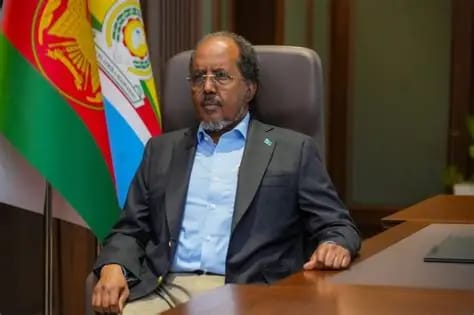
Somalia’s President, Hassan Sheikh Mohamud, delivered one of his strongest political responses yet against opposition groups on Sunday afternoon, accusing them of attempting to destabilize the country through planned demonstrations in Mogadishu while the nation was simultaneously witnessing what he described as a historic democratic milestone in South West State.
In a televised address that quickly drew national attention, the Somali president openly questioned why opposition leaders had chosen the exact same day that residents in South West State were participating in “one person, one vote” elections to organize protests in the capital. His remarks appeared to suggest that Villa Somalia viewed the demonstrations as politically calculated and deliberately timed to divert national and international attention away from the elections taking place in Baidoa and other parts of the state.
The speech came amid growing political tensions in Mogadishu, where opposition figures and groups had been mobilizing supporters over disagreements with the federal government, accusations surrounding governance issues, and frustrations over the country’s political direction. However, President Hassan Sheikh framed the demonstrations differently, arguing that the protests were not motivated by genuine democratic concerns, but rather by attempts to create instability and inflame public emotions during a sensitive political moment.
“The protest was not organized with good intentions; it was a demonstration aimed at destabilizing Somalia, as the government understood it,” President Hassan Sheikh Mohamud said during the address.
The president’s words marked one of the clearest indications yet that the federal government views the opposition-led mobilization as a direct challenge not only to the administration but also to the broader state-building process that Somalia has been pursuing over the past years.
Throughout the speech, President Hassan Sheikh repeatedly returned to one central theme: political disagreements, he argued, must be handled through ideas, policies, dialogue, and democratic competition rather than through confrontation, public incitement, or emotional mobilization.
He directly challenged opposition leaders to present clear political alternatives capable of winning public support through democratic means instead of relying on rhetoric designed to provoke anger or public unrest.
“Bring political ideas that can win public support, and do not inflame people’s sensitivities and emotions,” the president declared.
The statement reflected the administration’s growing frustration with what it sees as increasingly confrontational political tactics by some opposition actors in Mogadishu. For the president, Somalia’s political future, particularly as the country attempts to transition toward broader electoral participation, should revolve around policy debates rather than street-level power struggles.
President Hassan Sheikh also delivered a stern warning regarding security during demonstrations, emphasizing that armed individuals would not be tolerated at protests and that weapons had no place in political gatherings.
“Weapons are prohibited at protests, and armed individuals are not allowed to take part in demonstrations,” he said firmly.
The comments came at a time when security concerns remain highly sensitive in Somalia, particularly in the capital Mogadishu, where political protests have historically carried risks of clashes, instability, and infiltration by armed actors. By emphasizing the issue of weapons, the president appeared to be signaling both a warning and a justification for heightened security measures around planned demonstrations.
Observers noted that the president’s remarks carried both political and security dimensions. On one hand, he sought to portray the federal government as defending constitutional order and democratic progress. On the other hand, the opposition may interpret the comments as an attempt to delegitimize dissent and discourage public demonstrations.
Yet the most politically significant part of the president’s speech centered around the timing of the protests.
While opposition groups were mobilizing in Mogadishu, South West State was conducting local council and representative elections under the “one person, one vote” framework a process the federal government has heavily promoted as a major step toward Somalia’s democratic transformation.
For years, Somalia’s electoral system has largely relied on indirect voting mechanisms, clan-based representation, and elite negotiations. The gradual introduction of direct voting in parts of the country has therefore been framed by the federal leadership as a historic achievement aimed at restoring public participation in governance after decades of conflict, instability, and political fragmentation.
President Hassan Sheikh appeared visibly frustrated that, instead of the national spotlight focusing on citizens lining up to cast ballots in South West State, media attention and political discourse were instead dominated by tensions surrounding protests in Mogadishu.
Somalia’s leader suggested that the demonstrations risked overshadowing what should have been celebrated as a democratic breakthrough.
“Bring political ideology to the negotiating table. Chaos, anarchy, and public incitement are not beneficial to our nation,” the president said.
The wording of the speech reflected broader anxieties within the federal government regarding the fragile nature of Somalia’s political transition. The administration has repeatedly argued that the country cannot move toward stable governance if political actors continue to resort to confrontation whenever disagreements emerge.
For supporters of the government, the president’s speech represented a defense of state institutions and democratic progress. Many government allies argue that Somalia is at a delicate stage where political stability is essential for reforms, security operations against Al-Shabaab, economic recovery, and electoral transformation.
They believe that direct elections, even if limited in scope at this stage, represent a historic opportunity for ordinary Somalis to reclaim political participation after decades in which voting rights were constrained by conflict and clan-based arrangements.
From that perspective, government supporters viewed the timing of the protests as deeply unfortunate and potentially harmful to national unity.
However, critics and opposition supporters are likely to see the matter differently.
Opposition groups in Somalia have long accused the federal government of centralizing power, restricting political space, and failing to adequately consult stakeholders on key national issues. Some opposition leaders insist that public demonstrations are a legitimate democratic tool and that criticism of the government should not automatically be interpreted as destabilization.
For them, the protests reflect public frustrations that deserve attention rather than dismissal.
This widening political divide is increasingly shaping Somalia’s national discourse as the country navigates difficult questions about governance, elections, constitutional reforms, and power-sharing arrangements.
The president’s speech therefore was not merely about one protest or one election day. It represented a broader clash over Somalia’s political direction and the meaning of democracy itself.
At the center of the dispute lies a critical question: should Somalia’s transition be driven primarily through state-led institutional reforms and gradual electoral processes, as the federal government argues, or through stronger opposition pressure and public mobilization demanding accountability and broader consultation?
President Hassan Sheikh’s address made clear where he stands.
He portrayed organized demonstrations that, in his view, encourage emotional reactions or public disorder as dangerous distractions from the country’s democratic progress. By repeatedly emphasizing political ideas, ideology, and negotiation, he attempted to frame the government as the side focused on nation-building while casting the opposition as actors risking instability.
The speech also underscored the president’s determination to protect the image and legitimacy of the South West State elections.
For Villa Somalia, the elections are more than just local polls. They symbolize a larger political narrative one where Somalia gradually moves away from indirect clan-based systems toward universal suffrage and citizen participation.
That is why the president appeared particularly concerned that the demonstrations in Mogadishu were dominating headlines at the same moment citizens in South West State were standing in long queues to vote.
The images emerging from Baidoa and surrounding areas showed residents participating in the electoral process, an image the government hopes will reinforce Somalia’s democratic credentials both domestically and internationally.
The federal administration has repeatedly argued that Somalia cannot continue relying indefinitely on indirect electoral systems if it hopes to achieve long-term political stability and legitimacy. The president’s speech was therefore not only a reaction to the protests themselves, but also a defense of the broader democratic transition his administration says it is trying to build.
Whether the opposition accepts that narrative remains uncertain.
What is clear, however, is that Sunday’s events once again exposed the deep political tensions currently shaping Somalia’s future. As demonstrations, electoral reforms, and political rivalries continue unfolding simultaneously, the country faces the difficult challenge of balancing democratic freedoms with stability and national cohesion.
For now, President Hassan Sheikh Mohamud has drawn a firm line: protests, in his view, must not become platforms for chaos, emotional incitement, or instability, and political competition should instead be fought through ideas, negotiations, and democratic legitimacy.