

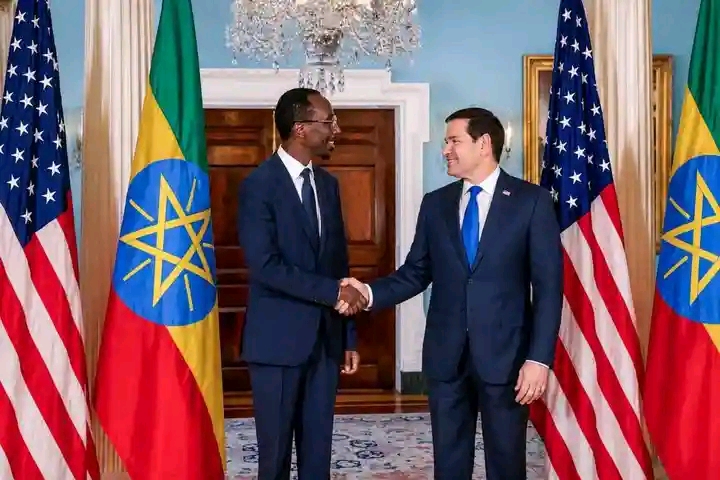
The sudden visit by Ethiopian Foreign Minister Gedion Timothewos to the United States, accompanied by senior Ethiopian figures including Girma Birru and intelligence chief Redwan Hussien, has triggered serious diplomatic speculation across the Horn of Africa.
At first glance, the official statements released after the meeting appeared routine. Ethiopia’s Foreign Ministry confirmed that Gedion met with U.S. Secretary of State Marco Rubio, while the U.S. State Department emphasized discussions on security cooperation, regional stability, and economic ties between Ethiopia and the United States.
But in diplomacy, timing matters more than press releases.
The meeting comes at a highly sensitive moment in the Horn of Africa a region increasingly becoming one of the world’s most strategically contested geopolitical theaters. Reports that Washington is considering easing or lifting sanctions on Eritrea while simultaneously deepening security talks with Ethiopia reveal something much larger than a bilateral discussion. It signals a major recalibration of American policy in the Red Sea arena.
The Red Sea today is no longer simply a maritime corridor connecting Africa to the Middle East. It has become a global power chessboard involving the United States, China, Gulf states, Türkiye, Russia, Iran, Egypt, Ethiopia, Eritrea, and several African nations competing for influence, ports, military positioning, and trade routes.
For Ethiopia, the issue is existential.
For Eritrea, it is about survival and strategic leverage.
For the United States, it is about preventing rivals from dominating one of the world’s most critical maritime corridors.
And that is why this meeting in Washington matters far more than the carefully worded diplomatic statements released afterward.
Ethiopia’s leadership has increasingly pushed the argument that a country of more than 120 million people cannot remain permanently landlocked. Since losing direct access to the sea after Eritrea’s independence in 1993, Ethiopia has relied heavily on ports in neighboring Djibouti, through which most of its imports and exports pass.
Prime Minister Abiy Ahmed has repeatedly framed sea access as a strategic necessity rather than a political ambition. His government argues that Ethiopia’s economic growth, security future, and regional influence require guaranteed and diversified access to maritime trade routes.
However, the rhetoric surrounding this issue has alarmed neighboring states, especially Eritrea.
Tensions escalated further after Ethiopia signed a controversial memorandum of understanding with Somaliland earlier this year, seeking potential port access along the Gulf of Aden. The agreement sparked outrage from Somalia, which considers Somaliland part of its sovereign territory.
At the same time, Eritrean officials and regional observers began interpreting Ethiopia’s increasingly assertive language about sea access as a possible long-term threat to Eritrea’s coastline and sovereignty.
This is where Washington enters the picture.
The United States understands that any direct confrontation between Ethiopia and Eritrea would destabilize the entire Horn of Africa and threaten Red Sea security at a time when global shipping routes are already under pressure from conflicts in the Middle East.
The Red Sea is among the world’s most vital trade arteries. A significant percentage of global commerce and energy supplies pass through the Bab el-Mandeb Strait linking the Red Sea to the Gulf of Aden. Any instability involving Ethiopia, Eritrea, or neighboring states risks affecting international shipping, military deployments, energy markets, and global supply chains.
Washington therefore appears to be pursuing a dual-track strategy: maintain strong ties with Ethiopia while simultaneously opening channels with Eritrea.
This explains why reports about possible sanction relief for Eritrea emerged almost simultaneously with the high-level Ethiopia-U.S. security talks.
For years, Eritrea has faced American sanctions and diplomatic isolation over allegations related to regional destabilization, military involvement in the Tigray conflict, and human rights concerns. Relations between Asmara and Washington deteriorated sharply during the war in northern Ethiopia, where Eritrean troops fought alongside Ethiopian federal forces against the Tigray People’s Liberation Front.
Yet geopolitics often overrides old hostilities.
The United States now faces growing competition in the Red Sea from China, Russia, Gulf powers, and Iran. China already possesses a major military base in Djibouti. Russia has long sought stronger naval access in the region. Gulf countries continue investing heavily in ports and strategic infrastructure across the Horn of Africa.
American policymakers likely fear that completely isolating Eritrea could push Asmara deeper into rival geopolitical camps.
Eritrea occupies one of the most strategically valuable coastlines in Africa. Its location along the Red Sea gives it enormous geopolitical relevance disproportionate to its size or economy. Washington knows that ignoring Eritrea entirely may no longer be strategically sustainable.
But that does not necessarily mean the United States has suddenly become an ally of Eritrea.
Instead, Washington seems to be attempting strategic hedging engaging all sides while preventing any single regional crisis from spiraling into open conflict.
That balancing act explains the significance of the Washington meetings.
The United States likely wanted direct clarity from Ethiopia regarding its intentions toward Eritrea and the broader Red Sea issue. American officials may also be seeking assurances that Ethiopia’s pursuit of sea access will remain diplomatic and economic rather than military.
For Ethiopia, the visit offered an opportunity to reassure Washington that Addis Ababa remains a critical American partner in East Africa despite growing regional anxieties.
Ethiopia remains one of Africa’s most important states. It hosts the headquarters of the African Union, possesses one of the continent’s largest populations and militaries, and plays a central role in regional counterterrorism, peacekeeping, and diplomacy.
The United States cannot afford to lose influence in Ethiopia.
Even after tensions over the Tigray war strained relations between Addis Ababa and Washington, both sides understand the strategic importance of continued cooperation.
That is why the meeting with Marco Rubio matters symbolically and strategically.
It signals that Washington still sees Ethiopia as a key regional partner despite disagreements and concerns.
However, America’s message also appears clear: Ethiopia’s ambitions for Red Sea access must not ignite another regional war.
The Real American Position: Prevent Conflict, Preserve Influence, Control the Red Sea Balance
The biggest question emerging from these developments is whether the United States genuinely intends to lift sanctions on Eritrea.
The answer is likely more complicated than a simple yes or no.
Washington may ease certain restrictions or reopen diplomatic engagement gradually if it believes doing so advances broader strategic goals in the Red Sea. But full normalization would require careful calculation.
American policymakers are unlikely to completely abandon concerns over Eritrea’s governance, military policies, or regional conduct. At the same time, they also recognize that geopolitical realities in the Horn of Africa are changing rapidly.
In international politics, strategic geography often shapes policy more than ideology.
Eritrea’s value to global powers has increased because of its Red Sea position.
At the same time, Ethiopia’s importance has also increased because of its demographic, economic, and political weight.
The United States therefore appears determined to avoid choosing one side entirely over the other.
Instead, Washington seems to be constructing a regional balance where Ethiopia remains stable and cooperative while Eritrea is prevented from drifting fully into anti-Western strategic alignments.
This balancing policy also explains why the United States has avoided openly endorsing Ethiopia’s maritime rhetoric.
American officials understand Ethiopia’s economic frustrations as a landlocked power. But they also recognize that any perception of military pressure against Eritrea or Somalia could destabilize the entire Horn.
That is why Washington continues emphasizing dialogue, regional integration, and negotiated solutions rather than territorial confrontation.
The issue becomes even more delicate because the Horn of Africa today intersects directly with Middle Eastern security politics.
The wars and tensions stretching from Gaza to Yemen have increased the strategic value of the Red Sea dramatically. Houthi attacks on shipping lanes have already disrupted global maritime trade and drawn major Western military responses.
Any new crisis involving Ethiopia and Eritrea would further complicate an already volatile maritime environment.
For the United States, the worst-case scenario would be simultaneous instability across the Red Sea corridor conflict in Yemen, maritime insecurity, and renewed interstate tensions in the Horn of Africa.
Washington’s current diplomacy appears aimed at preventing exactly that outcome.
At the same time, Ethiopia itself faces difficult realities.
While Addis Ababa strongly insists on access to the sea, achieving that goal remains extremely complicated politically and diplomatically.
Military confrontation would carry massive regional consequences and international backlash.
Negotiated economic arrangements remain the more realistic path.
That could include expanded port agreements with Djibouti, deeper economic cooperation with Somaliland if political disputes are managed carefully, or future regional trade frameworks involving Eritrea itself under improved diplomatic conditions.
Ironically, if U.S.-Eritrea relations improve even slightly, Washington could eventually attempt to encourage broader regional economic integration involving Ethiopia and Eritrea rather than confrontation between them.
But such a scenario remains distant given the deep mistrust between the two governments.
What is clear, however, is that the Horn of Africa is entering a new geopolitical phase.
The old regional order is shifting.
Global powers are competing aggressively for influence.
The Red Sea is becoming central to global security calculations.
And Ethiopia’s search for maritime access is no longer merely a national issue it is now part of a much larger international strategic contest.
The urgent Washington visit by Gedion Timothewos and Ethiopia’s security leadership therefore should not be viewed simply as a diplomatic courtesy meeting.
It was likely a high-stakes strategic conversation about the future balance of power in the Horn of Africa.
For Ethiopia, the challenge will be pursuing its maritime ambitions without isolating neighbors or alarming international partners.
For Eritrea, the opportunity may lie in leveraging its geographic importance to reduce isolation and regain diplomatic relevance.
For the United States, the mission is to preserve influence across the Red Sea while preventing new conflicts from erupting in one of the world’s most fragile strategic regions.
And for the Horn of Africa itself, the coming months may determine whether the region moves toward negotiated regional integration or deeper geopolitical rivalry shaped by global competition over the Red Sea.