

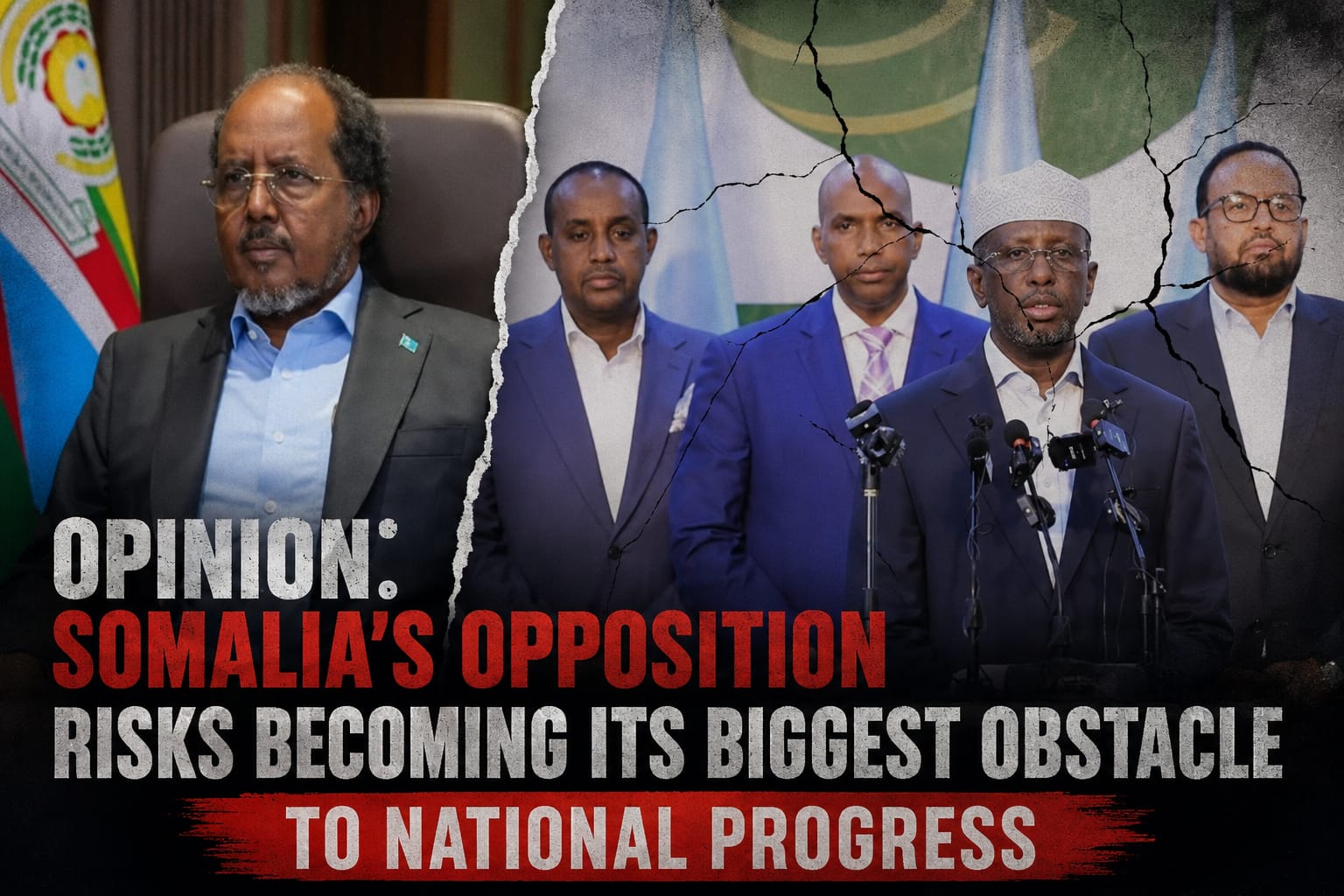
For years, Somalia’s political instability has often been blamed on weak institutions, insecurity, terrorism, clan divisions, foreign interference, and fragile governance structures. While all these factors remain significant challenges, recent events in Mogadishu have once again exposed another uncomfortable reality that many Somalis are increasingly beginning to acknowledge openly: the country’s opposition politics itself has become one of the biggest obstacles to political maturity, democratic transition, and national unity.
The failed opposition-led protests in Mogadishu on Sunday were not merely a political embarrassment for a group of opposition leaders. They represented something much deeper a revealing moment that exposed the widening disconnect between Somalia’s political elite and ordinary citizens.
For weeks, opposition figures attempted to frame the demonstrations as a major public uprising against President Hassan Sheikh Mohamud and the Federal Government of Somalia. They accused the administration of authoritarianism, political suppression, forced evictions, and centralization of power. The rhetoric was dramatic, emotional, and intentionally designed to ignite public anger.
Yet when the crucial moment arrived, the streets remained largely quiet.
Instead of witnessing a massive anti-government movement capable of paralyzing Mogadishu, Somalia saw an opposition that appeared politically cornered, strategically confused, and organizationally overwhelmed by the state machinery. Security forces quickly moved across key areas of the capital, opposition leaders reportedly found themselves unable to mobilize supporters effectively, and the anticipated demonstrations failed to gain the momentum many expected.
The government, meanwhile, projected confidence and control.
The Federal Government defended its security measures by insisting that peaceful protests had not been banned. Authorities stated that Koonis Stadium had been approved as the designated venue for demonstrations, while accusing opposition organizers of attempting to stage unrest simultaneously across 22 locations in Mogadishu. Officials further warned against the presence of armed individuals allegedly linked to opposition groups within civilian neighborhoods.
Whether one fully agrees with the government’s approach or not, the political outcome of the day was unmistakable: Villa Somalia successfully outmaneuvered the opposition.
This matters because opposition groups had attempted to rally citizens around deeply emotional grievances land disputes, displacement, demolitions, and frustrations that genuinely affect ordinary Somalis. These are not imaginary issues. They are real concerns that touch thousands of families struggling with economic hardship and insecurity in the capital.
But despite these emotionally charged issues, the opposition still failed to generate a significant public uprising.
That failure raises a serious question about the future of Somalia’s opposition politics.
If opposition leaders cannot mobilize citizens around existing public frustrations, what exactly is their long-term political strategy? More importantly, are they genuinely offering a national political vision for Somalia, or are they simply relying on elite clan-based political calculations designed primarily to weaken whichever administration is currently in power?
This question becomes even more important as Somalia enters a sensitive political period centered around electoral reforms and the push toward one-person, one-vote elections.
President Hassan Sheikh Mohamud’s administration has consistently presented universal suffrage as one of its defining political objectives. Critics may debate the pace, implementation, and political intentions behind the process, but the significance of the reforms themselves cannot simply be dismissed.
For decades, Somalia’s indirect electoral system has empowered political elites while excluding ordinary citizens from directly choosing their leaders. Clan delegates, political brokers, and elite negotiations have long dominated Somalia’s political culture. The ordinary Somali citizen has largely remained a spectator in national decision-making.
Now, for the first time in years, the country is witnessing tangible movement toward expanding direct electoral participation.
The elections taking place in Southwest State, particularly in Baidoa, symbolize more than just a regional political exercise. They represent a test case for Somalia’s democratic ambitions. Images of long queues of citizens participating in local elections under the one-person, one-vote model send a powerful message that many Somalis are hungry for political participation beyond the traditional clan power-sharing system.
Naturally, the process is imperfect. Somalia remains fragile. Security threats remain severe. Institutional weaknesses persist. But no democratic transition in a post-conflict country has ever emerged perfectly organized from the beginning.
What becomes difficult to understand, however, is why sections of the opposition appear more focused on obstructing the process rather than improving it.
Constructive opposition is essential in every democracy. No government should operate without scrutiny, criticism, or accountability. Opposition leaders play a critical role in challenging state excesses, exposing corruption, and protecting constitutional order. Somalia absolutely needs a strong opposition.
But there is a major difference between constructive opposition and perpetual political sabotage.
Increasingly, Somalia’s opposition politics appears driven less by national reform and more by elite power competition. Instead of presenting alternative policies, governance blueprints, or long-term institutional visions, many opposition figures seem trapped in a cycle of reactionary politics centered around opposing whatever the current administration attempts to implement.
This weakens public confidence.
Ordinary Somalis today face enormous challenges: unemployment, insecurity, rising living costs, drought recovery, terrorism, displacement, weak infrastructure, and limited economic opportunities. Young people are searching for hope, opportunity, and political stability. Businesses want predictability. Families want security. Citizens want institutions that function beyond clan calculations.
Yet much of the opposition rhetoric continues to revolve around political confrontation without presenting a compelling national alternative.
Sunday’s failed demonstrations reflected this problem clearly.
The opposition attempted to create the image of a nationwide uprising, but the reality on the ground suggested something very different. The inability to mobilize significant numbers despite weeks of political tension exposed limitations that go beyond temporary security restrictions.
It exposed a credibility problem.
Many Somalis are increasingly skeptical of political actors who appear energized only during moments of power struggle while remaining disconnected from the daily realities facing ordinary citizens. There is growing public fatigue with political elites who recycle the same alliances, same confrontations, and same grievances every electoral cycle without delivering meaningful national transformation.
President Hassan Sheikh Mohamud recognized this dynamic in his Sunday evening remarks when he questioned why opposition leaders chose confrontation over political dialogue and policy competition. His message appeared carefully designed to portray the government as committed to stability while framing the opposition as politically disruptive.
Again, critics may argue that the administration itself bears responsibility for rising tensions. Governments are never innocent participants in political crises. Power naturally attracts accusations of overreach, and Somalia’s federal government is no exception.
But politics is ultimately judged not only by accusations but by effectiveness.
At this moment, the opposition appears reactive while the government appears strategic.
Villa Somalia understood something critical before Sunday’s planned protests: perception matters as much as numbers. By projecting preparedness, deploying security forces early, limiting organizational space, and controlling the narrative around public order, the government effectively prevented the opposition from creating momentum.
The opposition, meanwhile, appeared to rely heavily on expectation rather than organization.
That miscalculation could carry long-term consequences.
If the opposition continues to rely primarily on emotional mobilization without developing coherent political structures, policy agendas, and grassroots organization, it risks becoming increasingly irrelevant outside elite political circles.
The deeper danger for Somalia is that weak opposition politics can unintentionally strengthen executive power even further.
Democracy requires balance. A government without credible opposition risks becoming complacent and unaccountable. But an opposition without credibility also weakens democracy because citizens begin losing faith in political competition altogether.
Somalia today stands at a crossroads where institutional development matters more than elite political theatrics.
The one-person, one-vote debate perfectly illustrates this challenge.
Rather than participating aggressively in shaping the electoral framework, improving transparency, strengthening safeguards, and ensuring inclusivity, sections of the opposition appear focused primarily on discrediting the process entirely. That strategy may produce short-term political headlines, but it risks alienating citizens who genuinely want democratic progress.
Many ordinary Somalis may not fully trust politicians from any side, but they still understand the symbolic importance of casting a vote directly. For a country emerging from decades of conflict and political fragmentation, even imperfect democratic participation carries psychological significance.
The scenes from Baidoa matter because they create a sense of national possibility.
Opposition leaders should recognize that reality instead of appearing hostile toward every step of electoral reform simply because it is occurring under Hassan Sheikh Mohamud’s administration.
If the opposition truly believes the process lacks credibility, the solution should be deeper engagement, stronger organization, broader civic mobilization, and better political alternatives — not simply street confrontation without sustainable momentum.
The failed protests also exposed another uncomfortable truth about Somali politics: elite political influence on social media does not always translate into real public mobilization on the streets.
Online rhetoric can create the illusion of overwhelming support, but political legitimacy ultimately depends on actual public trust and organizational capacity. Sunday demonstrated that digital outrage alone cannot substitute for genuine grassroots movements.
This should serve as a wake-up call not only for opposition figures but for Somalia’s entire political class.
The country’s future cannot remain permanently trapped between government survival tactics and opposition disruption strategies. Somalia requires serious politics capable of moving beyond endless cycles of confrontation.
The public mood itself appears to be evolving.
Many Somalis today are less interested in political slogans and more interested in practical governance outcomes. They want security improvements. They want economic opportunities. They want roads, schools, healthcare, jobs, and functioning institutions. They want leadership capable of reducing clan tensions rather than constantly exploiting them.
Any political movement whether government or opposition that fails to understand this shift risks losing relevance.
For now, President Hassan Sheikh Mohamud appears politically strengthened by Sunday’s events. The government successfully prevented large-scale unrest while simultaneously projecting itself as the defender of stability and constitutional order.
The opposition, meanwhile, faces difficult questions about its political direction, organizational capacity, and long-term strategy.
Most importantly, Somalia itself faces a defining national test.
Will the country continue operating within the familiar cycle of elite confrontation, political mistrust, and clan-centered competition? Or can it gradually transition toward issue-based politics centered around institutions, citizenship, and democratic participation?
The answer will determine far more than the fate of one administration or one opposition coalition.
It will determine whether Somalia can finally move beyond survival politics and begin building a stable political culture capable of sustaining national progress.
At this critical moment, Somalia does not merely need louder political actors.
It needs wiser ones.