

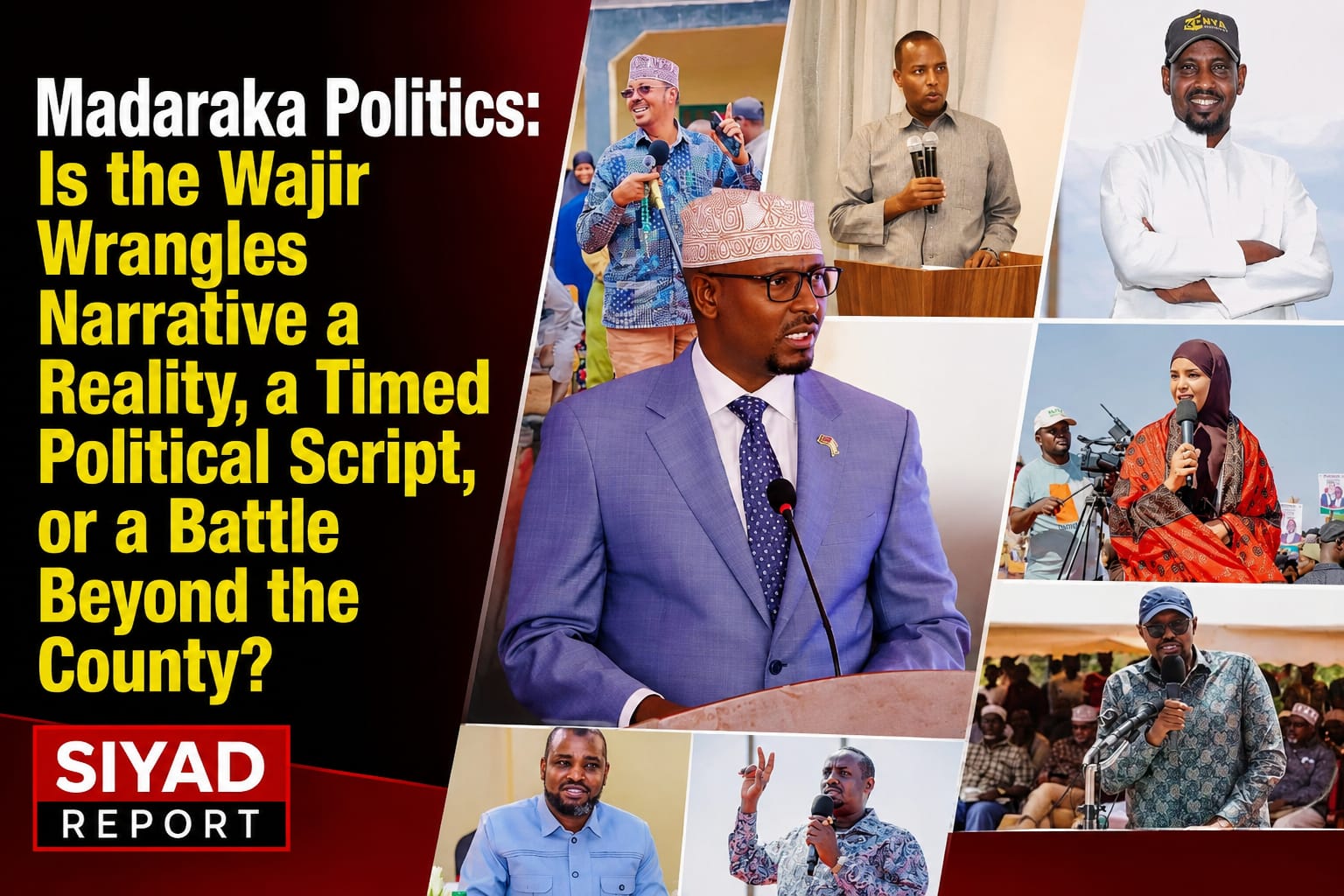
As Kenya prepares for this year’s Madaraka Day celebrations in Wajir County, political temperatures across the county are rising almost as fast as the pace of government preparations on the ground. Roads are being upgraded, public spaces renovated, and development projects hurriedly finalized ahead of the historic national event.
But beyond the construction works and official speeches lies another unfolding story one that has increasingly dominated conversations in political circles, local media platforms, and online discussions: the alleged deep political wrangles within Wajir’s leadership ahead of Madaraka Day.
Over the last few weeks, several reports and commentaries have painted a picture of a divided county leadership, suggesting that political tension and rivalry could overshadow the celebrations. Some headlines have gone even further, portraying Wajir as politically unstable and internally fractured at a time when it should be projecting unity before the nation.
Yet the bigger question now emerging is not whether political disagreements exist because they clearly do but whether the current narrative surrounding Wajir’s political wrangles is an honest reflection of reality or a carefully amplified political storyline serving interests beyond the county itself.
The timing of the reporting has become just as controversial as the wrangles being discussed.
Political analysts and observers argue that while Wajir has experienced political competition and leadership divisions for years, the sudden intensity and coordinated framing of the crisis ahead of Madaraka Day raises critical questions. Why now? Why has the conversation escalated precisely at the moment the county is preparing to host one of Kenya’s most symbolic national celebrations?
Some local observers believe the current wave of political reporting may not be entirely organic. According to analysts, there appears to be a deliberate attempt by certain actors to shape public perception around the county at a nationally sensitive moment.
“What we are witnessing may not necessarily be the creation of a false story,” one political observer familiar with North Eastern Kenya politics tells Siyad Reports. “The wrangles exist, yes, but the portrayal of total political collapse or boycott is exaggerated. There is a difference between political rivalry and a complete governance crisis.”
That distinction is becoming increasingly important.
In many counties across Kenya, political competition between governors, MPs, senators, and local power brokers is common. In fact, political rivalry has become a defining feature of devolved governance since the introduction of county governments in 2013. Wajir is therefore not unique in experiencing internal leadership tensions.
However, what makes the Wajir situation politically significant is the national spotlight currently fixed on the county.
Hosting Madaraka Day places Wajir at the center of Kenya’s political attention. For the first time in years, the county is receiving major national visibility, state attention, infrastructure upgrades, and media focus. Such moments naturally carry political weight not just locally, but regionally and nationally.
And where there is political significance, there are often competing interests.
The Invisible Hands Behind the Political Noise
One of the deeper conversations now taking shape among analysts is whether influential figures outside Wajir could be playing a role in escalating the political narrative surrounding the county.
While no specific names are openly being mentioned, there is growing speculation that external political interests may see the Madaraka celebrations as more than just a national event. Some analysts believe the occasion is also being viewed as a strategic political stage ahead of the 2027 political realignments already quietly beginning across Kenya.
North Eastern Kenya has historically played an important role in national coalition politics. Counties such as Wajir, Mandera, and Garissa remain politically influential voting blocs capable of shaping regional alliances and national calculations.
Because of this, any political image emerging from Wajir during Madaraka Day carries symbolic and strategic importance.
A successful, united, and nationally celebrated event could politically strengthen certain leaders while weakening rival narratives that portray the region as unstable or divided. On the other hand, sustained reporting about political wrangles, disunity, or internal rebellion could reshape public perception and dilute the political gains associated with hosting the celebrations.
At the center of much of this political conversation is Governor Ahmed Abdullahi himself. Supporters view him as a leader attempting to cement a development legacy through visible projects and national exposure during Madaraka Day, while critics argue that the growing political tension around the county reflects deeper dissatisfaction within sections of the political establishment.
With the next election cycle slowly approaching, analysts believe the governor may increasingly find himself balancing governance, political survival ,regional alliances, and legacy-building all at once.
“This is no longer just about Madaraka Day,” another political analyst tells Siyad Reports. “It is also about positioning, influence, and who controls the political narrative heading into the future.”
This is why some analysts believe the current discourse may not simply be about local disagreements inside Wajir County Assembly corridors or among county leaders. Instead, they argue, the situation could reflect a broader political contest involving interests extending beyond county borders.
“There are always layers in Kenyan politics,” another analyst tells Siyad Reports. “What is visible on the surface is rarely the full story. National events often attract national political interests.”
That observation reflects a long-standing reality in Kenyan political culture where local issues frequently become entangled with wider power struggles.
Still, despite the speculation, others warn against dismissing the political tensions in Wajir as mere propaganda or manufactured narratives.
The county has genuinely experienced periods of political instability, leadership disagreements, and factional divisions in recent years. Political competition among elected leaders has occasionally slowed cooperation and weakened collective messaging on development priorities.
Critics argue that if leaders were fully united, the public would not even be debating the possibility of boycotts, divisions, or political camps ahead of such a major national occasion.
This means the truth may ultimately lie somewhere in the middle.
The wrangles may be real, but perhaps not as catastrophic as some portray them. The reporting may contain legitimate concerns, but perhaps amplified by political interests eager to influence perception during a crucial national moment.
That is what makes the Wajir situation politically fascinating.
For residents on the ground, however, the priority remains different. Many ordinary citizens are less concerned with elite political calculations and more focused on what Madaraka Day could mean for the county’s future.
For decades, North Eastern Kenya has often complained of marginalization, underdevelopment, and exclusion from national investment. The decision to host Madaraka Day in Wajir is therefore being viewed by many locals as an opportunity to change narratives about the region.
Residents hope the event will showcase Wajir not as a county consumed by political chaos, insecurity, or endless disputes, but as a region capable of hosting national functions and attracting investment and attention.
This explains why some citizens have expressed frustration over the increasingly negative political framing dominating parts of the public discussion.
To them, the celebrations should represent a unifying moment rather than a battlefield for political messaging.
Yet politics rarely pauses for symbolism.
As June 1 approaches, Kenya will be watching not only the speeches delivered during Madaraka Day celebrations, but also the body language of Wajir’s political class. Who attends, who stays silent, who shares the platform, and who distances themselves may all carry political meaning beyond the official event itself.
In Kenyan politics, symbolism matters.
A handshake can become a headline. A missing leader can trigger speculation. A photograph can redefine alliances.
That is why the current political atmosphere in Wajir cannot simply be reduced to a straightforward question of whether wrangles exist or not. The reality appears far more layered, involving local rivalries, regional influence, media framing, national interests, and future political calculations all intersecting at once.
The coming Madaraka Day celebrations may therefore reveal more than completed roads and development projects. They may also expose the evolving power dynamics shaping Wajir’s political future and perhaps even broader political alignments across North Eastern Kenya.
For now, one question continues to linger across political conversations:
Is Wajir truly facing a dangerous political crisis ahead of Madaraka Day, or is the county becoming the stage for a larger political script being written quietly behind the scenes?
Perhaps the answer will emerge not from the headlines themselves, but from the political movements that follow after the celebrations are over.