

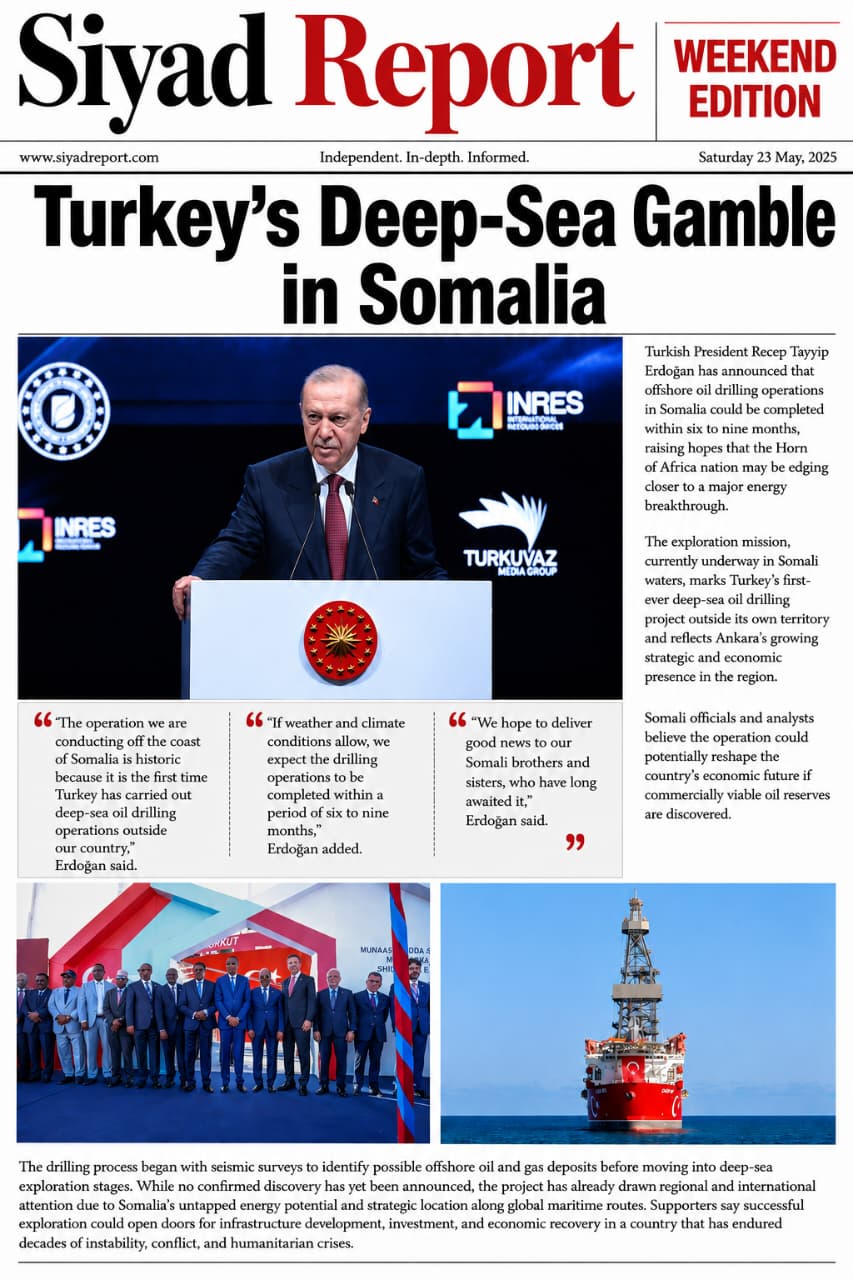
Turkish President Recep Tayyip Erdoğan has announced that the ongoing offshore oil exploration mission along the Somali coast could be completed within the next six to nine months, marking what Ankara describes as a historic phase in the growing strategic partnership between Turkey and Somalia.
Speaking on Friday, Erdoğan described the mission as Turkey’s first-ever deep-sea oil drilling operation outside its own territorial waters, underlining Ankara’s ambitions to expand its geopolitical and economic footprint in the Horn of Africa.
“The operation we are conducting off the coast of Somalia is historic because it is the first time Turkey has carried out deep-sea oil drilling operations outside our country,” Erdoğan said.
The Turkish leader added that progress on the project will largely depend on weather and climate conditions in the Indian Ocean, but expressed optimism that the drilling campaign would conclude within the projected timeline.
“If weather and climate conditions allow, we expect the drilling operations to be completed within a period of six to nine months,” he stated.
Erdoğan further framed the exploration mission as a project tied not only to energy interests, but also to Somalia’s long-standing hopes for economic transformation after decades of insecurity, drought, and instability.
“We hope to deliver good news to our Somali brothers and sisters, who have long awaited it, and who have endured conflict and famine for many years,” he added.
The remarks come at a time when Somalia is increasingly positioning itself as a potential future energy producer, with vast untapped offshore reserves believed to exist beneath the waters of the Indian Ocean.
For years, Somalia’s offshore basin has attracted international attention due to studies suggesting the country may possess significant oil and gas reserves. Energy experts have often compared parts of Somalia’s coastline to the hydrocarbon-rich regions of neighboring East African states such as Kenya and Mozambique.
However, political instability, insecurity, weak infrastructure, and legal uncertainty delayed meaningful exploration efforts for decades.
In recent years, the Somali government has accelerated efforts to revive the sector by introducing petroleum legislation, signing exploration agreements, and seeking international partnerships aimed at unlocking the country’s natural resources.
Turkey emerged as one of Somalia’s closest strategic allies during this process.
The relationship between Ankara and Mogadishu has expanded significantly over the past decade, covering military cooperation, infrastructure development, education, humanitarian aid, and trade. Turkey operates one of its largest overseas military training facilities in Mogadishu and has become a key partner in Somalia’s state-building efforts.
The offshore drilling mission is therefore being viewed not only as an energy project, but also as another symbol of Turkey’s deepening influence in the Horn of Africa.
The exploration activities are reportedly being carried out in Somali waters by the Turkish seismic research and drilling fleet after agreements signed between the two governments earlier this year.
The process began with seismic surveys a crucial stage in offshore oil exploration where advanced vessels scan beneath the seabed to identify possible hydrocarbon deposits. These surveys help geologists determine whether commercially viable oil or gas reserves may exist underground.
Following the seismic studies, drilling operations were launched in selected offshore blocks believed to contain promising reserves.
Turkey’s involvement has brought advanced deep-sea drilling technology into Somali waters for the first time at such a scale. Deep-sea exploration is both technically challenging and financially expensive, often requiring sophisticated vessels capable of operating thousands of meters below sea level.
According to analysts, the current operation is still in the exploration phase, meaning no confirmed commercial oil discovery has yet been officially announced.
If viable reserves are discovered, Somalia could eventually move toward production-sharing agreements, infrastructure development, export planning, and refinery investments a process that could take several more years before oil revenues begin flowing into the country’s economy.
Still, Erdoğan’s latest comments suggest Ankara is confident enough in the exploration progress to publicly discuss timelines and expectations.
The prospect of oil discovery carries enormous expectations inside Somalia, where unemployment, poverty, and recurring humanitarian crises remain major challenges.
Supporters of the project argue that successful offshore drilling could provide Somalia with a new source of national revenue capable of funding infrastructure, healthcare, education, and economic development.
For a country that has struggled through decades of civil conflict and institutional collapse, the possibility of becoming an energy-producing nation is seen by many as a potential turning point.
Yet experts also caution that natural resources can become both an opportunity and a risk.
Across Africa and beyond, several resource-rich nations have experienced political disputes, corruption allegations, and conflict linked to oil wealth. Analysts therefore stress that Somalia will need strong institutions, transparency mechanisms, and accountable governance structures to ensure that any future energy revenues benefit ordinary citizens.
Questions also remain over maritime security and regional geopolitics.
Somalia’s strategic location along one of the world’s busiest shipping routes has already made the country an important player in regional security calculations involving Gulf states, Turkey, Western powers, and emerging international actors.
An eventual oil discovery could further increase competition and international interest in Somali waters.
Turkey’s Expanding Role in the Horn of Africa
Turkey’s growing engagement in Somalia reflects Ankara’s broader foreign policy strategy across Africa.
Over the last decade, Turkey has expanded diplomatic missions, trade agreements, humanitarian programs, and defense cooperation throughout the continent. Somalia has become one of the clearest examples of this strategy in action.
From constructing roads and hospitals to managing key infrastructure projects in Mogadishu, Turkey has steadily strengthened its presence in the country.
The offshore drilling initiative now adds an energy dimension to that partnership.
For Turkey, successful oil exploration in Somali waters could deliver both economic and geopolitical gains. It would also demonstrate Ankara’s growing capability to conduct major energy operations beyond its borders.
For Somalia, the operation represents a rare moment of optimism in a country long associated internationally with conflict, drought, and humanitarian crises.
Whether the exploration mission ultimately results in commercially viable oil discoveries remains uncertain. But Erdoğan’s statement signals that both governments believe the coming months could prove decisive.
If successful, the drilling campaign may reshape not only Somalia’s economic future, but also the balance of strategic influence in the Horn of Africa.