

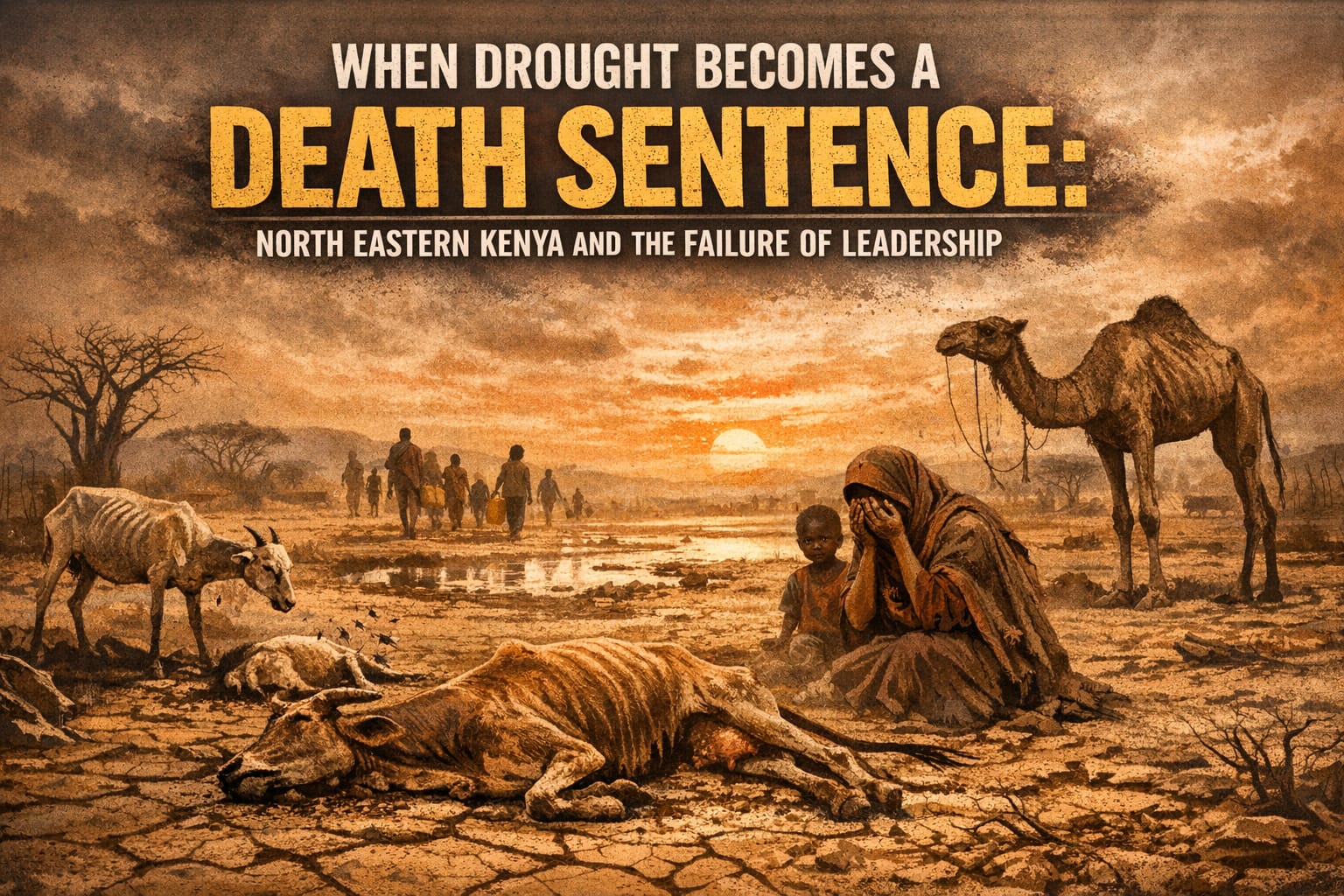
The drought ravaging North Eastern Kenya is no longer a slow-moving disaster waiting for attention. It is an emergency unfolding in real time, dismantling livelihoods, breaking families, and pushing already vulnerable communities toward irreversible loss. Across Mandera, Wajir, Garissa and surrounding pastoral areas, the signs of collapse are everywhere in markets, in homes, in empty water pans, and in the bodies of animals that once sustained entire households.
In Mandera, a goat that sold for Sh10,000 only days ago now struggles to fetch Sh1,000, if it can be sold at all. This dramatic price crash is not just a market fluctuation; it is a signal of systemic failure. For pastoralist communities, livestock is everything. It provides food through milk and meat, income through sales, school fees for children, healthcare access, and social standing within the community. When livestock dies or loses value overnight, families are stripped of their only safety net.
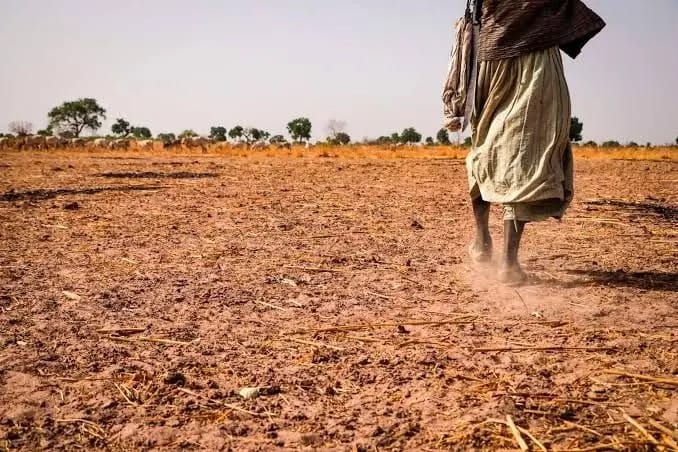
The drought has transformed once-functional ecosystems into hostile landscapes. Water pans that served villages for generations are now dry craters. Boreholes operate intermittently or have broken down completely. Seasonal rivers have disappeared, forcing people and animals to walk longer distances in search of water that may no longer exist. Grazing land has turned to dust, leaving animals weak, malnourished and vulnerable to disease.
Livestock deaths are rising rapidly. Goats, sheep and cattle collapse under extreme heat and hunger, too weak to continue migrating. Some die along roadsides, others within homesteads, leaving families to watch helplessly as their wealth and survival fade away. Veterinary services are scarce, fodder is unavailable, and emergency livestock support has not kept pace with the scale of need.
Women and children are bearing the heaviest burden of this crisis. Mothers spend hours sometimes entire days walking under the scorching sun in search of water, often returning with empty containers. The physical exhaustion is compounded by emotional strain, as households ration the little food they have left. Children are withdrawn from school to assist with migration, water collection, or household survival. Those who remain in school struggle to learn while hungry and dehydrated.
Malnutrition is no longer a looming threat; it is present. Health facilities in parts of the region are reporting rising cases of acute malnutrition, especially among children and expectant mothers. With weakened immunity, preventable illnesses become deadly. Access to healthcare is further complicated by long distances, lack of transport, and overstretched facilities.
Markets, once vibrant centres of trade and interaction, have turned into scenes of despair. Sellers outnumber buyers. Weak livestock fetch humiliating prices that reflect desperation rather than value. Families are forced to sell several animals just to afford water or basic food. Others watch their animals die before they can reach the market, losing everything without compensation.
What makes this drought particularly devastating is how quickly it is erasing resilience built over generations. Pastoralist communities have long adapted to dry seasons, migration patterns and environmental shocks. But climate change has altered the equation. Rains are more erratic, droughts last longer, and recovery periods are shrinking. The traditional coping mechanisms that once sustained these communities are no longer enough.
This crisis did not arrive without warning. Early warning systems signaled danger months ago. Meteorological forecasts predicted poor rainfall. Community reports highlighted worsening water scarcity and livestock stress. Yet response remained slow and fragmented. What is unfolding today is not simply the result of failed rains, but the cost of delayed action.
NEGLIGENCE, SILENCE AND A LEADERSHIP THAT ARRIVES TOO LATE
The suffering in North Eastern Kenya cannot be explained by drought alone. It is amplified by chronic neglect and leadership failure. For years, the region has experienced a cycle of disaster, relief, and forgetfulness. Each drought is treated as a surprise, despite its predictability.
Emergency response continues to replace preparedness. Water trucking substitutes for sustainable water infrastructure. Food aid stands in for long-term food security planning. Press conferences replace visible action. Once again, intervention has arrived when damage is already severe and, in many cases, irreversible.
Critical questions demand honest answers. Why are boreholes still non-functional in drought-prone areas? Why does livestock protection begin after mass deaths occur? Why do drought mitigation funds fail to translate into lasting solutions on the ground? These are not technical oversights; they are governance failures.
North Eastern Kenya has become accustomed to being acknowledged only during crises. Leaders visit briefly, issue statements, promise assessments, and move on. Budgets are announced, but communities see little change. Taskforces are formed, but water does not flow. Each drought exposes the same uncomfortable truth: preparedness is weak, accountability is absent, and urgency fades too quickly.
Climate change is often cited, and rightly so. But climate change cannot excuse inaction. Adaptation is no longer optional. Investment in sustainable water systems, drought-resilient livelihoods, livestock insurance, early intervention mechanisms and climate-smart infrastructure is essential. Without this, every drought becomes a humanitarian emergency by default.
The silence during moments like this is telling. While families queue for water, leaders debate priorities elsewhere. While animals die, reports remain unimplemented. While mothers cry, statements are issued. The gap between leadership rhetoric and lived reality has grown dangerously wide.
A question that cannot be avoided must be asked: Would the response be this slow if this crisis were happening elsewhere? And when this drought eventually ends, what guarantees exist that the next one will not produce the same suffering?
A TEST OF CONSCIENCE AND RESPONSIBILITY
The drought in North Eastern Kenya is a moral test for leadership and a measure of national conscience. It demands more than emergency relief and temporary attention. It demands accountability, sustained investment and respect for communities that have endured decades of marginalization.
Drought may be natural. Mass suffering is not inevitable. It is the result of choices choices to delay, to under-invest, and to normalize hardship in certain regions.
History will remember this moment, not for the absence of rain, but for the presence or absence of action.
This crisis must not fade quietly. If it does, the next drought will be deadlier, and the cost will be higher. North Eastern Kenya deserves more than survival. It deserves leadership that acts before tragedy becomes routine.