

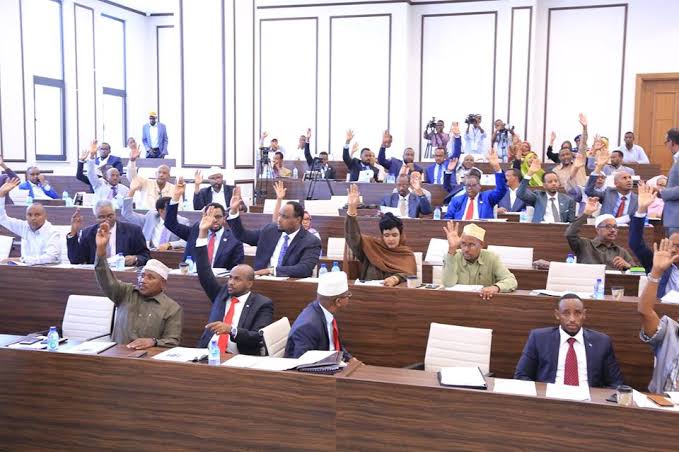
For more than a decade, constitutional reform has been one of the most repeated promises in Somali presidential campaigns. Every serious candidate who has stood before the Somali public whether in Mogadishu, Garowe, Baidoa, or Kismayo has pledged to “complete” or “finalize” the Constitution. It has become a political ritual: fix the Constitution, clarify federalism, strengthen governance, and move Somalia beyond the provisional era.
Today, President Hassan Sheikh Mohamud is attempting to turn that long-standing promise into reality.
The question facing the nation is no longer whether constitutional reform is necessary. It is whether this is the right time and whether this version of reform is the right foundation for Somalia’s future.
Reform, Resistance, and the Politics of Timing
Since the adoption of Somalia’s Provisional Constitution in 2012, the country has operated under a framework that was always intended to be temporary.
Successive administrations acknowledged gaps, ambiguities, and unresolved chapters. Yet progress remained slow, often overshadowed by security crises, electoral disputes, and fragile federal relations.
During his campaigns, President Hassan Sheikh repeatedly emphasized constitutional completion as a top priority. Now, midway through his current term, he appears determined to fulfill that pledge.
Through consultations, political negotiations, and parliamentary mobilization, his administration is pushing amendments that would reshape eligibility criteria, federal arrangements, executive-legislative relations, and the governance structure of Mogadishu.
Supporters argue that leadership means acting decisively. If constitutional reform is always postponed because “the time is not right,” then the provisional era could become permanent. From this perspective, President Hassan Sheikh is doing what previous leaders hesitated to do: confronting unfinished state-building head-on.
Opposition leaders, however, argue that the country is navigating multiple sensitive fronts simultaneously security challenges, economic strain, federal tensions, and regional instability. They contend that major constitutional changes require broad-based consensus, not simple parliamentary arithmetic.
Their central concern is not necessarily the idea of reform itself. It is the timing and inclusiveness of the process. In a federal system as delicate as Somalia’s, perception matters as much as procedure.
If key political actors feel sidelined or rushed, reforms intended to strengthen unity could instead deepen divisions.
The debate, therefore, is less about the necessity of a constitution and more about legitimacy. Does this process carry sufficient national consensus? Are federal member states fully aligned? Has civil society been meaningfully engaged? Will contested clauses particularly those on citizenship and eligibility withstand legal and social scrutiny?
The proposed changes are not cosmetic. They touch core aspects of state identity and governance. The move toward direct election of Members of Parliament signals an ambition to transition from clan-based indirect selection toward broader democratic participation. At the same time, maintaining parliamentary election of the President preserves continuity within the federal balance.
Other provisions including stricter eligibility criteria for top office, prohibitions on dual citizenship, asset declaration requirements, and structural reforms in Mogadishu’s governance aim to clarify authority and strengthen accountability.
Supporters frame these measures as long overdue institutional strengthening. Critics warn that certain clauses may raise legal and social questions, particularly in a country with a vast diaspora deeply involved in national rebuilding.
History rarely offers perfect timing for structural reform. Waiting for absolute political harmony may mean waiting indefinitely. On the other hand, pushing reform without broad trust risks weakening the very institutions the Constitution seeks to strengthen.
A Defining Constitutional Moment
For President Hassan Sheikh Mohamud, the constitutional push carries both national and personal dimensions.
Completing the Constitution would solidify his legacy as the leader who transitioned Somalia from provisional governance to a clearer constitutional order.
Yet legacy alone cannot sustain constitutional durability. A constitution survives political cycles only if it commands cross-generational and cross-factional acceptance. The opposition’s skepticism is not unusual in democratic systems. Major reforms often face resistance. The test of statesmanship lies in whether disagreement leads to compromise or confrontation.
Even if Parliament approves the amendments and the President signs them into law, the real challenge begins afterward. Can Somalia organize credible direct parliamentary elections nationwide? Will new governance arrangements in Mogadishu function without institutional overlap? Will asset declaration rules be enforced transparently? Will eligibility clauses be interpreted fairly and consistently?
Constitutional text sets direction. Institutions bring it to life. If implementation is inclusive, transparent, and consultative, today’s contested reforms could become tomorrow’s accepted framework. If implementation appears partisan or selective, reform could generate prolonged political friction.
Perhaps the more honest question is not whether it is the perfect time, but whether Somalia can afford to remain in a provisional constitutional state any longer. A nation rebuilding from decades of fragmentation cannot indefinitely postpone foundational clarity. Yet neither can it ignore the importance of consensus in a federal democracy.
The current moment presents both opportunity and risk: opportunity to consolidate democratic principles and clarify authority, and risk of deepening political polarization if consensus is insufficient.
In the end, constitutions are not only legal documents. They are social contracts. Their strength lies not just in parliamentary votes, but in public trust. Somalia stands at a constitutional crossroads. Whether this moment becomes remembered as the beginning of a more stable institutional era or as another chapter of political contestation will depend less on the timing alone and more on how inclusively and responsibly this reform is carried forward.
There may never be a perfect time. But there is always a defining one.