

Mogadishu is preparing for what could become one of the most politically significant opposition mobilizations in recent years, after Somali opposition leaders confirmed plans for large-scale anti-government demonstrations scheduled to begin on Sunday, May 10, across the Banaadir region.
The planned protests come amid growing political tensions, public frustration over forced evictions, governance disputes, and increasing criticism directed at the administration of Somali President Hassan Sheikh Mohamud. Opposition leaders say the demonstrations are intended to challenge what they describe as worsening political exclusion, abuse of power, and the displacement of vulnerable communities in Mogadishu.
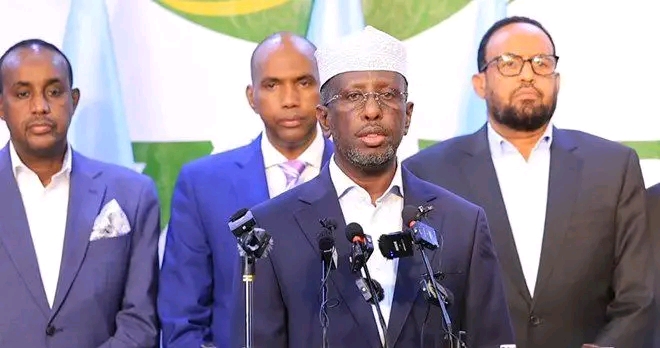
The opposition coalition, which includes former Somali President Sharif Sheikh Ahmed, former Prime Minister Hassan Ali Kheyre, and opposition politician Abdirahman Abdishakur Warsame, announced on Saturday that demonstrations would officially begin at 7:00 a.m. in districts across the capital.
Speaking during a press conference in Mogadishu, Former Prime Minister Hassan Ali Kheyre declared that the protests would not be temporary or symbolic, suggesting that the opposition intends to sustain pressure on the government until demands are addressed.
“This protest is tomorrow at seven in the morning. It is not a one-day protest; once it starts, it will continue until everyone receives their rights,” Kheyre stated.
The demonstrations are largely centered around growing anger over forced evictions and demolitions in parts of Mogadishu, where residents have accused authorities and politically connected actors of displacing families under urban redevelopment programs. Opposition leaders argue that many of those affected are poor residents and internally displaced communities with little political protection.
Abdirahman Abdishakur Warsame called on displaced residents and supporters to participate in the demonstrations, describing the protests as a fight for justice and dignity.
“We call on everyone who was displaced from their land to come out; we stand with you because it is your right,” he said.
The opposition has also linked the demonstrations to broader national frustrations, including delayed political reforms, disputes over governance, accusations of shrinking democratic space, and concerns surrounding the arrests of journalists and activists critical of the government.
The planned protests have already triggered heightened political activity in Mogadishu. Former President Sharif Sheikh Ahmed reportedly relocated from an area near Aden Adde International Airport to Mirinaayo in northern Mogadishu, where opposition mobilization efforts are expected to intensify ahead of Sunday’s demonstrations.
Reports indicate that several opposition figures have similarly moved across different districts of Mogadishu as preparations continue for mass mobilization.
The Somali Federal Government, however, has attempted to contain the demonstrations by restricting protest locations. Authorities announced that protests would only be permitted at Eng. Yariisow Stadium, warning that demonstrations held elsewhere would be considered unauthorized and unlawful.
The government’s position reflects growing concerns within security circles that widespread demonstrations across multiple districts could create instability in a city that continues to face threats from militant groups, political tensions, and fragile security conditions.
In response to the public outrage over evictions, the Somali government recently announced a temporary suspension of some land-related actions tied to urban redevelopment projects in Mogadishu. Authorities also unveiled a new housing initiative aimed at constructing 12,000 homes for approximately 80,000 displaced and low-income residents in the capital.
Despite those measures, opposition leaders argue that the government acted only after public pressure intensified and accuse the administration of attempting to silence criticism while avoiding accountability.
The atmosphere in Mogadishu ahead of the protests remains tense but politically charged. Security agencies are expected to deploy heavily across key roads and districts, while residents continue to debate whether the demonstrations could evolve into a larger national political movement.
Can Somalia’s Planned Protests Produce Real Political Change? Lessons from Africa’s Protest Movements
The planned anti-government protests in Mogadishu raise a deeper political question that extends beyond Somalia itself: can sustained public demonstrations in fragile African states genuinely transform governance, or do they ultimately fade without meaningful structural change?
Across Africa, protests have historically played a decisive role in reshaping governments, toppling leaders, and forcing political reforms. Yet the effectiveness of such demonstrations has varied dramatically depending on several factors including state institutions, military neutrality, opposition unity, economic pressure, international involvement, and public participation.
In Somalia’s case, the country’s complex political and security environment makes the answer far from straightforward.
Unlike many African states where protests occur within relatively stable institutional frameworks, Somalia remains a fragile post-conflict nation with ongoing security threats, clan-based political structures, and weak state institutions. This reality creates both opportunities and limitations for opposition movements seeking political leverage through street mobilization.
Still, Somali politics has long been shaped by pressure campaigns, public mobilization, and elite political alliances. The current planned protests therefore deserve closer examination not only as isolated demonstrations, but as part of Somalia’s broader political evolution.
One of the most notable examples in Africa was the 2019 Sudan uprising that ultimately led to the removal of longtime ruler Omar al-Bashir after nearly three decades in power.
The Sudanese protests began over economic hardship and rising bread prices but gradually transformed into a nationwide political revolution. Protesters maintained sustained pressure for months despite violent crackdowns. Most importantly, sections of Sudan’s military eventually withdrew support from Bashir, creating conditions for his removal.
Similarly, in Burkina Faso in 2014, mass protests forced President Blaise Compaoré to resign after attempts to extend his rule triggered nationwide outrage.
In Tunisia, the 2011 protests that sparked the Arab Spring overthrew President Zine El Abidine Ben Ali after widespread demonstrations fueled by unemployment, corruption, and state repression.
Even in Ethiopia, sustained anti-government protests between 2015 and 2018 contributed significantly to political change that eventually brought Abiy Ahmed to power following the resignation of former Prime Minister Hailemariam Desalegn.
However, not all African protest movements achieve transformational outcomes.
In Uganda, repeated protests against President Yoweri Museveni have often struggled to generate lasting institutional change despite strong opposition mobilization.
This highlights a central political reality: protests alone rarely overthrow governments. Demonstrations become politically effective when they combine with elite fractures, economic crises, institutional pressure, and broad national consensus.
For Somalia, several critical factors will determine whether the planned demonstrations become historically significant or merely another temporary political episode.
First is the issue of public participation.
Somalia has witnessed protests before, but many have remained politically fragmented or limited to specific clans, districts, or political groups. For the current demonstrations to create substantial pressure on the government, organizers would need to attract broad-based participation extending beyond traditional opposition supporters.
If the protests are perceived primarily as elite political competition between opposition figures and the federal government, public momentum could weaken quickly.
Second is the question of opposition unity.
Somali opposition groups have historically struggled with internal divisions, shifting alliances, and competing political ambitions. While current opposition leaders appear united around criticism of forced evictions and governance concerns, sustaining long-term coordination will be difficult.
African protest movements that achieved significant change often depended on unusually broad alliances between civil society groups, youth movements, opposition parties, labor organizations, and sections of the political elite.
At present, Somalia’s planned protests appear heavily driven by established political figures rather than grassroots civic organizations alone.
Third is the role of the security establishment.
In many African political transitions triggered by protests, the position of security forces became decisive. In Sudan, Zimbabwe, and Burkina Faso, ruling leaders weakened once parts of the military establishment stopped offering unconditional support.
Somalia’s security structure, however, is far more fragmented and intertwined with political dynamics, clan balances, and counterterrorism priorities. Security agencies are unlikely to tolerate prolonged instability in Mogadishu given ongoing threats posed by Al-Shabaab.
This means authorities may respond aggressively to demonstrations perceived as threatening national stability.
Another important factor is economic pressure.
Many successful protest movements across Africa gained strength during periods of severe economic crisis, inflation, or unemployment. Somalia certainly faces deep economic hardship, but the country’s political economy differs from states with centralized economic systems.
Nevertheless, forced evictions and land disputes touch directly on survival, housing, and urban inequality — issues capable of generating strong emotional public reactions.
The symbolism of displacement in Mogadishu is especially powerful because many residents are already survivors of conflict, drought, terrorism, and prolonged instability.
Another factor is international attention.
Somalia remains heavily dependent on international donors, security partnerships, and diplomatic support. Western governments, the African Union, and regional actors closely monitor political stability in Mogadishu due to concerns about terrorism, migration, and regional security.
If protests escalate violently or expose deeper governance failures, international actors could increase pressure on both the government and opposition to negotiate political compromises.
At the same time, foreign partners often prioritize stability over confrontation, meaning international actors may ultimately support de-escalation rather than dramatic political change.
Historically, Somalia’s political culture also differs from many centralized African states because power is often negotiated through dialogue, clan consensus, and elite bargaining rather than outright revolutionary overthrow.
This makes a Sudan-style collapse of government authority less likely in the immediate term.
Instead, the more realistic outcome may involve increased political negotiations, temporary concessions, policy reversals, or attempts by the government to absorb public anger through reforms and dialogue.
The federal government’s recent decision to suspend some land-related actions and announce new housing projects already suggests authorities recognize the political sensitivity surrounding the issue.
Still, governments often underestimate how quickly localized grievances can evolve into broader national frustrations.
What begins as protests over evictions can gradually transform into wider debates about corruption, governance, political exclusion, inequality, and democratic accountability.
For President Hassan Sheikh Mohamud’s administration, the challenge now is not only security management but political legitimacy.
How the government responds to the demonstrations may shape public perception far beyond Mogadishu itself. A restrained and dialogue-focused response could reduce tensions and strengthen institutional credibility. Heavy-handed suppression, however, risks amplifying opposition narratives and attracting wider sympathy toward demonstrators.
Equally, the opposition faces its own test of credibility.
If demonstrations remain peaceful, organized, and focused on clearly articulated grievances, they may gain broader legitimacy among ordinary Somalis. But if protests descend into violence, clan polarization, or political opportunism, public support could fragment quickly.
Ultimately, tomorrow’s planned protests may not immediately threaten the survival of the Somali government, but they could still become politically significant in several ways.
They may expose the depth of urban frustration in Mogadishu, strengthen opposition coordination, pressure the government into concessions, or reshape political discourse ahead of future electoral processes.
For now, Mogadishu enters Sunday under intense political tension, with Somalia once again confronting the delicate balance between public dissent, political competition, and national stability.