

Somalia on Sunday entered another historic chapter in its long and difficult political transition as voting officially began across the Southwest regional state in a one-person, one-vote election process that many leaders and citizens described as a major milestone toward democratic governance after decades of clan-based indirect elections.
Polling stations opened early in the morning in Baidoa and 12 other districts across the Southwest State, with thousands of voters lining up to cast ballots for local council representatives and regional representatives in a process Somali authorities say is designed to strengthen democratic participation and expand political inclusion across the country.
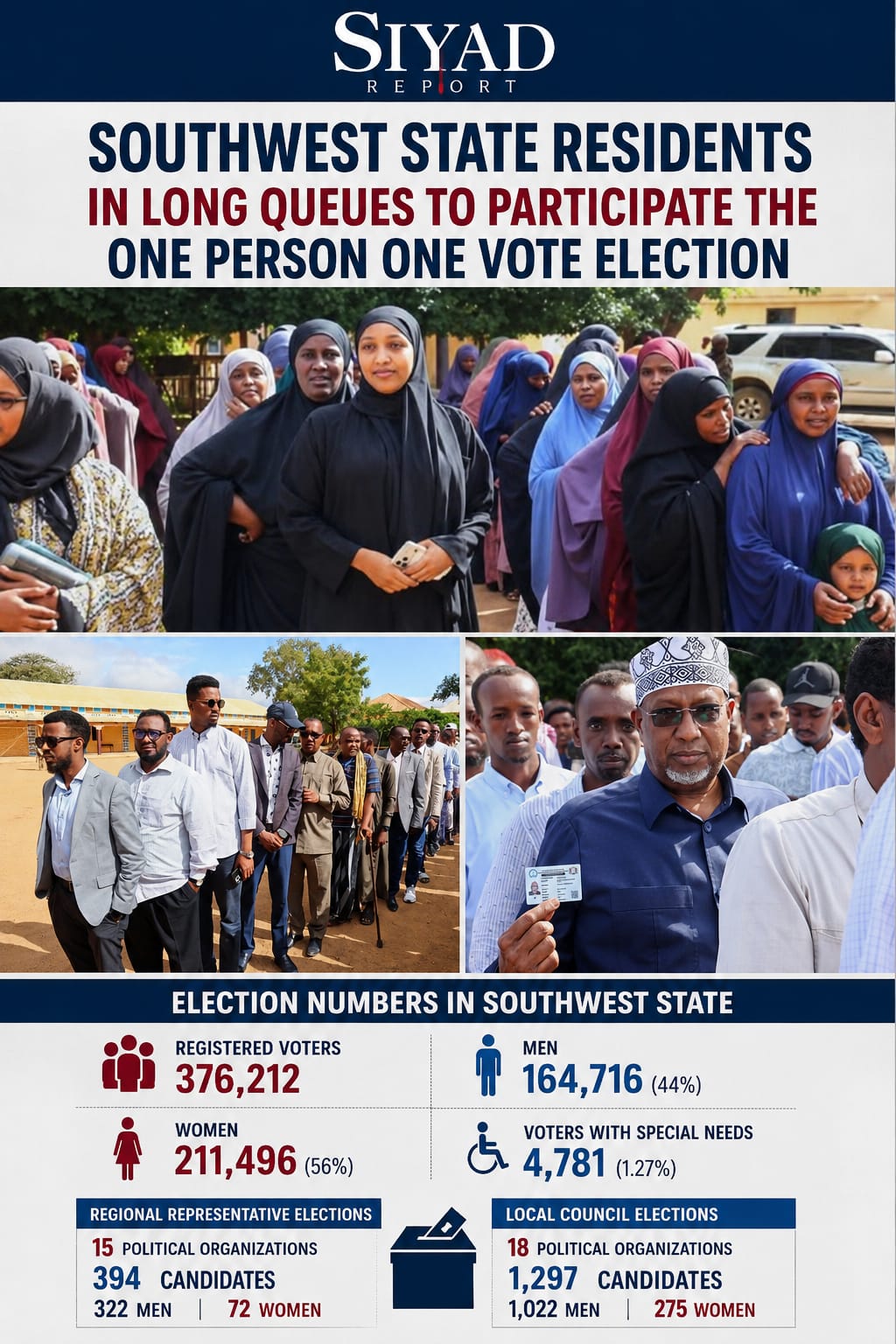
According to Somali election authorities, 376,212 voters were registered to participate in the elections. Of those registered, 164,716 are men, representing 44 percent of the electorate, while 211,496 are women, accounting for 56 percent of registered voters. Authorities also confirmed that 4,781 voters with special needs were registered, representing 1.27 percent of the total number of voters.
The elections are being held in the regions of Bay, Bakool, and Lower Shabelle under heightened security arrangements as Somali authorities attempt to ensure a smooth and peaceful voting process amid persistent security challenges facing the country.
Officials from the Somali government said security forces had been significantly reinforced around polling centers, roads, and strategic locations across the Southwest regional administration. The move reflects the importance of the elections and the sensitivity surrounding Somalia’s ongoing political transformation, particularly in a country that has spent decades struggling with instability, insurgency, and disputes over electoral systems.
The elections come at a time when Somalia is attempting to gradually move away from the indirect clan-based voting system that has dominated the country’s politics for years. Under the indirect model, clan elders and delegates selected lawmakers and leaders on behalf of communities, a process that critics argued excluded ordinary citizens from directly participating in governance and weakened democratic accountability.
For many Somalis, Sunday’s vote represented something larger than simply electing local representatives. It symbolized the possibility of ordinary citizens finally exercising political rights that generations had either never experienced or only heard about.
In several districts, long queues formed outside polling stations as residents waited patiently to vote. Election officials, local administrators, and observers monitored the process while security personnel maintained tight control around voting areas.
Somalia’s National Independent Electoral Commission stated that 15 political organizations are competing in the regional representative elections, with a total of 394 candidates contesting the seats. Among the candidates are 322 men and 72 women.
Meanwhile, 18 political organizations are contesting local council seats across the 13 districts designated for the elections. A total of 1,297 candidates are running for local council positions, including 1,022 men and 275 women.
The figures reflect a growing level of political participation within the regional state, particularly among women and younger voters, as Somalia attempts to build a more representative political system.
Government officials described the elections as a significant democratic exercise that could shape the future direction of governance in Somalia. Supporters of the process argue that direct elections can improve political legitimacy, increase accountability, and reduce the dominance of traditional clan power structures that have historically influenced Somali politics.
Speaking after casting his vote in Waajid district, Somalia’s Minister of Ports and Marine Transport, Abdulkadir Mohammed Nur expressed excitement over the process and emphasized the importance of citizen participation in the country’s democratic transition.
“I am delighted to have the opportunity to vote for the first time,” he said after participating in the local council and representative elections in Southwest State.
His remarks reflected the emotions shared by many voters who viewed the election as a rare and meaningful opportunity to directly influence leadership decisions within their communities.
In another symbolic moment during the elections, Sheikh Adan Mohamed Nur Madobe, commonly known as Sheikh Adan Madobe, also cast his vote in Southwest State and urged residents to participate responsibly in the democratic process.
“Elect the leader you believe can guide you to safety and salvation,” he told voters after casting his ballot.
His statement appeared aimed at encouraging citizens to focus on leadership qualities, governance, and public service during the elections rather than political divisions or clan affiliations.
The elections in Southwest State are being closely watched both inside Somalia and internationally because they could provide insight into whether Somalia is capable of successfully implementing broader universal suffrage elections in the future.
Somalia has for years struggled to fully establish a stable one-person, one-vote electoral system due to insecurity, political disagreements, logistical limitations, and tensions between the federal government and regional administrations. Several previous attempts at electoral reform faced delays and political disputes, often resulting in prolonged negotiations between political stakeholders.
Supporters of the current process argue that gradual regional-level elections could help build confidence and establish the institutional experience needed for nationwide democratic elections in the future.
However, the elections have not been without criticism and controversy.
Some opposition groups and political actors have previously raised concerns regarding the electoral framework, political environment, and inclusiveness of the process. Critics have argued that certain political stakeholders may not have been fully consulted during preparations for the elections, while others questioned whether the broader political environment guarantees fairness and equal competition.
There have also been concerns in some quarters regarding political tensions between federal authorities and opposition figures over the pace and structure of electoral reforms in Somalia.
Despite the criticism, federal and regional authorities insist that the elections represent a necessary and important step toward strengthening democratic institutions and increasing citizen participation.
Political analysts say the success or failure of the Southwest elections could have implications for future elections planned in other federal member states.
For decades, Somalia’s political system has largely revolved around clan power-sharing agreements, indirect representation, and elite negotiations. While those arrangements were initially designed to stabilize the country after years of civil conflict, many Somalis increasingly view direct elections as essential for building a more accountable and modern political system.
Young voters, in particular, have shown growing interest in political participation as Somalia experiences gradual changes in technology, media, civic awareness, and political engagement.
Across social media platforms, images and videos circulated throughout the day showing voters standing in queues, election workers organizing polling materials, and political supporters celebrating the voting process.
In Baidoa, one of the main centers of the elections, residents described the atmosphere as calm but highly emotional, with many people expressing hope that the elections could help improve governance, public services, and local representation.
Some voters said they viewed the elections as a chance to move beyond years of political uncertainty and instability.
Others stressed the importance of peaceful participation and national unity, particularly at a time when Somalia continues to face serious security and humanitarian challenges, including threats from the militant group Al-Shabaab, economic hardships, drought, displacement, and political divisions.
Security remains one of the biggest concerns surrounding any major political event in Somalia. Authorities therefore deployed additional security personnel to key areas in an effort to prevent disruptions or attacks targeting polling stations or election officials.
Government officials stated that the enhanced security measures were intended to reassure voters and guarantee the safety of the electoral process.
The successful opening of polling stations without major immediate incidents was viewed by many observers as a positive sign, although authorities continued monitoring developments throughout the day.
The elections also highlighted the growing role of women in Somalia’s political space. Women accounted for 56 percent of registered voters, according to election authorities, a figure many observers described as significant in a country where women have historically faced barriers to political participation and leadership representation.
Although male candidates still dominate the races numerically, the presence of hundreds of female candidates in both council and representative contests reflects gradual shifts in political participation and advocacy efforts aimed at increasing women’s representation in governance structures.
Civil society groups and democracy advocates have long pushed for broader political inclusion in Somalia, arguing that sustainable governance requires participation from all segments of society, including women, youth, and marginalized communities.
The inclusion of voters with special needs was also noted by election officials as part of efforts to make the electoral process more accessible and representative.
International partners and observers have repeatedly emphasized the importance of democratic reforms in Somalia as part of broader state-building efforts.
For Somalia’s leadership, the elections represent not only a political process but also an opportunity to demonstrate institutional progress and governance capacity to both domestic and international audiences.
As voting continued across Southwest State, expectations remained high regarding voter turnout and the overall conduct of the elections.
Many Somalis see the process as a test of whether democratic reforms can gradually take root in a country that has endured decades of conflict and political fragmentation.
The elections are also unfolding during a period of intense political debate nationally over Somalia’s future governance structure, constitutional reforms, and the balance of power between federal institutions and regional administrations.
In recent years, disputes over elections and political mandates have occasionally generated tensions between political leaders and opposition groups, raising fears of instability during transitional periods.
Because of this history, Sunday’s elections carried symbolic and political significance beyond Southwest State alone.
For some citizens, the process represented hope for a more inclusive political future. For others, it remained an experiment whose long-term success would depend on transparency, fairness, and political consensus.
Still, despite differing political opinions, the sight of ordinary citizens casting ballots directly was viewed by many as a notable moment in Somalia’s evolving political journey.
As the voting process progresses and eventual results emerge, attention will likely shift toward how the elections are managed, how disputes are handled if they arise, and whether the process strengthens confidence in Somalia’s democratic institutions.
For now, however, many residents across Southwest State appeared focused on the significance of participating in a process that only years ago would have seemed impossible in parts of Somalia.
Whether the elections ultimately become a turning point in Somalia’s democratic transition remains to be seen, but Sunday’s vote has already marked another important moment in the country’s attempt to redefine its political future through direct public participation.