

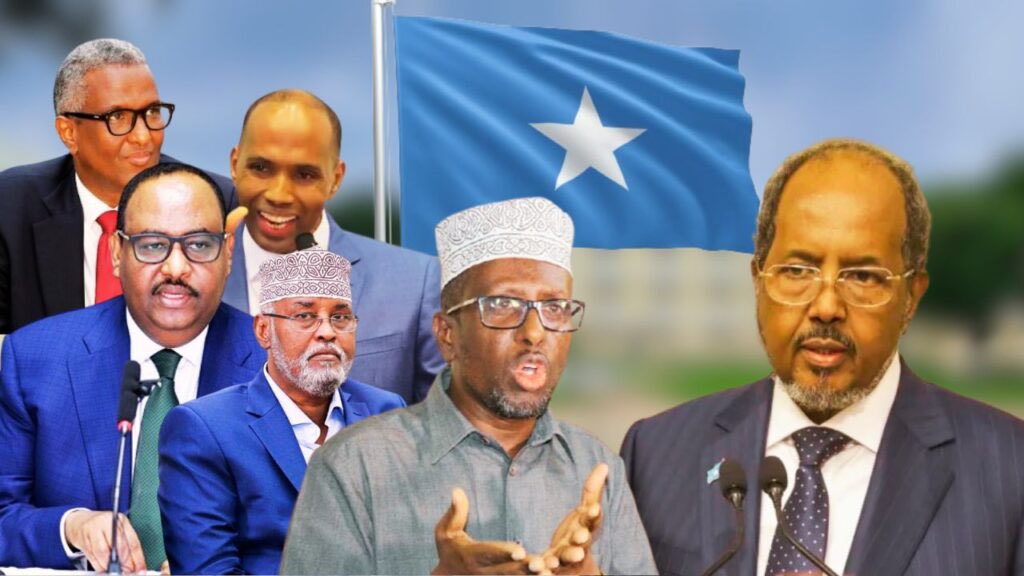
Mogadishu is once again becoming the center of Somalia’s political future.
The expected arrival of Puntland President Said Abdullahi Deni in the capital this week has intensified attention on a political confrontation that has been steadily building between the Federal Government led by Hassan Sheikh Mohamud and a coalition of opposition politicians and regional leaders who accuse Villa Somalia of pushing the country toward a dangerous constitutional and electoral crisis.
Behind the scenes, diplomatic pressure is mounting. International partners including the governments of Türkiye, United Kingdom, and the United States are now deeply involved in efforts to broker dialogue between the two sides, with meetings expected to take place inside the heavily fortified Halane compound near Aden Adde International Airport in Mogadishu.
The political atmosphere surrounding the talks reflects a country standing at a sensitive turning point. Somalia is attempting to transition from decades of indirect clan-based elections toward a universal suffrage system commonly described as “One Person, One Vote.” Supporters of the process argue that the country cannot continue recycling elite-driven political arrangements forever and that Somalia must eventually move toward a democratic system where ordinary citizens directly choose their leaders.
But opponents believe the current administration is moving too quickly, without national consensus, and using constitutional amendments to consolidate political power rather than genuinely democratize the country.
That disagreement now sits at the center of the Halane talks.
For the Federal Government, the political message is becoming increasingly clear: the constitutional amendments passed recently must become the foundation of the next electoral process. Villa Somalia appears determined not to reopen negotiations on whether Somalia should return to an indirect model. Officials close to the Presidency maintain that the transition toward direct elections is irreversible and represents the completion of a long-delayed state-building process.
From the government’s perspective, stepping back from the reforms would be politically damaging both domestically and internationally. It would also raise questions about whether Somalia’s leadership is capable of implementing difficult national transformations after years of promises about democratization.
Supporters of President Hassan Sheikh argue that Somalia cannot remain trapped in a cycle where a small group of delegates selected through clan structures repeatedly determine national leadership. They believe the indirect system has empowered corruption, entrenched political patronage networks, and prevented the emergence of accountable institutions.
To them, the current political confrontation is not simply about elections. It is about whether Somalia will finally evolve into a modern democratic state or continue operating under temporary political arrangements that were originally designed for post-conflict stabilization.
However, the opposition views the situation very differently.
Opposition politicians increasingly describe the current climate as dangerously similar to the tensions witnessed in 2021, when disputes over elections pushed Somalia to the brink of instability and armed confrontation in Mogadishu. Several opposition leaders argue that constitutional changes and electoral decisions cannot be implemented unilaterally without broad national agreement involving federal member states, opposition stakeholders, and civil society actors.
For them, the issue is not opposition to democratic elections in principle. Rather, they question whether Somalia currently possesses the institutional capacity, security environment, and political consensus required to hold credible nationwide one-person-one-vote elections.
Their concerns are not entirely without foundation.
Large parts of Somalia remain insecure due to the persistent threat posed by Al-Shabaab, which continues carrying out attacks across the country despite ongoing military operations. Organizing nationwide voter registration, establishing electoral infrastructure, and guaranteeing security in rural regions would represent an enormous logistical challenge even for stable states, let alone a country still rebuilding from decades of conflict.
The opposition therefore fears that the electoral transition could become selective, disputed, or politically manipulated if implemented without consensus mechanisms.
There is also growing anxiety among some regional administrations that the constitutional amendments may centralize power in Mogadishu at the expense of federal member states. Puntland in particular has emerged as one of the strongest critics of the current direction, accusing the Federal Government of undermining the federal system that was painstakingly negotiated over many years.
This is why Deni’s arrival matters politically.
His presence in Mogadishu potentially signals two simultaneous realities. On one hand, it shows that communication channels between Puntland and Villa Somalia have not completely collapsed despite escalating rhetoric. On the other hand, it demonstrates the seriousness of the current dispute, because Puntland would likely not engage directly unless the political situation had reached a critical stage.
Diplomatic actors now appear determined to prevent a deeper political fracture before tensions spiral further.
The choice of Halane as the venue is itself politically symbolic. The compound, protected by international security forces and home to many foreign embassies and international organizations, has often represented the center of international influence in Somali politics. For critics of foreign involvement, negotiations there reinforce perceptions that Somalia’s political direction remains heavily shaped by external actors. For supporters of the talks, however, Halane offers neutral ground where deeply divided Somali stakeholders can meet under secure conditions.
The involvement of Türkiye, the UK, and the USA also reflects growing international concern about the possibility of renewed political instability at a time when Somalia is facing multiple pressures simultaneously.
The country remains heavily dependent on international financial support, security cooperation, and development assistance. Prolonged political paralysis could affect donor confidence and slow down budgetary operations at a moment when Somalia’s institutions are already under strain.
There are also broader geopolitical calculations.
Türkiye has significantly expanded its influence in Somalia over the last decade through military cooperation, infrastructure projects, humanitarian engagement, and economic partnerships. The United States continues focusing heavily on counterterrorism cooperation against Al-Shabaab, while the UK has historically maintained strong diplomatic engagement in Somalia’s governance and security sectors.
None of these international actors appear interested in seeing Somalia slide back into open political confrontation.
Yet despite mediation efforts, major obstacles remain unresolved.
One of the biggest questions concerns the transitional timeline itself. The opposition fears that extending political mandates or altering constitutional timelines without consensus could undermine legitimacy and provoke wider resistance. Meanwhile, government officials argue that the reforms already approved through constitutional mechanisms provide sufficient legal foundation for the next phase of governance.
This legal-versus-political legitimacy debate may ultimately define the success or failure of the Mogadishu talks.
A decision can be constitutional on paper while still lacking broad political acceptance. Somalia’s modern political history repeatedly demonstrates that elite consensus often matters as much as legal frameworks. Agreements that exclude major stakeholders rarely survive for long, especially within fragile political systems where trust remains limited.
Another sensitive issue is whether President Hassan Sheikh himself will directly engage in face-to-face meetings inside Halane. Reports suggesting that Villa Somalia prefers alternative formats may indicate concerns about optics, protocol disputes, or fears that direct engagement under international mediation could be interpreted as political weakness.
At the same time, avoiding direct engagement could frustrate opposition leaders who want clear political commitments from the President himself rather than lower-level negotiators.
The talks are therefore not simply technical negotiations over electoral procedures. They represent a broader struggle over power, legitimacy, and the future structure of the Somali state.
For ordinary Somalis, however, the political tensions also carry a sense of exhaustion.
Many citizens increasingly worry that endless disputes among political elites are distracting attention from urgent national priorities including insecurity, unemployment, inflation, drought recovery, and economic hardship. There is growing frustration that political crises repeatedly dominate national discourse while social and economic challenges continue worsening across many parts of the country.
This frustration creates additional pressure on all sides to avoid another prolonged standoff.
If the Halane discussions succeed in producing even a limited political understanding, the outcome could reduce tensions and create space for gradual compromise on electoral arrangements and constitutional implementation. A negotiated roadmap balancing electoral reform with political consensus could potentially stabilize the transition period and reassure both domestic and international stakeholders.
But if the talks collapse, Somalia could enter a far more volatile phase.
A complete breakdown in dialogue risks deepening divisions between the Federal Government and regional administrations while emboldening opposition mobilization inside Mogadishu. Such an outcome could trigger institutional paralysis, increased political polarization, and renewed uncertainty surrounding the country’s electoral future.
The stakes are therefore exceptionally high.
What is unfolding in Mogadishu this week is not merely another political meeting. It is a test of whether Somalia’s leaders can manage disagreement through negotiation rather than confrontation. It is also a test of whether Somalia’s fragile federal system can absorb major constitutional and electoral disputes without destabilizing the country itself.
As political delegations gather in Halane and diplomatic mediators intensify consultations behind closed doors, Somalia once again finds itself balancing between opportunity and crisis.
The decisions made in Mogadishu over the coming days may shape not only the next election, but the direction of the Somali state for years to come.