

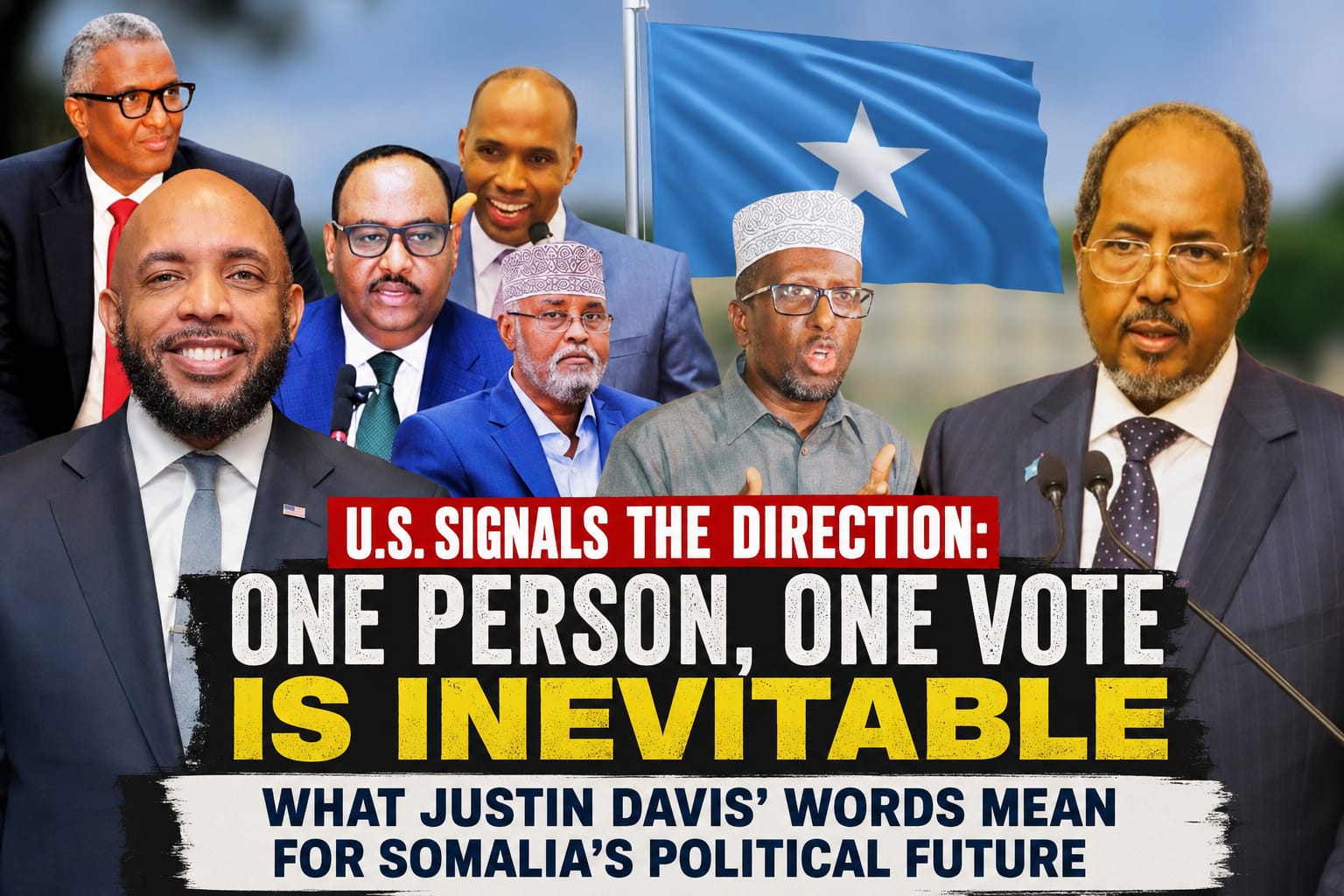
As Somalia enters another decisive political moment, remarks by Justin Davis have added a new layer of meaning to the already tense discussions taking place in Mogadishu between the Federal Government and opposition leaders.
“I think both sides agree that some form of direct elections is inevitable.”
“The future of Somalia is in the hands of the Somali people and its leaders.”
“The Somali people should choose their own leaders, and the specific process and timelines of elections are up to them.”
These words may appear diplomatic on the surface, but politically they carry enormous weight. They come at a critical time, just as Somalia’s political actors gather for high-level talks involving President Hassan Sheikh Mohamud, opposition figures led by former President Sheikh Sharif Sheikh Ahmed, and Puntland President Said Abdullahi Deni, who arrived in Mogadishu amid growing political tension over the country’s electoral direction.
The talks, taking place in the heavily fortified Halane area and supported by international partners including the United States, the United Kingdom, and Türkiye, are not just another political meeting. They are increasingly being viewed as a battle over Somalia’s political future: whether the country remains tied to the clan-based indirect electoral model or transitions toward a direct one-person-one-vote system championed by the federal government.
And in this debate, Justin Davis’ words matter.
The first and perhaps most important message from the U.S. diplomat is that Washington does not want to be seen as dictating Somalia’s internal political arrangements. For decades, Somali politicians and citizens alike have criticized foreign interference in Somalia’s governance process. The United States understands this sensitivity.
By saying “the Somali people should choose their own leaders,” Davis was carefully positioning America as a supporter of Somali-led consensus rather than an external enforcer of political outcomes.
But diplomacy often speaks in layers.
While Davis emphasized Somali ownership of the process, he also made something else unmistakably clear: direct elections are, in America’s view, the long-term destination for Somalia.
That single sentence “some form of direct elections is inevitable” may end up being the most politically significant message delivered ahead of the Halane talks.
The United States did not openly endorse President Hassan Sheikh Mohamud’s exact electoral roadmap or timeline. However, it effectively signaled support for the broader principle behind the government’s position: Somalia cannot remain permanently dependent on clan-based indirect voting systems.
This is a major political signal because the current disagreement between Villa Somalia and opposition actors is not necessarily about whether Somalia should eventually hold direct elections. Even many opposition figures publicly support the idea in principle. The real disagreement is about timing, trust, implementation mechanisms, constitutional legitimacy, and fears of political centralization.
The opposition camp, particularly Puntland and some federal member state leaders, argues that the country is not institutionally prepared for universal suffrage elections nationwide. They point to security concerns, incomplete constitutional processes, disputes over electoral laws, and fears that the federal government could dominate state institutions during the transition.
From their perspective, maintaining a clan-based negotiated model for now offers political balance and safeguards against what they see as possible overreach by the central government.
President Hassan Sheikh Mohamud’s administration, on the other hand, argues that Somalia has delayed democratic transition for too long. The federal government believes that continuing the indirect clan-based model weakens legitimacy, entrenches elite bargaining politics, and prevents ordinary Somalis from directly shaping leadership.
For Villa Somalia, one-person-one-vote elections are not simply an electoral reform; they are part of state-building itself.
Justin Davis’ statement therefore shifts the political atmosphere in an important way.
It does not eliminate the opposition’s arguments, but it weakens the opposition’s ability to frame clan-based indirect elections as a sustainable long-term alternative. If Somalia’s most influential international partner is openly describing direct elections as “inevitable,” then the diplomatic momentum begins leaning toward the federal government’s broader narrative.
That matters enormously because Somalia’s political negotiations rarely happen in isolation from international influence. International donors fund large parts of Somalia’s institutions, security architecture, stabilization programs, and electoral support mechanisms. Even when foreign governments insist on Somali ownership, their positions shape political legitimacy inside Somalia.
For the opposition, this creates a difficult political challenge.
If they strongly resist direct elections altogether, they risk appearing anti-democratic in the eyes of both the international community and many Somali citizens, especially younger generations who increasingly want a political system based on citizenship rather than clan quotas.
At the same time, if they fully embrace the government’s current roadmap without guarantees, they risk losing leverage and political influence within the evolving system.
This is why the opposition’s strategy ahead of the talks is likely to focus less on rejecting one-person-one-vote entirely and more on demanding conditions, safeguards, timelines, and consensus mechanisms before implementation.
The opposition will likely insist that any transition toward direct elections must be negotiated inclusively and constitutionally rather than imposed unilaterally.
That distinction is critical.
The Real Political Battle Is No Longer About “If” But “How”
Justin Davis’ remarks may have quietly transformed the political debate itself.
For years, Somalia’s electoral discussions often revolved around whether universal suffrage was realistic at all. But the U.S. message now suggests the international conversation is moving beyond that question.
The debate is increasingly becoming about how Somalia reaches direct elections, how quickly it happens, and who controls the transition.
This is politically advantageous for the federal government because it aligns the administration with the language of democratic inevitability and national progress.
President Hassan Sheikh Mohamud can now argue that even Somalia’s key international partners recognize that the country cannot indefinitely remain under the clan power-sharing model.
However, this does not necessarily mean the government has already “won” the political argument.
Somalia’s politics are rarely decided through rhetoric alone. Political trust remains extremely fragile. Federal member states still possess major influence. Security challenges remain serious in many parts of the country. Constitutional disputes remain unresolved. And perhaps most importantly, Somali political actors deeply fear exclusion from power.
The opposition still holds important leverage.
Puntland, for example, remains one of Somalia’s most politically influential federal member states. President Said Deni’s arrival in Mogadishu itself is significant because it signals willingness to engage rather than boycott entirely. That creates room for compromise politics.
Former President Sheikh Sharif also retains substantial political networks and influence. The opposition is therefore not entering the talks from a position of total weakness.
Instead, their leverage may increasingly come from demanding consensus-based implementation rather than outright rejection of democratic transition.
This is also where European mediators and other international actors enter the equation.
The United Kingdom, Türkiye, and broader European partners involved in supporting the talks are likely to adopt a more cautious balancing role than the clearer messaging coming from the U.S.
European states traditionally prioritize stability and negotiated compromise in Somalia. Their fear is not simply electoral delay, but political fragmentation or conflict triggered by disputed reforms.
That means European actors may privately support eventual direct elections while simultaneously encouraging gradual implementation, broad consultation, and power-sharing assurances.
In other words, while America’s position appears to lean more openly toward the inevitability of universal suffrage, European mediators may focus more on preventing political rupture during the transition.
This creates an interesting diplomatic dynamic.
Washington appears to be setting the strategic direction: Somalia should move toward direct elections.
European partners may focus more on managing the pace and ensuring the transition does not destabilize fragile political arrangements.
Türkiye, meanwhile, occupies a unique position because it maintains close relations with the federal government while also presenting itself as a trusted partner capable of dialogue with multiple Somali actors.
The Halane talks therefore become more than a domestic Somali political meeting. They represent a test of whether Somalia’s leaders can negotiate a democratic transition without pushing the country into another constitutional crisis.
Justin Davis’ words also reflect a broader international understanding about Somalia’s changing demographics and political mood.
A younger generation of Somalis increasingly questions the sustainability of the 4.5 clan power-sharing formula. Many urban youth believe the system empowers political elites while limiting merit-based politics and citizen participation.
This does not mean clan identity has disappeared from Somali politics far from it. Clan structures remain deeply influential socially and politically. But there is growing frustration among many Somalis who feel excluded from meaningful democratic participation.
The federal government has attempted to position itself as the political vehicle for this democratic aspiration.
The opposition, however, argues that democratic language alone is not enough. They fear that without strong institutions and trust-building mechanisms, rushed direct elections could simply concentrate power rather than distribute it fairly.
This is why today’s talks are so critical.
The real question is no longer whether Somalia should eventually democratize. The question is whether Somali leaders can agree on a pathway that balances democratic ambition with political stability.
Justin Davis’ remarks suggest the United States believes the direction is already clear.
But Somalia’s political history shows that agreeing on direction is often easier than agreeing on implementation.
The opposition now faces a strategic dilemma: resist too strongly and risk international isolation, or negotiate carefully and attempt to shape the terms of transition.
The government also faces risks. If it pushes too aggressively without sufficient consensus, it could deepen mistrust among federal member states and opposition actors, potentially triggering new political crises.
For ordinary Somalis watching these developments, the stakes are enormous.
This moment could either mark the beginning of a genuine democratic transition or become another chapter in Somalia’s long history of unresolved political disputes.
Justin Davis’ carefully chosen words were therefore not neutral diplomatic language. They were a signal a signal that the international community, particularly the United States, increasingly sees direct elections not as a distant dream but as Somalia’s political destination.
But as Somali leaders gather in Halane for talks that could shape the country’s future, the biggest unanswered question remains: can Somalia’s political class finally build a consensus around that destination before divisions once again pull the country into another political crisis?