

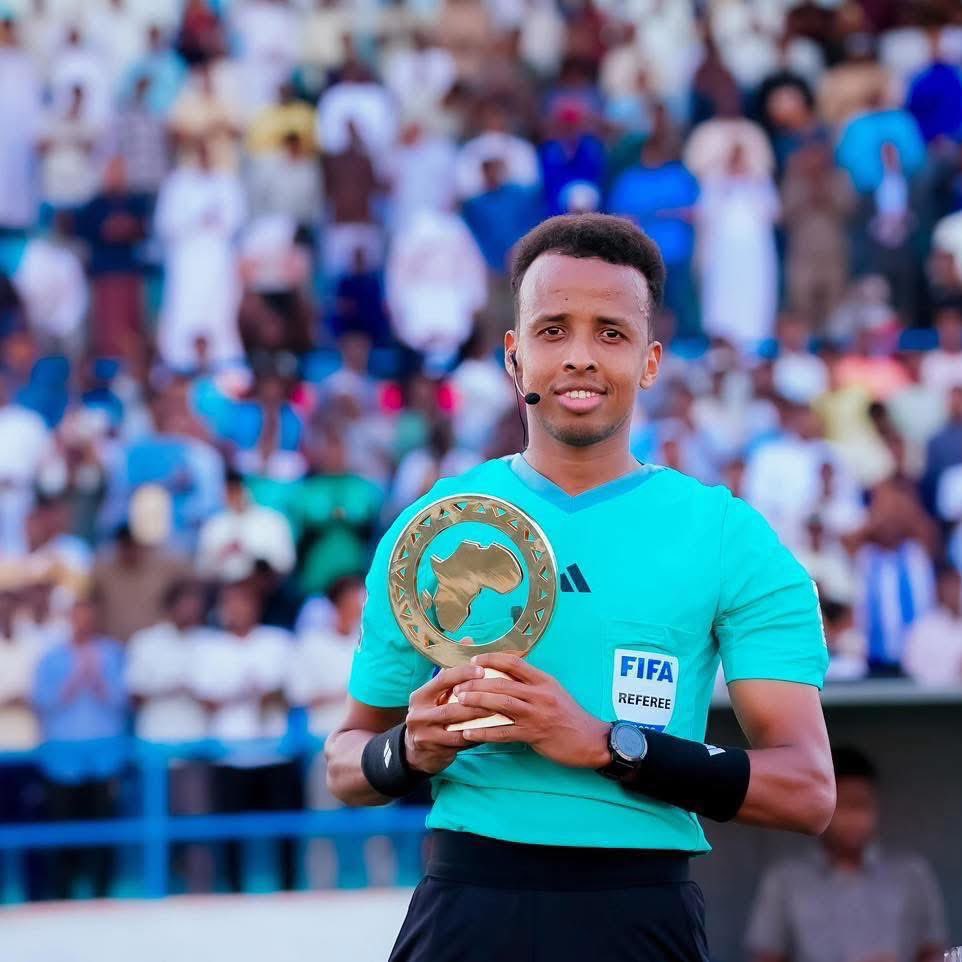
There are moments in a nation’s history that reveal far more than the event itself. They expose underlying realities, challenge long-held assumptions, and force difficult conversations that many would rather avoid. The recent case of Somali referee Omar Abdulkadir Artan is one such moment.For many Somalis, Omar Artan’s journey represented a rare story of hope.
Rising from the football pitches of Somalia to become one of Africa’s most respected referees, his appointment to the FIFA World Cup was not merely a personal achievement. It was a national milestone. It was proof that despite decades of conflict, instability, and hardship, Somali talent could still rise to the highest levels of global competition.Yet what should have been a moment of celebration quickly transformed into a moment of reflection and frustration. Instead of making history as the first Somali referee to officiate at a FIFA World Cup, Artan found himself at the center of an international controversy after being denied entry into the United States.
Regardless of the legal, diplomatic, or immigration factors involved, the symbolism was impossible to ignore. A man considered good enough for the world’s biggest football tournament suddenly became a reminder of the limitations imposed by one of the world’s weakest passports.The incident resonated far beyond football because many Somalis immediately recognized something familiar in the story.
Omar Artan’s experience was not viewed as an isolated event. Rather, it reflected a reality that countless Somali citizens encounter every day. Students accepted into prestigious universities abroad, entrepreneurs invited to international conferences, professionals selected for global fellowships, athletes competing on international stages, and ordinary citizens seeking opportunities overseas all face the same challenge. Their ambitions often extend beyond borders, but their passports do not always allow them to move with the same freedom enjoyed by citizens of many other nations.
A passport is often described as a travel document, but in reality it is much more than that. It is a reflection of a country’s diplomatic standing, institutional credibility, international partnerships, and global reputation. Strong passports are not built by chance. They are the result of decades of investment in governance, diplomacy, economic development, and international trust.
Weak passports, meanwhile, often reflect deeper structural challenges facing a nation.The Somali passport has consistently ranked among the least powerful travel documents in the world. While rankings alone do not define a nation, they do reveal an uncomfortable truth. The ability of citizens to travel, work, study, invest, and engage globally is often shaped by how their country is perceived internationally.
The consequences are not measured merely in visa applications or border controls. They are measured in missed opportunities, delayed dreams, and barriers that individuals must overcome simply because of where they come from.What makes Omar Artan’s case particularly significant is that he had already overcome the obstacles normally associated with success. He was not an unknown traveler. He was not seeking entry based on speculation or promise. He was a proven professional recognized by FIFA and respected across Africa.
His credentials were unquestionable. Yet even exceptional achievement could not entirely shield him from the realities attached to nationality and international mobility.
This raises a deeper and more uncomfortable question: what does it say about a country when one of its most accomplished citizens still finds himself constrained by the limitations of the state he represents?For years, Somalia has produced extraordinary talent despite extraordinary adversity. Across Africa, Europe, North America, the Middle East, and beyond, Somalis have distinguished themselves as doctors, academics, entrepreneurs, journalists, athletes, engineers, diplomats, and innovators. In refugee camps, remote villages, major cities, and international institutions, Somali success stories continue to emerge.
Yet there remains a troubling disconnect between the achievements of Somali citizens and the global reputation of the Somali state. In many respects, the people have moved ahead faster than the institutions that represent them. Somali youth continue to dream globally while their country struggles to establish a strong and stable international identity.This is where the conversation inevitably turns toward politics and leadership.
For more than three decades, Somalia’s political landscape has been dominated by recurring cycles of internal disputes, constitutional disagreements, election-related tensions, federal-state conflicts, and power struggles among competing political actors. While these debates are important in any evolving democracy, they have often consumed enormous amounts of national energy that could otherwise have been directed toward strengthening institutions, improving governance, attracting investment, and enhancing Somalia’s standing in the international community.
Too often, political success in Somalia is measured by short-term victories rather than long-term nation-building. Political leaders rise and fall, alliances shift, and rivalries intensify, but the ordinary Somali citizen continues to face many of the same challenges year after year. The result is a perception that political competition frequently takes precedence over national transformation.The consequences of this are not abstract.
They affect how the world views Somalia and, by extension, how Somalis are treated abroad.A nation’s global reputation is not built through speeches alone. It is built through consistency, stability, effective institutions, economic credibility, security cooperation, and professional diplomacy.
Countries that enjoy strong international standing have invested years building trust and confidence among their partners. Their citizens benefit from that investment every time they travel, study, work, or do business internationally.
Somalia’s challenge is that its political class has often struggled to create a coherent and compelling national story capable of replacing the narratives of conflict and instability that continue to dominate international perceptions. While progress has undoubtedly been made in many areas, the country still faces the burden of a reputation shaped by decades of crisis.As a result, ordinary citizens frequently pay the price.
The student applying for a scholarship abroad is affected. The entrepreneur seeking investors is affected. The journalist pursuing international training opportunities is affected. The athlete competing internationally is affected. The young graduate searching for global opportunities is affected.These individuals are not responsible for the historical and political challenges facing Somalia.
Yet they often bear the consequences.This is why Omar Artan’s experience struck such a deep emotional chord. It symbolized the frustrations of an entire generation. It represented the feeling that no matter how hard one works, certain barriers remain difficult to escape. It highlighted the gap between individual achievement and national reputation.
At the same time, however, the story should not be interpreted solely as a tale of failure. There is another lesson embedded within it.The fact that Omar Artan rose from Somalia to the highest levels of world football demonstrates the extraordinary resilience of Somali talent. His journey proves that excellence can emerge even under difficult circumstances.
It reminds young Somalis that their ambitions remain valid and their potential remains limitless.But talent alone cannot carry a nation forward. Individuals can inspire, but institutions must sustain progress. Heroes can break barriers, but governments must create systems that expand opportunities for millions, not just a fortunate few.
Ultimately, Omar Artan’s story is not simply about football. It is about citizenship. It is about diplomacy. It is about national image. It is about the relationship between a country’s leadership and its people. Most importantly, it is about whether Somalia can build a future in which its citizens are judged first by their abilities rather than by the limitations associated with their passport.
The disappointment surrounding Omar Artan’s World Cup journey will eventually fade. New headlines will emerge, new controversies will dominate public debate, and new political battles will capture attention.
Yet the questions raised by his experience will remain.Can Somalia build a stronger global reputation?Can its institutions earn greater international confidence?Can its diplomacy translate into greater opportunities for ordinary citizens?Can its political class focus less on power struggles and more on the long-term project of national renewal?
The answers to these questions will determine not only the future strength of the Somali passport but also the future opportunities available to millions of Somalis around the world.Because in the end, the true cost of a weak passport is not measured by rankings or statistics. It is measured by human potential.
It is measured by dreams delayed, opportunities restricted, and talented citizens forced to overcome obstacles they did not create.And that is why Omar Artan’s story matters.
It is not merely the story of one referee. It is the story of a nation still striving to ensure that the ambitions of its people are matched by the strength and credibility of the state they represent.