

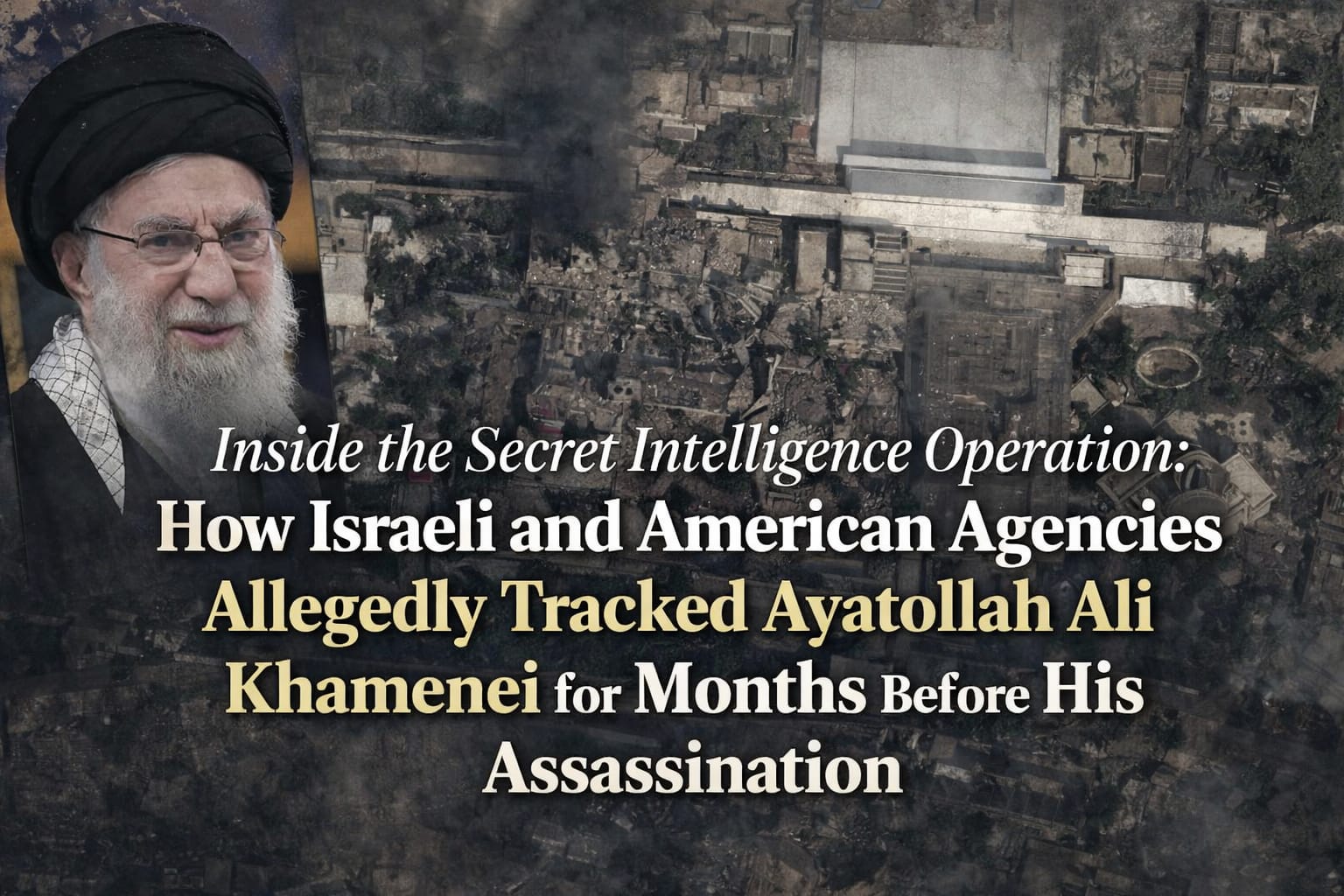
For months, according to reports cited by CNN and attributed to five individuals familiar with the matter, Israeli and American intelligence agencies had been quietly and methodically monitoring Iran’s Supreme Leader, Ali Khamenei. The operation, as described, was not sudden or reactive. It was deliberate, layered, and deeply strategic an intelligence campaign built on patience, surveillance, and the mapping of one of the most heavily protected political figures in the world.
At the center of these reports is a claim that agencies including Israel’s Mossad and the United States’ Central Intelligence Agency had been studying Khamenei’s daily patterns. That phrase “daily patterns” is far more significant than it first appears.
In intelligence language, patterns of life analysis is one of the most powerful tools in modern espionage. It involves tracking a target’s routines over extended periods of time: where they wake up, how they travel, who visits them, which rooms they use for meetings, how frequently they change locations, and what security adjustments are made under different threat levels. By compiling this data, agencies are able to predict behavior with increasing accuracy.
Khamenei, as Iran’s Supreme Leader since 1989, was not simply a political figure but the ultimate authority over Iran’s military, intelligence, and nuclear decisions.
Monitoring him would not only reveal his personal movements but also provide insight into the structure and rhythm of the Iranian state itself. His residences, for instance, are not ordinary homes. They function as fortified compounds with layered security, controlled perimeters, surveillance systems, and elite guard units.
To track such locations over time would require a combination of satellite imagery, signals intelligence, human sources, and potentially cyber penetration.
According to the sources cited, intelligence agencies were also focused on identifying the individuals he met with. In high-level intelligence work, knowing who meets a leader is often as important as knowing where he sleeps. Every visitor military commanders, nuclear advisors, political allies, or foreign envoys represents a node in a broader network. Tracking meetings helps agencies understand power dynamics, policy priorities, and emerging strategies.
If a particular commander begins visiting more frequently, it may indicate military planning. If certain advisors disappear from the rotation, it may signal internal shifts or purges.
Communication methods were reportedly another central focus of surveillance. For a leader like Khamenei, communication security is paramount. Sensitive discussions are unlikely to take place on ordinary phone lines. Instead, encrypted systems, trusted couriers, and secure facilities are typically used. Monitoring communication patterns does not always mean listening directly to conversations.
Often, intelligence agencies focus on metadata, who contacted whom, when, for how long, and from which locations. Even without hearing content, these patterns can reveal operational tempos and decision-making timelines.
Perhaps the most revealing detail in the reports is that agencies sought to identify where Khamenei might retreat under threat of attack. This suggests preparation for a worst-case scenario. Leaders of states in conflict zones often have contingency locations underground bunkers, alternate compounds, or undisclosed safe houses designed to preserve command continuity.
Identifying such fallback positions is among the most sensitive aspects of intelligence gathering. It requires either high-level human sources, cyber infiltration of classified planning documents, or prolonged surveillance capable of detecting unusual movement during crisis drills.
The alleged monitoring must also be understood within the broader geopolitical tension between Iran, Israel, and the United States. For decades, Israel has viewed Iran’s regional influence and nuclear ambitions as existential threats. The United States, while at times pursuing diplomacy, has also maintained economic sanctions, military deterrence, and covert pressure campaigns against Tehran.
Intelligence surveillance, therefore, would not necessarily mean immediate action. Often, such operations serve dual purposes: deterrence and preparation.
The concept of waiting for an “opportune moment,” as suggested in the reports, reflects the strategic patience characteristic of intelligence planning.
An opportune moment is not merely a window of vulnerability. It is a convergence of factors: geopolitical context, operational feasibility, minimized collateral risk, and calculated political consequences.
Decisions at this level would involve not just intelligence agencies but national leadership and military planners.
If the reports are accurate, the alleged assassination was not spontaneous. It would have been the culmination of months possibly years of layered intelligence collection. Every observation of residence, every mapped meeting, every intercepted signal would contribute to a detailed profile. Intelligence work often resembles assembling a vast puzzle.
Individual pieces may seem minor, a changed route, a new security detail, a delayed meeting. But over time, patterns emerge. Vulnerabilities appear not because security is weak, but because no system is perfectly unpredictable.
Such operations also highlight the evolution of modern espionage. Unlike earlier eras dominated solely by human spies, today’s intelligence ecosystem combines satellite surveillance, cyber operations, artificial intelligence analysis, biometric tracking, and advanced signal interception. Monitoring a figure like Khamenei would likely involve all these elements working in coordination. Cyber units might attempt to penetrate secure networks.
Satellite imagery analysts would track compound activity. Signals intelligence teams would map communication flows. Human sources could provide insight into internal movements.
However, it is crucial to recognize that reports citing anonymous sources represent one side of a highly complex story. Intelligence agencies rarely confirm operational details, especially regarding high-level surveillance. Governments may strategically leak information to shape narratives, send deterrent signals, or influence diplomatic positioning.
Therefore, while the reported details outline a plausible intelligence scenario, the full operational truth remains known only to those directly involved.
The broader implications of such alleged monitoring are profound. The targeted surveillance of a sitting Supreme Leader carries enormous risks. It can escalate regional tensions, provoke retaliatory measures, and alter the balance of deterrence. At the same time, intelligence agencies justify such operations as necessary for national security, especially when confronting adversarial states perceived as threats.
In analyzing the reported operation word by word, one theme stands out: control of information. Surveillance is ultimately about reducing uncertainty. By tracking residence, meetings, communications, and contingency plans, intelligence agencies aim to eliminate guesswork.
They seek to transform unpredictability into manageable risk. In conflicts where miscalculation can lead to regional war, information becomes both shield and sword.
The alleged months-long monitoring of Ali Khamenei illustrates the modern reality of geopolitical rivalry. Power struggles today are not fought solely on battlefields but in encrypted networks, orbital satellites, and shadowy intelligence corridors. Leaders operate behind layers of protection, yet remain subjects of relentless observation by adversaries.
In this environment, every movement can be studied, every pattern analyzed, every contingency anticipated.
Whether viewed as a strategic necessity or a dangerous escalation, the reported operation underscores a central truth of contemporary global politics: intelligence dominance shapes outcomes long before headlines announce them. Behind every public crisis lies an invisible contest of surveillance, prediction, and preparation.
And in that silent contest, patience measured not in days but in months or years—often determines the decisive moment.