

Ayatollah Ali Khamenei’s killing in reported U.S.–Israeli strikes has plunged the Islamic Republic into one of the most consequential transitions in its nearly five-decade history. As a 40-day national mourning period begins, the urgency of succession has overtaken the ritual solemnity of state grief. Iran’s political system meticulously engineered to preserve ideological continuity is now being tested in real time.
Abbas Araghchi, Iran’s foreign minister, told Al Jazeera that a new supreme leader could be chosen within “one or two days,” a strikingly swift timeline for a position that holds ultimate authority over the state’s political, military, and religious apparatus. Meanwhile, President Masoud Pezeshkian announced that a temporary leadership council “has begun its work,” signaling that constitutional mechanisms have been activated.
The speed of this transition matters. Iran is not merely selecting a political successor; it is choosing the guardian of its revolution. Since the 1979 overthrow of the monarchy, the Islamic Republic has replaced its supreme leader only once when Ruhollah Khomeini died in 1989 and Khamenei assumed the mantle. That precedent shapes everything unfolding today.
This moment is not just about personality. It is about ideology, power networks, generational change, and the balance between hardline continuity and cautious adaptation. The stakes stretch beyond Tehran affecting regional conflicts, relations with the West, and Iran’s internal stability.
How Iran Chooses a Supreme Leader: The Constitutional and Political Process
The selection of Iran’s supreme leader is governed by a hybrid system blending theology and politics. Constitutionally, the responsibility rests with the Assembly of Experts an 88-member body of Islamic scholars elected by the public every eight years. However, candidates for this body are vetted by the Guardian Council, itself partly appointed by the supreme leader, creating a circular reinforcement of ideological loyalty.
When a supreme leader dies, resigns, or is deemed incapable of fulfilling duties, the Assembly of Experts convenes. In theory, members deliberate over qualified clerics who meet specific criteria, religious scholarship at the level of ijtihad (independent reasoning in Islamic law), political wisdom, administrative ability, justice, and piety.
But in practice, the process is deeply political.
In 1989, when Ayatollah Khomeini died, the Assembly moved rapidly. Although Khamenei was not widely regarded as a top-ranking religious authority at the time, political consensus within the elite particularly the Revolutionary Guard and influential clerics propelled him into office.
The constitution was amended shortly thereafter to lower the religious threshold, effectively tailoring the requirements to legitimize his leadership.
Today’s situation could follow a similar pattern. The temporary Leadership Council reportedly includes senior jurists tasked with maintaining stability until the Assembly makes its final decision.
However, the Islamic Revolutionary Guard Corps (IRGC) the most powerful military and economic force in the country is widely believed to exert decisive behind-the-scenes influence.
Thus, the succession is less about open theological debate and more about elite alignment. The key question is: who can command the loyalty of clerics, the IRGC, and the political establishment simultaneously?
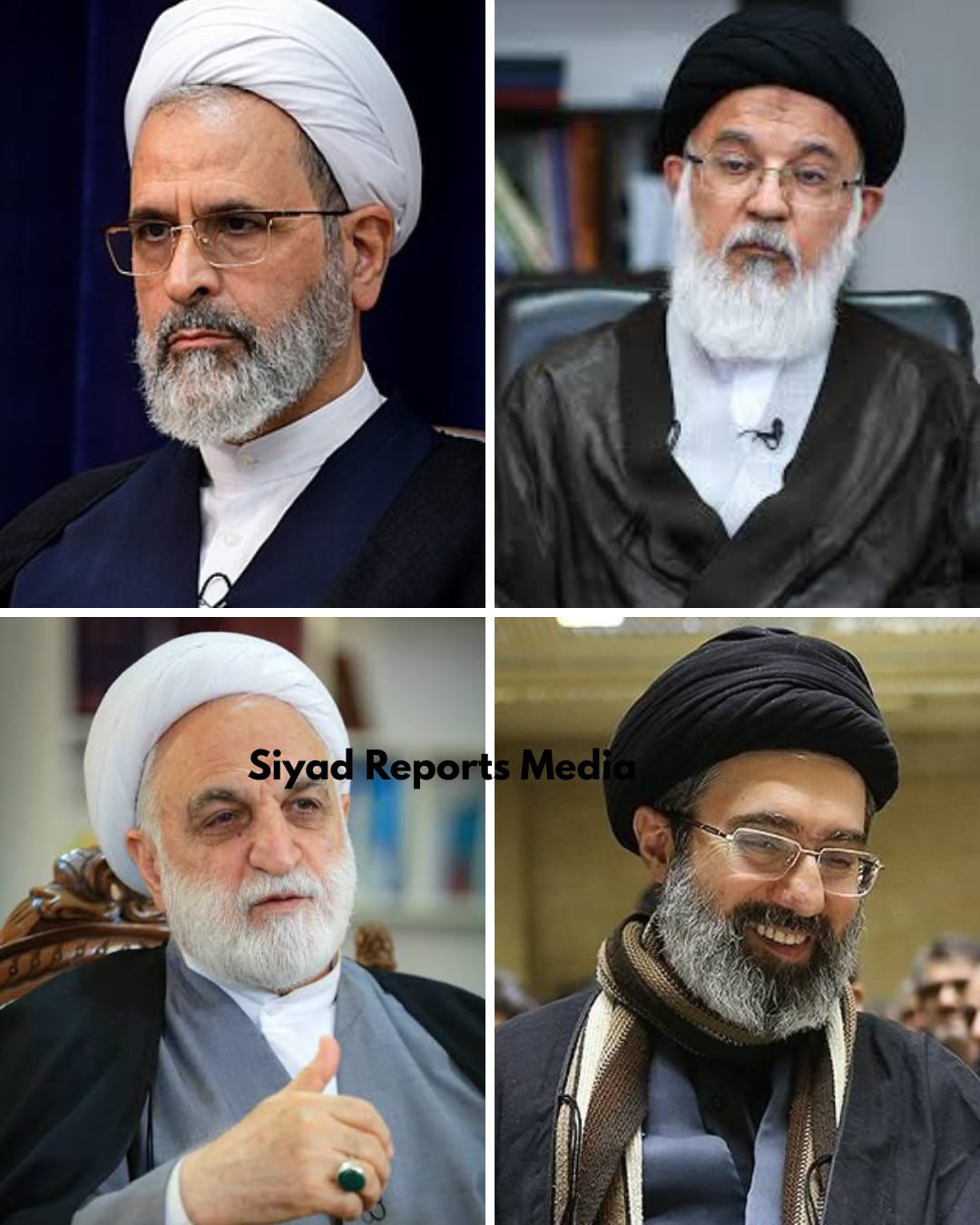
The Contenders: Ideology, Influence, and the Battle for Continuity
Mojtaba Khamenei
Mojtaba Khamenei, the second son of the late supreme leader, has long been rumored as a potential successor. Though he has never held formal public office, insiders describe him as deeply influential within both clerical circles and the IRGC.
His candidacy symbolizes continuity.
Those who favor stability amid regional conflict may see him as the safest option. He is believed to share his father’s hardline worldview and has reportedly played a quiet but strategic role in political maneuvering over the years.
Yet his lineage is both strength and weakness. The Islamic Republic was founded on opposition to hereditary monarchy. The 1979 revolution overthrew Mohammad Reza Pahlavi, whose rule symbolized dynastic power. A father-to-son succession risks evoking precisely what the revolution rejected.
If Mojtaba is selected, it would signal that power consolidation outweighs ideological symbolism and that the IRGC’s preference for continuity has prevailed.
Alireza Arafi
Alireza Arafi represents institutional legitimacy. A senior cleric, deputy chairman of the Assembly of Experts, member of the Guardian Council, and Friday prayer leader of Qom, he stands at the heart of Iran’s religious establishment.
His influence is rooted in the seminary system. As head of Iran’s clerical education network, Arafi shapes the ideological training of future religious leaders nationwide. His appointment as a jurist member of the temporary Leadership Council places him at the center of the current transition.
Unlike Mojtaba, Arafi’s candidacy would not raise dynastic concerns. However, he lacks widespread popular recognition and is not seen as a charismatic political figure. His selection would signal an emphasis on clerical orthodoxy over political dynamism reinforcing institutional continuity rather than dramatic change.
Mohammad Mehdi Mirbagheri
Mohammad Mehdi Mirbagheri is regarded as an ultra-hardline voice within Iran’s establishment. A member of the Assembly of Experts and head of the Islamic Sciences Academy in Qom, his worldview is sharply critical of Western influence.
Mirbagheri’s elevation would mark a decisive ideological hardening. He is associated with a confrontational posture toward the United States and Israel and advocates for deeper cultural resistance against Westernization.
However, his uncompromising stance could complicate diplomatic engagement and intensify regional tensions. While he may appeal to ideological purists, questions remain about his ability to unify diverse factions within the elite.
Gholam-Hossein Mohseni-Ejei
Gholam-Hossein Mohseni-Ejei currently heads Iran’s judiciary, appointed by Khamenei in 2021. With a background as intelligence minister and prosecutor-general, he is firmly aligned with the conservative wing.
Ejei’s profile blends security credentials with institutional experience. His leadership would likely emphasize internal stability and firm control, particularly amid external pressure.
Yet his image is closely tied to the security apparatus, which could limit his appeal beyond hardline circles. His candidacy suggests continuity with a security-first doctrine.
Hassan Khomeini
Hassan Khomeini, grandson of the revolution’s founder, embodies symbolic legitimacy. As custodian of his grandfather’s mausoleum in Tehran, he carries the revolutionary legacy in name and presence.
Unlike most other contenders, Hassan Khomeini is viewed as relatively moderate. He has expressed reformist tendencies and once sought membership in the Assembly of Experts but was disqualified by the Guardian Council.
His selection would send shockwaves through the political landscape, signaling openness to recalibration perhaps easing domestic tensions or reopening diplomatic channels. However, resistance from hardline factions could be fierce. The same institutions that disqualified him in the past would need to endorse him now.
The Deeper Stakes: Continuity or Transformation?
The next supreme leader will inherit a nation facing immense pressure: economic sanctions, regional confrontation, generational dissatisfaction, and ideological fatigue among segments of society.
The IRGC’s role cannot be overstated. Over decades, it has evolved from a revolutionary militia into a sprawling economic and military powerhouse. Any candidate must maintain its confidence.
At the same time, Iran’s youth born long after the 1979 revolution view governance through a different lens. The leadership transition presents a rare moment for recalibration. Whether the system chooses insulation or adaptation will shape Iran’s trajectory for decades.
If the Assembly moves within “one or two days,” as Araghchi suggested, it would demonstrate elite consensus. A prolonged process, by contrast, might expose fractures.
The Islamic Republic was designed to survive external shocks. Its founders embedded mechanisms to prevent power vacuums. Yet no constitutional clause can fully eliminate political uncertainty when a leader who ruled for more than three decades is suddenly gone.
Khamenei’s death marks the end of an era. His successor will define the next one determining whether Iran doubles down on revolutionary rigidity or cautiously navigates a changing world.
In the coming days, the Assembly of Experts will not simply select a cleric. It will choose the ideological compass of a nation whose influence stretches far beyond its borders.