

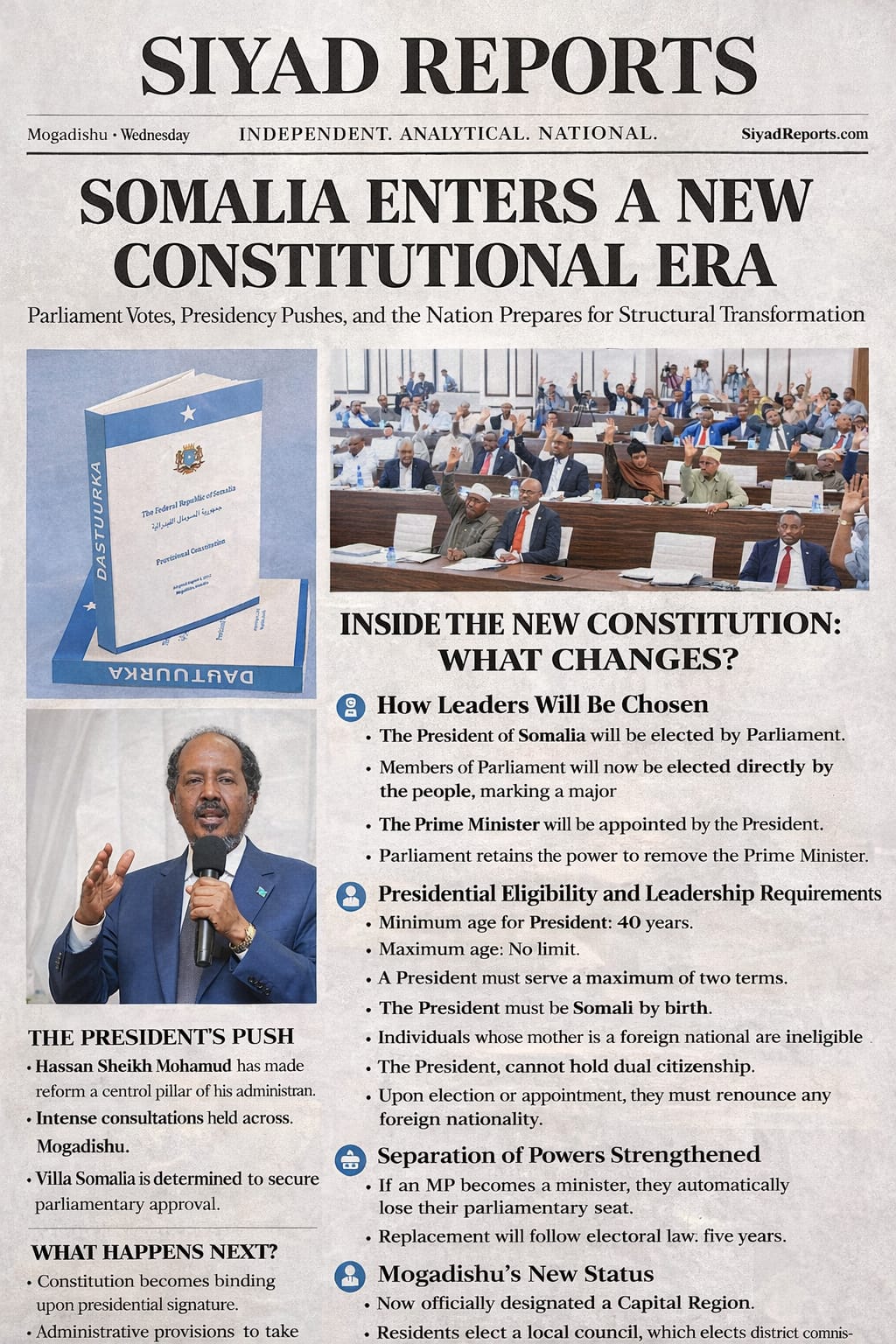
Somalia’s Federal Parliament has officially approved the country’s permanent Constitution after concluding an extensive review and amendment process covering Chapters 1 through 13, a move widely regarded as a historic step in strengthening state-building and consolidating federal governance.
In a joint session of both houses the House of the People and the Upper House lawmakers passed the Constitution by an overwhelming majority vote. A total of 223 members voted in favor, including 186 members of the House of the People and 37 senators from the Upper House.
The session was chaired by the Speaker of the House of the People, Sheikh Adan Mohamed Nur, who formally announced the results and declared that the Constitution had been legally enacted.
“The official Constitution of the Federal Republic of Somalia has been lawfully approved and will now come into force across the country,” the Speaker stated.
With this approval, Somalia officially moves beyond the Provisional Constitution adopted in 2012 and enters a new constitutional era aimed at strengthening democratic institutions, clarifying federal arrangements, and reinforcing institutional stability.
Key Provisions and National Implications
The newly approved Constitution introduces major structural, political, and governance reforms.
Under the new framework, the President of Somalia will continue to be elected by Parliament, while Members of Parliament will now be elected directly by the people, marking a significant step toward universal suffrage. The President will appoint the Prime Minister, and Parliament retains the authority to remove the Prime Minister from office. A President may serve a maximum of two terms, and the minimum age for presidential candidates is set at 40 years, with no maximum age limit.
The Constitution establishes strict eligibility requirements for top national leaders. The President must be Somali by birth, and individuals whose mother is a foreign national are not eligible. The President, Prime Minister, Speakers of Parliament, and Chief Justice are prohibited from holding dual citizenship and must renounce any foreign nationality upon election or appointment. These officials are also barred from having a foreign spouse.
In a move aimed at strengthening separation of powers, Members of Parliament who are appointed as ministers automatically lose their parliamentary seats, with replacements determined in accordance with electoral law. The official term of government institutions is set at five years, providing greater clarity and stability to electoral cycles.
Transparency provisions have also been strengthened. The President, Prime Minister, and the two Speakers of Parliament are required to declare their movable and immovable assets to the Auditor General following election or appointment.
The Constitution further defines the age of religious maturity at 15 years and legal responsibility at 18 years, while setting the minimum age for Members of Parliament at 25 and for ministers at 30.
One of the most significant administrative reforms concerns Mogadishu. The capital is now officially designated as a Capital Region under a hybrid governance structure. Residents of Mogadishu will elect a local council, which will in turn elect district commissioners and a Capital Council.
The Capital Council will elect the Mayor. Meanwhile, the Federal Government will appoint a senior official responsible for overseeing security and political affairs in the capital, while the Mayor will manage municipal administration.
Lawmakers described the vote as a defining moment in Somalia’s post-conflict reconstruction.
“This is a historic step forward for Somalia,” said Ali Mohamed Omar, State Minister for Foreign Affairs and a Member of the Federal Parliament. “The revised Constitution reflects significant progress in strengthening democratic institutions, clarifying the federal system, and moving beyond the provisional constitutional phase.”
The review and amendment process, which covered all 13 chapters of the Constitution, is seen as crucial in clearly defining the powers of the Federal Government and Federal Member States, enhancing good governance, and promoting institutional stability.
With parliamentary approval secured, the Constitution now enters into legal force. Administrative provisions are expected to be implemented in the coming months, including preparations for direct parliamentary elections and institutional adjustments required under the new framework.
The adoption of the permanent Constitution marks a major advancement in Somalia’s efforts to strengthen federalism, ensure long-term political stability, and rebuild national sovereignty after decades of political fragmentation.
For many observers, the vote represents more than a legislative milestone. It signals Somalia’s determination to consolidate its institutions and solidify the legal foundation of its federal republic.
Somalia now begins a new constitutional chapter one that will shape its political future for generations to come.