

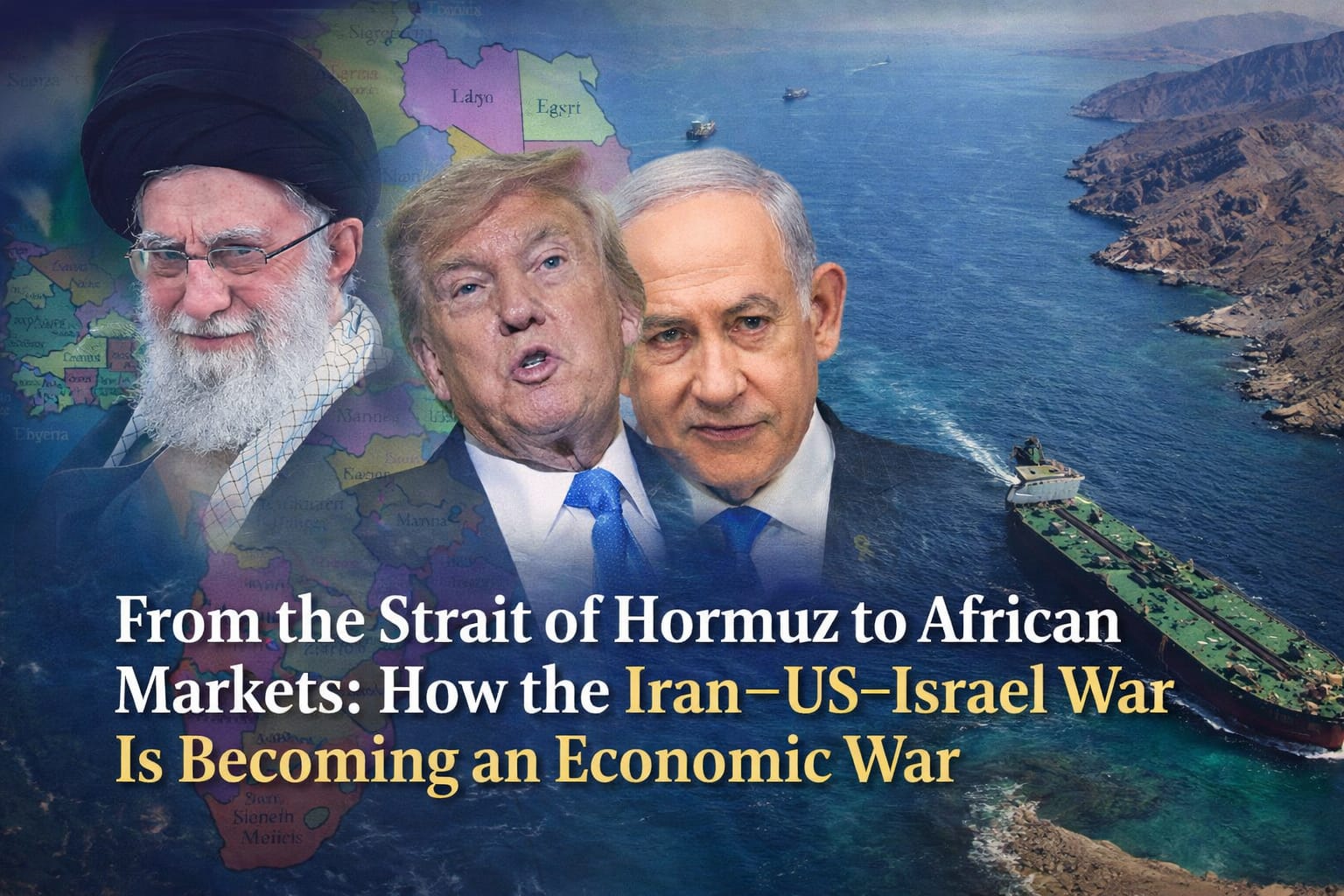
The war unfolding between Iran, the United States, and Israel is widely viewed through the lens of military confrontation missile strikes, air defenses, intelligence operations, and geopolitical alliances. Yet beneath the visible battlefield lies another conflict that may ultimately shape the outcome far more profoundly: an economic war whose consequences are spreading across global markets.
While military clashes dominate headlines, the deeper strategic contest is unfolding across energy markets, shipping corridors, supply chains, and financial systems. In this evolving conflict, oil tankers, maritime insurance rates, shipping routes, and commodity prices have become instruments of pressure just as powerful as fighter jets and missiles.
At the center of this economic battlefield lies one narrow but immensely important maritime passage: the Strait of Hormuz. This narrow corridor, located between Iran and the Arabian Peninsula, serves as one of the most critical energy arteries of the global economy. Nearly one-fifth of the world’s oil supply passes through it every day, making it indispensable to the functioning of modern industrial economies.
For decades, strategists and economists have warned that any disruption in the Strait of Hormuz could trigger severe economic consequences across the globe. Today, that warning appears closer to reality. As tensions escalate in the Middle East, the possibility of disrupted energy flows has raised fears of an economic shock that could ripple far beyond the region.
But the economic consequences of this war are not confined to the Gulf. From energy markets in Europe to consumer prices in Asia, and from shipping corridors in the Indian Ocean to food markets across Africa, the ripple effects are already spreading.
For African economies in particular, the stakes are enormous. Many African countries depend heavily on imported fuel, international shipping routes, and stable commodity markets. As the war transforms into a struggle over economic pressure, Africa finds itself indirectly drawn into the consequences of a conflict it is not fighting.
The emerging question is no longer simply who gains the upper hand on the battlefield. Instead, it is whether the war will reshape global trade patterns, energy markets, and economic stability and whether regions like Africa will bear the hidden costs.
Energy, Shipping Routes, and the Strategic Power of the Strait of Hormuz
To understand why the Strait of Hormuz sits at the center of the economic dimension of the war, one must first appreciate its global significance.
The Strait functions as a narrow maritime gateway connecting the oil-rich Persian Gulf to international markets. Major energy exporters including Saudi Arabia, Iraq, Kuwait, and the United Arab Emirates rely on this corridor to transport oil and liquefied natural gas to customers around the world.
Because so much of the global energy supply flows through a single chokepoint, the Strait has long been viewed as a strategic vulnerability. Even a temporary disruption could send shockwaves through the global economy.
In the current conflict, Iran possesses a unique form of leverage in this regard. While it may not match the military capabilities of the United States, its geographic position gives it the ability to threaten or disrupt maritime traffic through the Strait.
Such disruptions do not necessarily require a full blockade. Even the perception of risk can produce economic consequences. When shipping companies fear attacks or instability in a maritime corridor, they often respond by raising insurance premiums, delaying shipments, or rerouting vessels.
These reactions alone can drive up transportation costs and energy prices.
Oil markets are particularly sensitive to such developments. Because oil is traded globally, price fluctuations affect economies far removed from the original source of disruption. A sudden increase in oil prices raises transportation costs, manufacturing expenses, and energy bills across entire continents.
In this sense, control over energy routes becomes a powerful economic weapon.
For Iran, the strategy is straightforward: if direct military confrontation with stronger adversaries is difficult, increasing the economic cost of the conflict can alter the strategic balance. By threatening global energy supply routes, Tehran can pressure not only its military rivals but also the broader international system that depends on stable energy flows.
This dynamic explains why global markets react immediately whenever tensions escalate in the Gulf. Traders, investors, and governments understand that instability in this region can rapidly translate into higher energy prices and economic uncertainty worldwide.
Yet the economic consequences extend far beyond energy markets alone.
Shipping routes, insurance systems, and global logistics networks are also deeply affected.
When vessels face heightened risk in a particular region, shipping companies often seek alternative routes. One such alternative involves redirecting cargo vessels around the southern tip of Africa via the Cape of Good Hope.
While this route avoids the Gulf chokepoints, it dramatically increases travel distance and transportation costs. Cargo shipments that normally move through shorter routes suddenly require additional weeks at sea, raising fuel consumption and shipping expenses.
The result is a ripple effect across global supply chains.
Products take longer to reach markets. Shipping costs rise. Insurance premiums increase. Businesses pass these costs on to consumers.
Over time, these disruptions can translate into higher prices for everything from fuel and food to manufactured goods.
Africa at the Crossroads of a Global Economic Shock
Although Africa is geographically distant from the primary battlefield, the continent is deeply exposed to the economic consequences of the conflict.
One of the most immediate impacts is felt through energy markets.
Many African economies rely heavily on imported petroleum products. When global oil prices rise, governments and consumers across the continent experience the effects almost immediately.
Fuel subsidies become more expensive for governments to maintain, transportation costs rise, and inflation spreads through the broader economy.
Higher fuel prices increase the cost of transporting goods, operating machinery, and generating electricity. These rising costs often cascade through entire economic systems, eventually affecting the price of food and basic commodities.
For ordinary households, this translates into higher living costs and greater economic pressure.
But the consequences extend beyond energy alone.
Shipping disruptions caused by instability in the Middle East can also reshape trade patterns across the Indian Ocean. As maritime routes shift, African ports may experience increased traffic from vessels seeking alternative pathways.
This dynamic could bring both opportunities and challenges.
On one hand, increased maritime activity could strengthen the strategic importance of certain African ports and shipping corridors. Countries positioned along alternative routes may see new investments in logistics infrastructure, port facilities, and maritime services.
On the other hand, higher global shipping costs could place additional burdens on African import-dependent economies.
Africa’s food systems could also face pressure.
Agriculture across many African countries depends heavily on imported fertilizers, a significant portion of which originates from or passes through Middle Eastern production and trade routes. If shipping disruptions slow fertilizer supplies or raise prices, agricultural production costs could increase sharply.
This scenario would have serious implications for food security.
Higher fertilizer costs often translate into lower crop yields or higher food prices both of which can exacerbate existing economic vulnerabilities.
The war’s economic ripple effects therefore extend into everyday life across the continent, influencing everything from fuel prices at local petrol stations to the cost of food in urban markets.
Another dimension of the conflict involves geopolitical strategy.
As global powers adjust to instability in the Middle East, Africa’s geographic position becomes increasingly important. The continent sits at the intersection of several major maritime routes linking Asia, Europe, and the Americas.
This strategic location has already attracted the presence of multiple foreign military bases and international security partnerships, particularly in the Horn of Africa.
In a world where energy corridors and shipping routes are becoming geopolitical assets, Africa’s role in global trade networks may become even more significant.
Yet this strategic importance also carries risks.
If global tensions escalate further, competition among major powers for influence over maritime corridors and logistical infrastructure could intensify.
African governments may find themselves navigating complex diplomatic pressures as external actors seek access to ports, trade routes, and strategic locations.
In this sense, the Iran–US–Israel conflict is not merely a regional war.
It represents a broader geopolitical struggle in which economic leverage, energy security, and global trade networks play central roles.
For Africa, the challenge lies in managing the economic consequences while positioning itself strategically within the evolving global order.
The war may be fought thousands of kilometers away, but its economic shockwaves are already traveling across oceans and markets.
From rising fuel costs to shifting shipping routes, from fertilizer supply chains to geopolitical competition, the economic battlefield now stretches far beyond the Middle East.
And in that expanding arena, Africa stands at a critical crossroads both vulnerable to global shocks and increasingly central to the future architecture of international trade.