

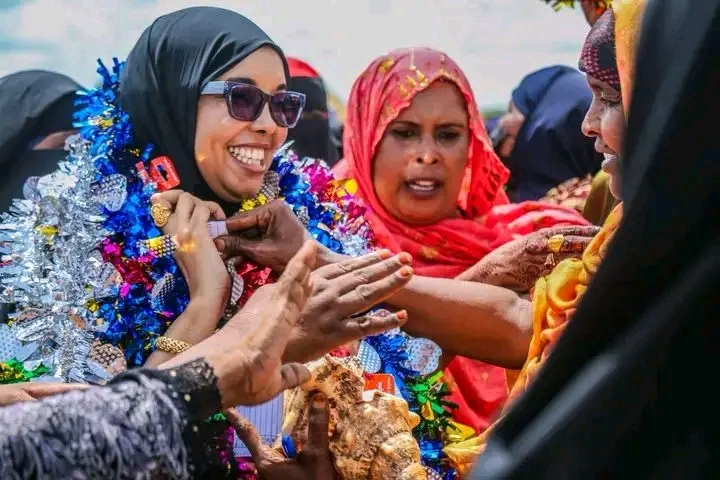
The sound of rotor blades cutting through the dry air of Habaswein on a quiet Saturday afternoon was impossible to ignore. For many residents, it was not just the arrival of a leader it was the arrival of expectation, long delayed and heavily anticipated. When Fatuma Jehow finally touched down in Wajir South constituency, the moment carried political weight far beyond the spectacle itself.
This was a visit that had been awaited for a long time, a rare physical presence of national leadership in a region that often feels peripheral to the centers of power. Yet what unfolded after that landing has sparked a deeper and more uncomfortable national conversation, one that goes beyond a single visit and into the very heart of leadership, responsibility, and the ethics of public resource use.
At first glance, the event itself might appear straightforward: the launch of a sanitary pads initiative and the issuance of a cheque worth one million shillings to Habaswein ward. On paper, these are interventions that fall squarely within the expected mandate of a Woman Representative. Access to menstrual hygiene products remains a critical issue in many marginalized regions of Kenya, and financial support to local communities is often welcomed in areas where resources are stretched thin.
But politics, especially in a place like Wajir South, is never just about what is done it is about how it is done, what it signals, and what it ultimately reveals about priorities.
The decision to hire a helicopter from Nairobi to Habaswein is where the narrative sharply shifts from routine constituency engagement to a matter of public scrutiny. In a country where the cost of chartering such aircraft can easily run into hundreds of thousands or even millions of shillings depending on distance and duration, the optics of such a choice cannot be separated from the realities on the ground.
Habaswein is not a constituency defined by abundance. It is a place where communities navigate drought, limited infrastructure, underfunded schools, and healthcare systems that are often stretched beyond capacity. In such a setting, every visible act of expenditure carries symbolic weight, and every symbol is interpreted through the lens of lived hardship.
Even if the helicopter was privately funded or sourced through means that do not directly draw from public development allocations, the perception remains politically significant. Leadership, particularly in public office, is as much about judgment as it is about legality.
The question that naturally arises among constituents is not only whether the funds were properly used, but whether the choice itself reflects an understanding of their realities. Could the same journey have been undertaken in a more modest way? Would a less costly approach have sent a stronger message of solidarity with the people on the ground? These are not trivial concerns they go to the core of what it means to lead in a region where inequality is not an abstract concept, but a daily experience.
The initiative to distribute sanitary pads, while undeniably important, further complicates this picture when viewed against the scale of the logistical investment. Menstrual hygiene is a serious issue, one that directly affects school attendance, health outcomes, and the dignity of young girls. Programs aimed at addressing it are both necessary and overdue in many parts of Kenya, including Wajir.
However, meaningful intervention in this space requires consistency, planning, and sustainability. A single launch event, no matter how well-intentioned, cannot substitute for a structured, long-term program that ensures continuous access, community education, and integration with local institutions such as schools and health centers.
This is where the imbalance becomes difficult to ignore. When a high-cost logistical operation culminates in a relatively modest intervention, the disparity between input and output becomes a legitimate subject of public debate. It raises questions about whether the focus was on maximizing impact or maximizing visibility.
In a political environment where leaders are constantly balancing service delivery with public image, the line between the two can easily blur, sometimes to the detriment of the very communities they are meant to serve.
The one million shilling cheque issued to Habaswein ward adds yet another layer to this unfolding discussion. While such an amount may seem substantial in isolation, its significance diminishes when considered in the context of an entire ward with thousands of residents and a wide range of needs.
Without clear communication on how these funds will be allocated, who will benefit, and what mechanisms will ensure accountability, such gestures risk being perceived as symbolic rather than transformative. In communities where development needs are both urgent and extensive, the scale of intervention matters just as much as the intention behind it.
What makes this moment particularly significant is not just the event itself, but the broader context in which it is taking place. Kenya’s political landscape is changing. Citizens are increasingly aware of how public resources are used, and they are more willing than ever to question decisions that appear misaligned with their priorities.
In regions like Wajir South, where historical marginalization has shaped public consciousness, expectations of leadership are evolving rapidly. People are no longer satisfied with occasional visits or one-off initiatives. They are demanding consistency, transparency, and a clear demonstration that their leaders understand and are committed to addressing their realities.
The Habaswein visit, therefore, becomes more than a local event. It becomes a case study in the politics of perception, a moment that forces both leaders and citizens to confront difficult questions about governance. What does responsible leadership look like in underserved regions? How should limited resources be prioritized? And perhaps most importantly, how can leaders ensure that their actions align not just with policy mandates, but with the lived experiences of the people they represent?
For Wajir South, these questions are not theoretical. They are grounded in everyday challenges that require thoughtful, sustained intervention. Access to clean water remains inconsistent in many areas, forcing communities to travel long distances or rely on unreliable sources. Infrastructure, particularly roads, continues to limit economic activity and access to essential services.
Schools face shortages of both resources and personnel, while healthcare facilities struggle to meet the needs of growing populations. In such an environment, development cannot afford to be episodic or symbolic it must be strategic and deeply rooted in local realities.
This is why the use of high-cost transport for a short, highly visible event has resonated so strongly with many observers. It highlights a tension that exists not just in Wajir, but across many parts of Kenya, the tension between political visibility and developmental substance. While visibility is an inevitable part of political life, it cannot come at the expense of meaningful impact. Leaders are not judged solely by the events they attend or the speeches they deliver, but by the tangible changes they bring to the lives of their constituents.
At the same time, it is important to recognize that moments like these also present opportunities. Public scrutiny, when approached constructively, can serve as a catalyst for better governance. For Fatuma Jehow, the reaction to the Habaswein visit offers a chance to engage more deeply with constituents, to clarify decisions, and to outline a more comprehensive vision for Wajir South.
Transparency in explaining the circumstances of the visit, the source of funding for the helicopter, and the long-term plans for development in the constituency could go a long way in addressing concerns and rebuilding trust.
Ultimately, the image of that helicopter landing in Habaswein will endure, not just as a moment in time, but as a symbol open to interpretation. For some, it may represent access and attention a sign that their constituency is not entirely forgotten.
For others, it may symbolize a disconnect between leadership and the realities on the ground, a visual reminder of priorities that seem out of step with pressing needs. In politics, symbols matter because they shape perception, and perception, in turn, shapes legitimacy.
As the dust settles and the conversations continue, one thing becomes increasingly clear: leadership in today’s Kenya demands more than presence. It demands alignment between action and need, between expenditure and impact, between promise and delivery. The people of Habaswein, like many across the country, are watching closely—not just what their leaders say, but what they do, how they do it, and why.
In that scrutiny lies a powerful reminder that public office is not just a platform for visibility, but a responsibility for stewardship. And in regions where every resource counts, stewardship is not optional it is the very foundation upon which trust, credibility, and meaningful development are built.