

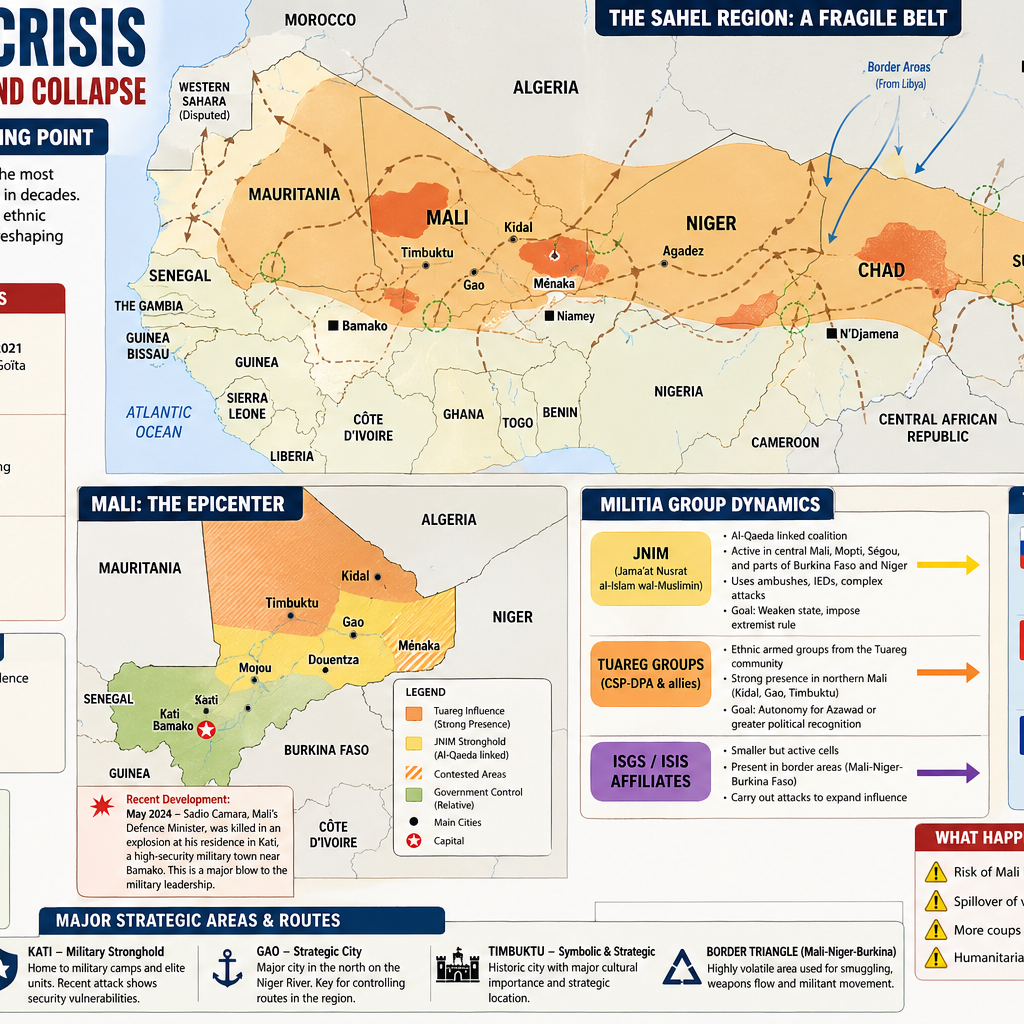
The crisis in Mali is not an event that started recently, nor is it a single war that can be explained in isolation. It is a long, layered collapse of a state that has been unfolding for more than a decade, shaped by rebellion, terrorism, repeated military coups, foreign intervention, and deep political failure.
To understand what is happening today in Mali where armed groups continue to challenge the state, where the military remains in power after coups, and where foreign actors still influence security decisions you must go back to the moment the country first began to fracture in 2012.
That year marked the breaking point.
Northern Mali erupted into rebellion led by Tuareg armed movements who had long felt excluded from political power and economic development in Bamako. The Tuareg are a historically nomadic people spread across the Sahara and Sahel regions, with a long history of resistance and autonomy struggles. In 2012, they launched an organized uprising under the National Movement for the Liberation of Azawad, demanding independence for northern Mali, which they refer to as Azawad.
At first, this was a political and ethnic rebellion. But the situation rapidly changed shape as the Malian state weakened. The national army, poorly equipped and demoralized, began losing ground. Within months, entire northern cities such as Gao, Timbuktu, and Kidal fell out of government control.
What transformed the conflict was the entry of extremist Islamist groups. These groups, some linked to al-Qaeda networks, were not interested in Tuareg independence. Their objective was ideological control, aiming to establish strict governance under their interpretation of religious law. As the state collapsed in the north, these groups quickly became dominant, sidelining the original separatist movement.
By 2013, Mali was effectively split: the north under militant control and the south under a fragile state struggling to survive.
This collapse triggered international alarm. France intervened militarily in 2013 under Operation Serval, later transitioning into a broader regional mission. French forces pushed militants out of major northern cities and temporarily stabilized key areas. However, while the intervention prevented the immediate collapse of the state, it did not resolve the underlying structural problems that had allowed the crisis to emerge.
Instead, the conflict evolved rather than ended.
Militants dispersed into rural areas, regrouped, and adapted into guerrilla-style warfare. Attacks shifted from territorial control to ambushes, roadside bombs, and targeted assaults on military convoys and government installations. Central Mali, previously considered relatively stable, became increasingly violent, with ethnic tensions and local militias adding new layers to the conflict.
At the political level, instability deepened.
The government of President Amadou Toumani Touré collapsed under pressure in 2012 when soldiers frustrated with the handling of the rebellion staged a coup. This marked the beginning of a recurring pattern in Mali’s political system: military intervention in response to perceived civilian failure.
Later, civilian rule returned, and Ibrahim Boubacar Keïta became president in 2013. His presidency was built on promises of restoring peace and rebuilding institutions. However, during his time in office, insecurity expanded rather than declined. Jihadist attacks increased, particularly in central Mali, while the government struggled with corruption allegations, weak governance, and loss of territorial control.
By 2020, public anger erupted into mass protests in Bamako. The protests were driven by frustration over insecurity, economic hardship, and perceived government incompetence. The military once again intervened, removing Keïta from power.
In 2021, another coup followed, this time consolidating military control under Colonel Assimi Goïta. Since then, Mali has been governed by a transitional military authority, with repeated delays in returning to full civilian rule.
This political instability did not exist in isolation—it was directly tied to the security crisis. As the state weakened, armed groups expanded. As armed groups expanded, political legitimacy weakened further. This created a feedback loop of collapse.
At the center of the armed conflict today is a complex network of militant organizations. One of the most significant is JNIM (Jama’at Nusrat al-Islam wal-Muslimin), an al-Qaeda-linked coalition formed in 2017 through the merger of several extremist factions operating in the Sahel. JNIM is not a single unified army but a decentralized network that operates across Mali and neighboring countries.
Its strategy is based on mobility and fragmentation rather than territorial governance in a conventional sense. It conducts coordinated attacks on military bases, uses ambush tactics against convoys, and gradually builds influence in rural communities where the state is absent or weak. In many areas, its presence is less about direct control and more about filling governance gaps left by the state.
Alongside JNIM, there are ISIS-linked factions and multiple local armed groups with shifting alliances. This creates a highly fragmented battlefield where loyalties change frequently and no single actor has complete dominance.
The Tuareg issue remains central within this wider conflict structure. While the original separatist movement fractured, Tuareg identity and political grievances have not disappeared. Some Tuareg groups signed peace agreements with the government, others continued armed resistance, and some have been absorbed into broader insurgent dynamics. The failure to resolve long-standing issues of political inclusion and regional development ensures that northern Mali remains unstable.
Foreign powers, shifting alliances, and the international dimension of the war
The crisis in Mali is deeply connected to foreign intervention and geopolitical competition.
After 2013, France remained the most visible external military actor in Mali through Operation Barkhane, deploying thousands of troops across the Sahel region in counterterrorism operations. The European Union also supported training missions for Malian security forces, while the United States provided intelligence support and logistical assistance.
Despite this long-term foreign military presence, the security situation did not stabilize. Instead, militant groups expanded into new regions, including central Mali and across borders into Burkina Faso and Niger.
Over time, public perception in Mali shifted. Many citizens and political actors began to view foreign military involvement as ineffective or politically intrusive. This sentiment intensified after repeated failures to fully eliminate insurgent groups.
By 2022, tensions between Mali’s transitional military government and Western partners escalated significantly, leading to the withdrawal of French forces. This marked a major turning point in Mali’s external relations and symbolized a broader shift in Sahel geopolitics.
Following France’s withdrawal, Mali moved closer to alternative security partnerships, including cooperation with Russia and Russian-linked security actors. This realignment reflected not only security needs but also political signaling, as military governments in the Sahel increasingly sought partners outside traditional Western alliances.
The result is a fragmented international environment where multiple external actors Western, Russian, and regional interact indirectly with Mali’s internal conflict, each with different priorities and methods.
Meanwhile, the United States maintains a more limited role focused on intelligence and counterterrorism coordination, without large-scale ground deployment.
This complex web of external involvement has not resolved the crisis but has instead added another layer to it.
The broader West African and Sahel region is now experiencing what can only be described as a systemic security breakdown. Mali is not alone. Similar patterns of military coups, insurgencies, and state weakening have emerged in Burkina Faso and Niger, forming a regional belt of instability.
In recent years, military coups have become increasingly common across this region. These coups are often justified by the military as necessary responses to failing civilian governments and worsening insecurity. However, they rarely resolve the underlying problems that lead to instability.
Instead, they create a cycle: civilian governments struggle with insecurity → military intervenes → transitional rule fails to stabilize the country → insecurity persists → further political breakdown occurs.
This cycle is reinforced by several structural factors. Weak state institutions, limited economic opportunities, corruption, rural marginalization, and the expansion of armed groups all contribute to a situation where governments struggle to maintain legitimacy.
In the Sahel, security has become the central measure of political legitimacy. When governments fail to provide security, they are quickly challenged, often by their own militaries. This explains why coups have become more frequent in Mali and neighboring states.
At the same time, insurgent groups like JNIM exploit these weaknesses, expanding their influence in areas where state presence is minimal. This creates a dual crisis: political instability at the top and armed fragmentation at the bottom.
In the latest and most dramatic escalation, the fragile balance inside Mali has been severely shaken by a new wave of coordinated attacks and a high-profile assassination that has sent shockwaves through the ruling military establishment.
Fighting that erupted recently has now entered its second consecutive day, with the Malian military still under the control of the post-2021 coup leadership facing what analysts describe as one of the most intense pressures in years. Reports indicate that large portions of territory, particularly in the north, have fallen into the hands of Tuareg fighters, while central and southern zones, including areas near the capital Bamako, have come under coordinated assault by JNIM.
One of the most significant and destabilizing developments in this latest phase of the conflict is the reported killing of Mali’s Defence Minister, Sadio Camara. According to emerging reports, the attack was carried out using a vehicle packed with explosives combined with suicide bombers who targeted his residence in the heavily secured military town of Kati, located roughly 15 kilometers from Bamako. Kati is not just any town it is the strategic heart of Mali’s military leadership and the base from which several coups were organized, making the breach particularly alarming.
The scale and sophistication of the attack have raised serious concerns about the security capabilities of the Malian state. That such an operation could be executed in one of the most fortified areas of the country signals a major intelligence and defense failure. It also reflects the growing operational strength of militant groups who are now capable of striking at the very core of power.
The death of Sadio Camara, if fully confirmed, represents more than just the loss of a senior official. He was widely viewed as a central figure within the military establishment and a potential future leader, given his prominent role in the coups of 2020 and 2021 and his influence within the armed forces. His assassination would therefore constitute a significant blow to the cohesion and morale of the ruling military leadership.
At the same time, President Assimi Goïta is reported to be alive and has been moved to a secure location, continuing to maintain command over the armed forces. However, the broader picture suggests a system under severe strain.
The current battlefield dynamics indicate a convergence of forces that were previously fragmented. Tuareg armed factions in the north and JNIM militants in central and southern regions appear to be operating under a form of strategic coordination, reportedly building on understandings reached in recent periods to align their efforts against the Malian military. This shift where previously competing or disconnected groups begin to synchronize their operations marks a dangerous new phase in the conflict.
The consequences of this escalation are profound. There is now a growing possibility, once considered unlikely, that Mali could become the first country where a group linked to al-Qaeda establishes dominant territorial and political control. While this outcome is not yet certain, the current trajectory of events has made it a serious concern among regional and international observers.
Equally significant is the apparent absence of immediate military support from neighboring countries such as Burkina Faso and Niger, both of which are also under military rule and have aligned themselves politically with Mali in recent years. Despite their shared stance against Western influence and their closer ties with alternative partners like Russia and China, there has been little visible intervention to support Mali in this critical moment.
This raises broader geopolitical questions. Mali’s pivot away from Western allies toward new partners was framed as a move toward greater sovereignty and more effective security cooperation. However, the current crisis is testing those assumptions. The inability, at least so far, of these partnerships to decisively stabilize the situation risks undermining the credibility of the new alignment and exposing the limits of external support in resolving deeply rooted internal conflicts.
The current unrest in Mali reflects this broader reality. While the state remains formally in control, repeated attacks by armed groups demonstrate the limits of its authority. The conflict is no longer a conventional war between two sides; it is a multi-layered struggle involving fragmented armed networks, political instability, and competing foreign influences.
What makes Mali’s situation particularly significant is that it represents a broader warning for the Sahel region, without strong institutions, inclusive governance, and sustainable security solutions, cycles of rebellion and coups are likely to continue.
The crisis is no longer just about Mali. It is about the future stability of West Africa as a whole.