

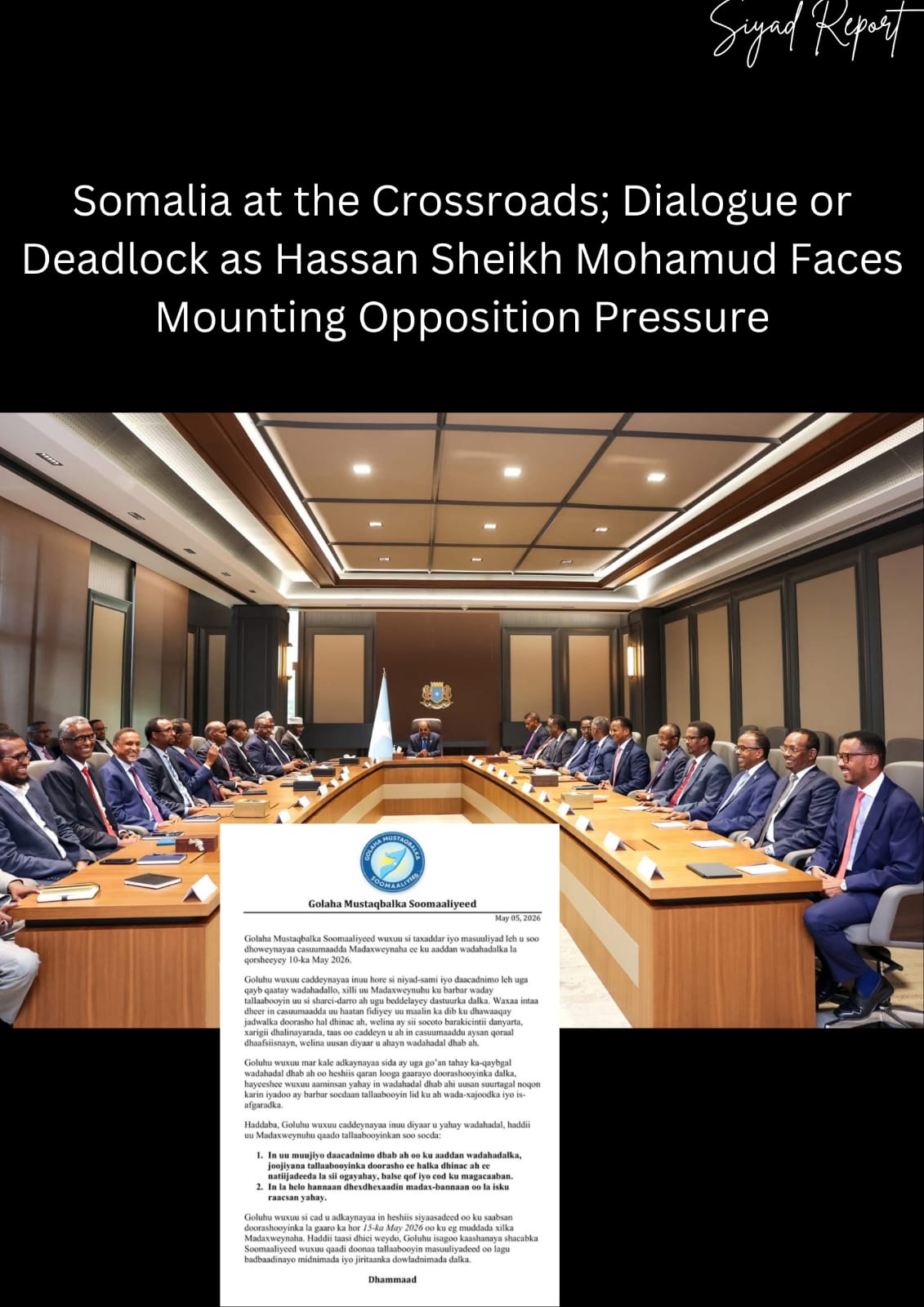
Somalia stands at a defining political moment. With the clock ticking toward May 15 the constitutional end of President Hassan Sheikh Mohamud’s four-year term the fragile balance between governance, legitimacy, and national stability is being tested in ways not seen in recent years.
The President’s invitation to the opposition alliance, the Somali Future Council, for a consultative meeting scheduled on May 10, arrives not as a routine political gesture, but as a high-stakes maneuver in an increasingly tense political environment.
This invitation, however, has not been received with optimism alone. Instead, it has triggered a sharp and calculated response from the opposition, exposing deep mistrust, unresolved disputes, and fundamentally different visions for Somalia’s electoral future.
The Council’s conditions halting unilateral electoral processes and establishing an independent mediation mechanism are not merely procedural demands; they reflect a broader struggle over legitimacy, power, and the direction of Somalia’s democratic evolution.
At the heart of this standoff lies a core question: can Somalia transition toward a stable, inclusive electoral system, or will political fragmentation once again undermine its progress?
To understand the gravity of the current moment, it is essential to revisit the recent past. Only months ago, the President and opposition figures engaged in dialogue aimed at resolving electoral disputes.
Those meetings, while initially promising, ultimately failed to produce a lasting consensus. The opposition entered those discussions in what it describes as “good faith,” but later accused the government of pursuing unilateral decisions that undermined the spirit of dialogue.
This pattern engagement followed by unilateral action has significantly eroded trust. In fragile political environments like Somalia, trust is not a luxury; it is the foundation upon which any meaningful agreement must be built. Without it, even the most well-structured negotiations risk collapsing under suspicion and competing narratives.
The timing of the President’s latest invitation has only intensified skepticism. Coming just one day after the announcement of a unilateral election schedule, the move is viewed by the opposition as contradictory. On one hand, the government calls for dialogue; on the other, it continues to push forward with decisions that have not been collectively agreed upon. For the Somali Future Council, this dual approach signals a lack of genuine commitment to consensus-building.
Their response is therefore strategic rather than reactionary. By setting clear preconditions, the opposition is attempting to redefine the terms of engagement. They are effectively saying: dialogue cannot be meaningful unless it is accompanied by actions that demonstrate sincerity.
This brings us to a deeper layer of the crisis the competing visions for Somalia’s electoral model.
The President and his allies have been advocating for a transition toward a “one person, one vote” system. In principle, this represents a significant democratic milestone. For decades, Somalia has relied on indirect electoral processes based on clan representation, where elders and delegates select leaders.
Moving toward universal suffrage would mark a historic shift, aligning Somalia with global democratic norms and potentially strengthening citizen participation.
However, the opposition is not convinced that the current conditions are suitable for such a transition. Their concerns are both practical and political. Practically, Somalia continues to face security challenges, institutional weaknesses, and logistical constraints that could undermine the credibility of a nationwide direct election. Politically, there is fear that the process, as currently designed, could be manipulated to consolidate power rather than expand democratic space.
Instead, the opposition appears to favor a more negotiated electoral model one that builds on existing frameworks and ensures inclusivity through consensus among key stakeholders. This is not necessarily a rejection of universal suffrage in principle, but rather a caution against its implementation under conditions that lack broad agreement and institutional readiness.
This divergence in electoral vision is not a minor technical disagreement; it is a fundamental clash over how legitimacy is constructed in Somalia’s political system. For the President, legitimacy may come from advancing democratic reforms and fulfilling a long-standing national aspiration. For the opposition, legitimacy must first be rooted in consensus and trust, without which any reform risks being perceived as imposed rather than embraced.
A Nation Between Reform and Risk
The May 10 meeting, therefore, is more than a diplomatic engagement it is a test of political will. Its success or failure will depend on whether both sides are willing to move beyond entrenched positions and engage in genuine compromise.
From the President’s perspective, agreeing to the opposition’s conditions would signal flexibility but could also be seen as a concession that weakens his reform agenda. Halting the electoral process and introducing an independent mediation mechanism would likely delay timelines and complicate implementation. Yet, it could also restore confidence and create a more inclusive pathway forward.
For the opposition, participating in the meeting without their conditions being met could risk legitimizing a process they fundamentally oppose. At the same time, outright rejection of dialogue could position them as obstructive, particularly in the eyes of the international community, which has consistently emphasized the importance of inclusive political processes in Somalia.
The role of external actors cannot be ignored in this context. Somalia’s political trajectory is closely watched by regional and international partners, many of whom provide critical financial and security support. These stakeholders are likely to favor stability and continuity, but also expect adherence to democratic principles. Their influence, while often behind the scenes, could shape the incentives and constraints facing both the government and the opposition.
As the May 15 deadline approaches, the pressure to reach an agreement is intensifying. The opposition has made it clear that failure to achieve a political settlement before the end of the President’s term will prompt “responsible steps” to safeguard the unity and existence of the state. While the specifics of these steps remain undefined, the language suggests a willingness to escalate if necessary.
This raises concerns about potential political fragmentation. Somalia’s history offers cautionary lessons about the consequences of unresolved disputes and competing claims to authority. While the current situation is far from those extreme scenarios, the risk of institutional paralysis or parallel political processes cannot be dismissed.
So, what are the chances that the May 10 meeting will produce a positive outcome?
The answer lies in the interplay of three key factors: trust, timing, and compromise.
Trust is currently in short supply, but not entirely absent. The fact that both sides continue to engage, even under strained conditions, indicates that dialogue remains a viable option. However, rebuilding trust will require tangible actions, not just rhetoric.
Timing is both a constraint and an opportunity. The looming deadline creates urgency, which can either drive agreement or deepen divisions. In some cases, deadlines force actors to make difficult concessions; in others, they harden positions as each side seeks to maximize leverage.
Compromise is the decisive factor. Without it, the meeting risks becoming another symbolic exercise rather than a substantive breakthrough. Compromise does not mean one side winning and the other losing; it means finding a middle ground that both can accept, even if it falls short of their ideal outcomes.
In practical terms, this could involve a phased approach to electoral reform one that acknowledges the goal of universal suffrage while addressing the opposition’s concerns about readiness and inclusivity. It could also include the establishment of a mediation mechanism that is acceptable to all parties, thereby providing a neutral platform for resolving disputes.
Ultimately, the current crisis is not just about elections; it is about the broader trajectory of Somalia’s state-building process. The choices made in the coming days will have implications far beyond the immediate political cycle. They will shape public trust in institutions, influence the country’s stability, and determine whether Somalia can move closer to a sustainable democratic framework.
For a nation that has endured decades of conflict and reconstruction, the stakes could not be higher. The path forward is uncertain, but one thing is clear: dialogue, if conducted with sincerity and backed by meaningful actions, remains the most viable route to a peaceful and legitimate resolution.
Whether the May 10 meeting becomes a turning point or another missed opportunity will depend not only on what is said at the table, but on what is done before and after it.