

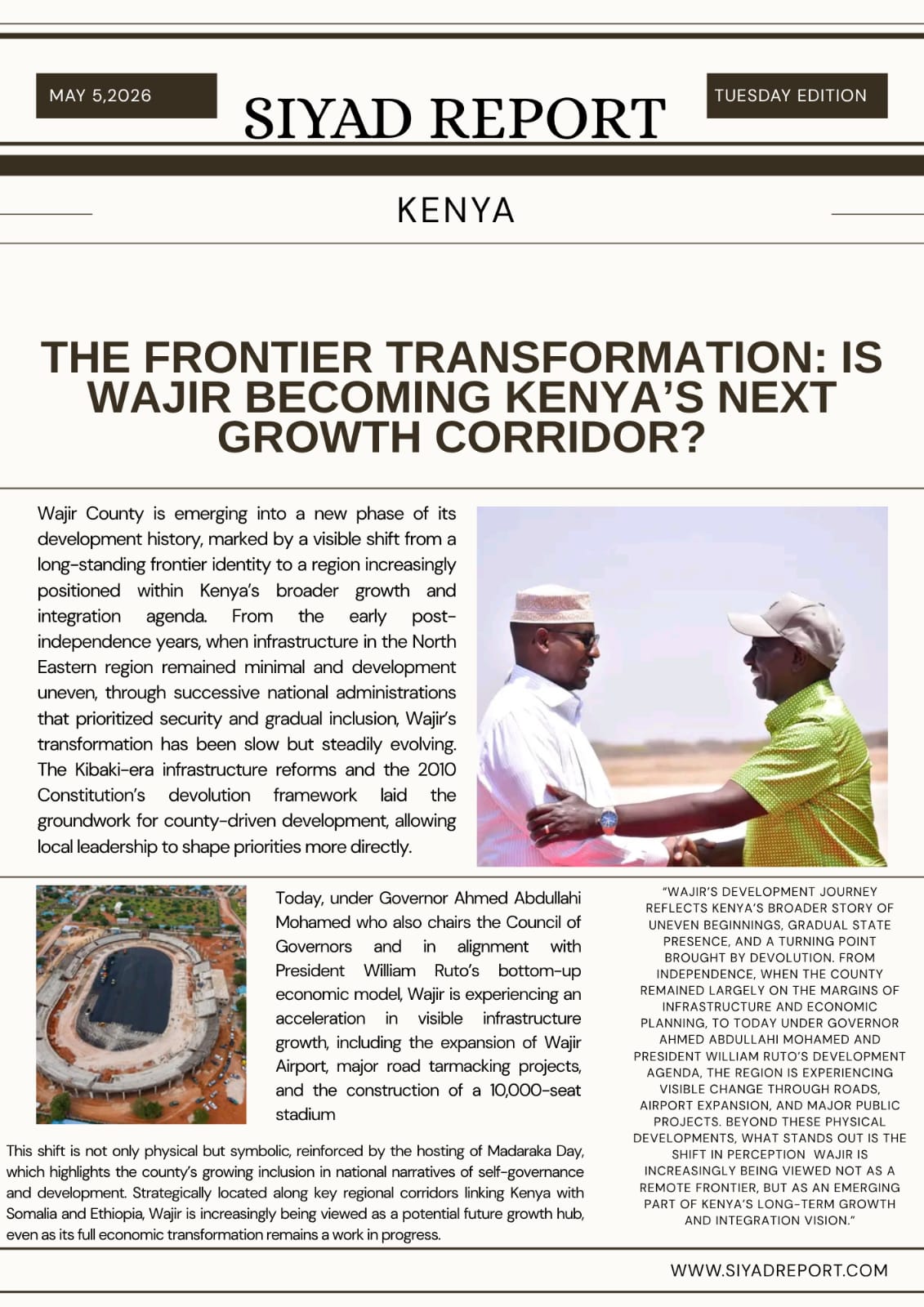
Introduction: From the Margins of Independence to the Center of National Conversation
When Kenya attained independence in 1963, the promise was not simply political freedom it was the creation of a united nation where development would reach every corner equally. Yet the geography of progress told a different story. Some regions inherited infrastructure, administrative systems, and economic momentum from the colonial state, while others began independence from almost zero development base.
Wajir County, located in Kenya’s vast North Eastern frontier, entered independence as one of the most structurally disadvantaged regions in the new republic. It was vast, strategic, and deeply important in terms of security and geography, but economically disconnected from the national growth engine. For decades, its identity in national discourse was shaped more by distance and climate than by opportunity or investment.
Roads were limited, health facilities were few, education access was minimal, and economic integration with the rest of Kenya remained weak. The state existed in Wajir, but often as administration rather than transformation.
Over time, this created a long-standing perception that Wajir was not just remote, but structurally outside the main development trajectory of the country.
Yet today, that narrative is beginning to shift in visible and symbolic ways. The expansion of Wajir Airport, the construction of major road networks, and the rise of large public infrastructure such as the 10,000-seat stadium signal something different. They represent not just government projects, but a change in how the Kenyan state imagines its northern frontier.
This year’s Madaraka Day celebrations in Wajir elevate this shift even further. Madaraka Day is not merely a public holiday it is a national reflection on self-governance and state-building. Hosting it in Wajir transforms the county from a peripheral observer of national history into a stage where that history is being publicly acknowledged.
It forces a deeper question: is Wajir still a frontier of delay, or is it becoming a frontier of transformation?
To understand this, we must move through time from independence, through successive national administrations, into the devolution era, and finally into the present moment under Governor Ahmed Abdullahi Mohamed and President William Ruto’s national leadership.
What emerges is not a simple story of progress, but a layered evolution shaped by policy shifts, governance changes, and changing national priorities.
Wajir at Independence and the Early State: A Frontier Defined by Distance, Not Development
At independence, Kenya inherited a deeply uneven development structure. The colonial economy had concentrated infrastructure and investment in agriculturally productive regions and administrative urban centers. Northern Kenya, including Wajir, was largely treated as a buffer zone strategically important but economically peripheral.
In Wajir, this meant that early independence years were defined by limited infrastructure. Roads were few and often seasonal. Connectivity to other parts of Kenya was difficult and unreliable. Economic activity was largely pastoral, shaped by livestock mobility rather than market integration. Government presence existed primarily in administrative form, with limited development expansion.
During the leadership of President Jomo Kenyatta, national development focused on consolidating the young state and expanding economic productivity in high-return regions. While this was a period of national stabilization, it also reinforced existing regional inequalities. Areas with agricultural and industrial potential advanced faster, while arid regions like Wajir remained structurally underdeveloped.
The result was not intentional exclusion in a simplistic sense, but a development model that did not yet prioritize spatial equity.
As Kenya transitioned into the era of President Daniel Arap Moi, governance became more centralized. The state strengthened its administrative control across the country, including in northern Kenya. In Wajir, this period saw increased presence of government structures, particularly related to security and administration.
However, development remained limited in scale. Roads expanded slowly, and investment in infrastructure remained modest. The region was often approached through a governance lens focused on stability rather than economic transformation.
For Wajir residents, this meant continuity rather than change the state was present, but development remained minimal. The region remained largely disconnected from the main economic circuits of the country.
Even as national politics evolved, Wajir’s structural position remained largely unchanged. It was part of Kenya, but not yet fully integrated into its development imagination.
Wajir in the Modern State: From Kibaki Reforms to the Devolution Era and the Slow Opening of the Frontier
A significant shift began during the administration of President Mwai Kibaki. His tenure introduced a reform-driven approach to governance, with infrastructure development becoming a central pillar of national policy.
Road construction and connectivity projects expanded across the country. Importantly, northern Kenya began to receive more attention within national infrastructure planning. Roads connecting previously isolated regions slowly improved, and government agencies began to engage more systematically with arid and semi-arid regions.
In Wajir, this period marked the beginning of structural opening. While change was not immediate or dramatic, it laid the groundwork for future integration. The idea that northern Kenya could be part of national economic planning started to gain traction.
However, the most significant structural transformation came with the 2010 Constitution and the introduction of devolution in 2013. This was a turning point not only for Wajir, but for Kenya as a whole.
Devolution fundamentally altered governance by transferring resources and decision-making power to counties. For Wajir, this meant local leadership could now define development priorities based on local realities rather than central allocation.
The first county administration under Governor Ahmed Abdullahi Mohamed focused on establishing the foundation of county governance. Systems had to be built from the ground up administrative structures, budgeting frameworks, service delivery systems, and basic infrastructure planning.
This was not a period of large visible transformation, but of institutional formation. Roads, water systems, and basic health and education infrastructure began to expand gradually. The county government became a visible actor in development for the first time.
The following administration continued this trajectory, focusing on strengthening internal connectivity and expanding public services. Roads improved, towns developed slowly, and administrative capacity increased.
However, development remained largely incremental. The transformation was real but gradual a process of building rather than accelerating.
It is within this context that the return of Governor Ahmed Abdullahi Mohamed in 2022 marks a new phase. This period is characterized not just by continuity, but by acceleration and strategic visibility. Large infrastructure projects have become central to the county’s development identity. Roads are being expanded at a faster pace, Wajir Airport is undergoing modernization, and major public infrastructure such as the stadium reflects a shift toward long-term urban and economic planning.
At the same time, national leadership under President William Ruto has introduced a development framework centered on bottom-up economic transformation. In this framework, historically marginalized regions like Wajir are no longer seen as peripheral, but as potential economic corridors.
This alignment between national and county priorities has significantly increased development momentum in the region.
Wajir Today: Governance, Development Acceleration, and the Politics of Inclusion
The current phase of Wajir’s development cannot be understood simply through infrastructure projects alone. It must be understood as a shift in governance philosophy, national integration, and regional positioning.
Governor Ahmed Abdullahi Mohamed, who also serves as the Council of Governors chair, occupies a unique position in Kenya’s governance landscape. His leadership is not only county-based but also nationally influential. This dual role has placed Wajir in a more visible position within national development conversations.
Under his administration, development has taken on a more coordinated and strategic form. The expansion of Wajir Airport is particularly significant, as it positions the county within regional air connectivity networks. Road infrastructure improvements are strengthening internal mobility and external connectivity. The stadium project reflects a broader investment in youth engagement, social infrastructure, and urban identity.
These developments are not isolated
they are interconnected elements of a broader transformation agenda.
At the national level, President William Ruto’s administration has emphasized infrastructure as a tool of economic inclusion. Northern Kenya has been framed as a key frontier in this strategy, particularly due to its geographic proximity to Somalia and Ethiopia. This positions Wajir not just as a county in Kenya, but as a potential hub in regional trade dynamics.
It is this convergence national policy direction, county leadership ambition, and geographic opportunity that has created the current wave of visible transformation.
Madaraka Day being hosted in Wajir is therefore not accidental. It is symbolic recognition of inclusion. It signals that the state is not only present in the region but is also willing to center it in national reflection.
For residents, this moment carries layered meaning. It represents progress, recognition, and visibility. But it also raises deeper questions about sustainability, long-term economic transformation, and the depth of change beyond infrastructure.
What is clear, however, is that Wajir is no longer in the same developmental category it once occupied. The nature of state engagement has shifted from presence to investment, from administration to development, and from isolation to integration.
The frontier is changing slowly, but visibly.
A Frontier in Motion, Not Yet a Finished Corridor
Wajir’s story is not a linear narrative of neglect followed by sudden transformation. It is a layered historical process shaped by national policy evolution, constitutional reform, county governance, and changing geopolitical priorities.
From independence to the present, the county has moved through distinct phases from marginalization, to administrative presence, to devolution-driven development, and now to accelerated infrastructure expansion.
Yet even in this moment of visible progress, Wajir remains a frontier in motion rather than a fully realized growth corridor.
The roads are expanding, the airport is growing, and the city is changing. But the deeper economic transformation industrialization, private sector anchoring, and diversified economic ecosystems is still developing.
What makes this moment historically important is not that Wajir has completed its transformation, but that it has entered a new phase of possibility.
Hosting Madaraka Day is therefore more than symbolic recognition. It is a statement of inclusion within Kenya’s national development story. It marks a shift in how the state sees its frontier not as a distant periphery, but as part of its future.
And in that shift lies the true meaning of the frontier transformation.
Wajir is no longer defined by distance from development. It is now defined by its movement toward it.