

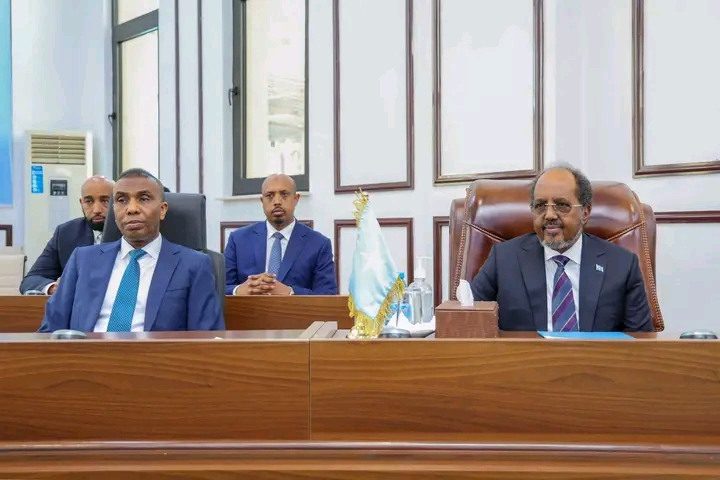
Despite recent political friction surrounding constitutional timelines and debates over the country’s future electoral direction, the administration of Hassan Sheikh Mohamud and Prime Minister Hamza Abdi Barre has, since taking office in mid-2022, overseen one of the most transformative periods in Somalia’s recent political and institutional history.
When the administration entered office, Somalia faced overlapping national crises. The country was emerging from a prolonged electoral standoff, worsening insecurity, strained federal-state relations, economic fragility, climate disasters, and international concerns over governance and stability. Public confidence in national institutions remained fragile, while the threat posed by Al-Shabaab continued to dominate both domestic and international security discussions.
Against that backdrop, the Hassan Sheikh–Hamza administration framed its mission around three central goals: reclaiming Somalia’s sovereign authority, restoring the country’s economic credibility, and accelerating the rebuilding of state institutions after decades of instability.
Four years later, supporters of the administration argue that Somalia has made undeniable progress in several key sectors, ranging from debt relief and diplomacy to security operations and institutional restructuring. Critics continue to raise concerns over political polarization, constitutional disagreements, and unfinished reforms, yet even many observers acknowledge that the government has presided over historic developments that may shape Somalia’s future for decades.
One of the administration’s most significant achievements came through Somalia’s successful completion of the Heavily Indebted Poor Countries Initiative process in late 2023. After years of economic reforms and negotiations involving multiple administrations, Somalia officially reached the HIPC Completion Point, resulting in the cancellation of approximately $4.5 billion in external debt.
For Somalia, this was more than just an economic milestone. It symbolized the country’s gradual return into the formal international financial system after decades of isolation caused by civil war, institutional collapse, and governance instability. The debt relief dramatically reduced Somalia’s external debt burden and reopened pathways to concessional loans, grants, and international development financing from institutions such as the World Bank, the International Monetary Fund, and the African Development Bank.
The administration described the achievement as the economic liberation of Somalia. Government officials argued that future generations would no longer remain trapped under unsustainable debt accumulated during previous decades. The debt relief also improved Somalia’s international financial credibility, strengthened investor confidence, and positioned the country for broader development partnerships.
Prime Minister Hamza Abdi Barre’s government additionally pushed financial management reforms aimed at modernizing procurement systems, improving transparency, and strengthening public institutions responsible for economic governance. The administration introduced regulatory and fiscal reforms designed to satisfy international financial benchmarks while gradually increasing state accountability mechanisms.
Security became the defining pillar of the administration’s domestic agenda. Shortly after returning to office, President Hassan Sheikh Mohamud declared what he called a “total war” against the militant group Al-Shabaab. Unlike previous offensives that were largely military-centered, the administration adopted a multi-dimensional strategy combining Somali National Army operations, international security cooperation, and community mobilization.
One of the most notable aspects of the campaign was the integration of local clan militias, particularly the Ma’awisley forces in central Somalia. These locally organized fighters became critical partners in operations across Hirshabelle and Galmudug, helping government forces reclaim territory that had remained under militant control for years.
The administration launched some of the largest coordinated military offensives Somalia had seen in more than a decade. Hundreds of villages and strategic towns were reportedly liberated during these operations, disrupting Al-Shabaab supply routes and weakening militant influence in several rural regions.
The government also invested heavily in strengthening Somalia’s international security partnerships. Military cooperation expanded with countries including the Turkey, the United States, the United Arab Emirates, and regional African partners supporting counterterrorism efforts.
Perhaps one of the administration’s most symbolic security victories came in late 2023, when the United Nations Security Council officially lifted the decades-long arms embargo on Somalia. For over 30 years, Somalia had faced restrictions limiting its ability to procure heavy weaponry for national defense purposes. The removal of the embargo represented a major diplomatic and sovereignty milestone for the Somali government.
Officials argued the decision reflected growing international confidence in Somalia’s institutions and its security transition process. For many Somalis, it symbolized the restoration of state legitimacy after decades during which the country depended heavily on external actors for security support.
The administration’s security record has also been visible inside the capital, Mogadishu. Once globally associated almost exclusively with bombings, checkpoints, and constant insecurity, Muqdisho has experienced visible transformation over recent years.
Although security threats still exist and Al-Shabaab continues to carry out attacks, many residents and observers note that Mogadishu today is considerably more stable than it was during previous decades. Businesses operate longer hours, new hotels and commercial buildings continue to emerge, diaspora investment has increased, and public spaces have gradually become more active.
Road connectivity, urban activity, and nightlife in parts of the capital have expanded significantly compared to the darkest years of insurgency and conflict. The government frequently points to Muqdisho’s changing atmosphere as evidence that Somalia is slowly reclaiming normalcy despite ongoing security challenges.
Diplomatically, the Hassan Sheikh–Hamza administration pursued an aggressive foreign policy aimed at restoring Somalia’s regional and international influence. One of the government’s major diplomatic victories was Somalia’s formal admission into the East African Community as the bloc’s eighth member state.
The move carried major political and economic significance. Membership in the EAC opened opportunities for regional trade integration, labor mobility, infrastructure cooperation, and expanded diplomatic influence within East Africa. Somali citizens also gained broader regional mobility opportunities through the bloc’s frameworks.
The administration additionally repaired previously strained diplomatic ties with key regional partners, particularly the Kenya and the United Arab Emirates. Relations with both countries had deteriorated under earlier political disputes, affecting trade, travel, and diplomatic cooperation.
Under the current administration, direct flights resumed, investment discussions intensified, and bilateral engagement improved significantly. Somali officials viewed these restored relationships as strategically important for regional stability, trade, and economic growth.
Domestically, the administration also attempted to reinforce national unity and federal authority. President Hassan Sheikh Mohamud’s visit to Laascaanood became historically symbolic, marking the first official visit by a sitting Somali national leader to the city in decades. Supporters described the visit as an important assertion of national sovereignty and unity during a sensitive political period in northern Somalia.
Prime Minister Hamza Abdi Barre’s government simultaneously focused on long-term state planning and institutional restructuring. One of the administration’s major governance frameworks became the National Transformation Plan (NTP-1), designed to replace previous transitional development frameworks with a more structured national strategy.
The administration also established Tubsan, Somalia’s national center for countering violent extremism. The institution was intended to create systematic rehabilitation and reintegration pathways for former combatants while supporting broader deradicalization programs and public safety initiatives.
Economically, Somalia’s recovery remains fragile, yet the administration has frequently highlighted improving macroeconomic indicators despite severe climate shocks, global inflation pressures, and fluctuating foreign aid support.
According to international financial assessments, Somalia’s GDP growth improved gradually, supported by private sector resilience, strong diaspora remittances, telecommunications growth, and recovering agricultural production following difficult drought periods.
The private sector, long considered Somalia’s economic backbone, continued expanding in sectors such as construction, telecommunications, transport, finance, and digital payments. Muqdisho in particular witnessed increasing business investments, infrastructure projects, and real estate development during the administration’s tenure.
Still, major challenges remain. Unemployment, poverty, insecurity, climate vulnerability, and dependence on external assistance continue to affect millions of Somalis. Critics argue that while macroeconomic progress is visible at institutional levels, ordinary citizens still struggle with rising living costs and limited economic opportunities.
Politically, the administration’s final years are increasingly overshadowed by constitutional tensions and debates over electoral reforms. Opposition groups and some regional actors have raised concerns regarding the timing and implementation of constitutional amendments, particularly around questions of governance structures and future elections.
Supporters of the administration argue that Somalia cannot indefinitely remain under temporary political arrangements and that constitutional completion is necessary to stabilize state institutions. Critics, however, insist that major constitutional changes require broader national consensus to avoid political fragmentation.
Despite these tensions, the Hassan Sheikh–Hamza administration has undeniably overseen a period of major state activity across security, diplomacy, finance, and governance. Supporters view the administration as one that restored momentum to Somalia’s reconstruction process after years of stagnation and political uncertainty.
Whether history ultimately judges this administration as transformational or incomplete may depend largely on what happens between now and beyond. The success of ongoing security operations, the sustainability of economic reforms, the handling of constitutional disputes, and the government’s ability to maintain political cohesion will all shape the final legacy of Hassan Sheikh Mohamud and Hamza Abdi Barre.
But four years into office, one reality remains increasingly difficult to ignore: Somalia today is politically louder, diplomatically more engaged, financially more connected, and institutionally more ambitious than it was in 2022 even as the country continues navigating the difficult road between recovery and lasting stability.