

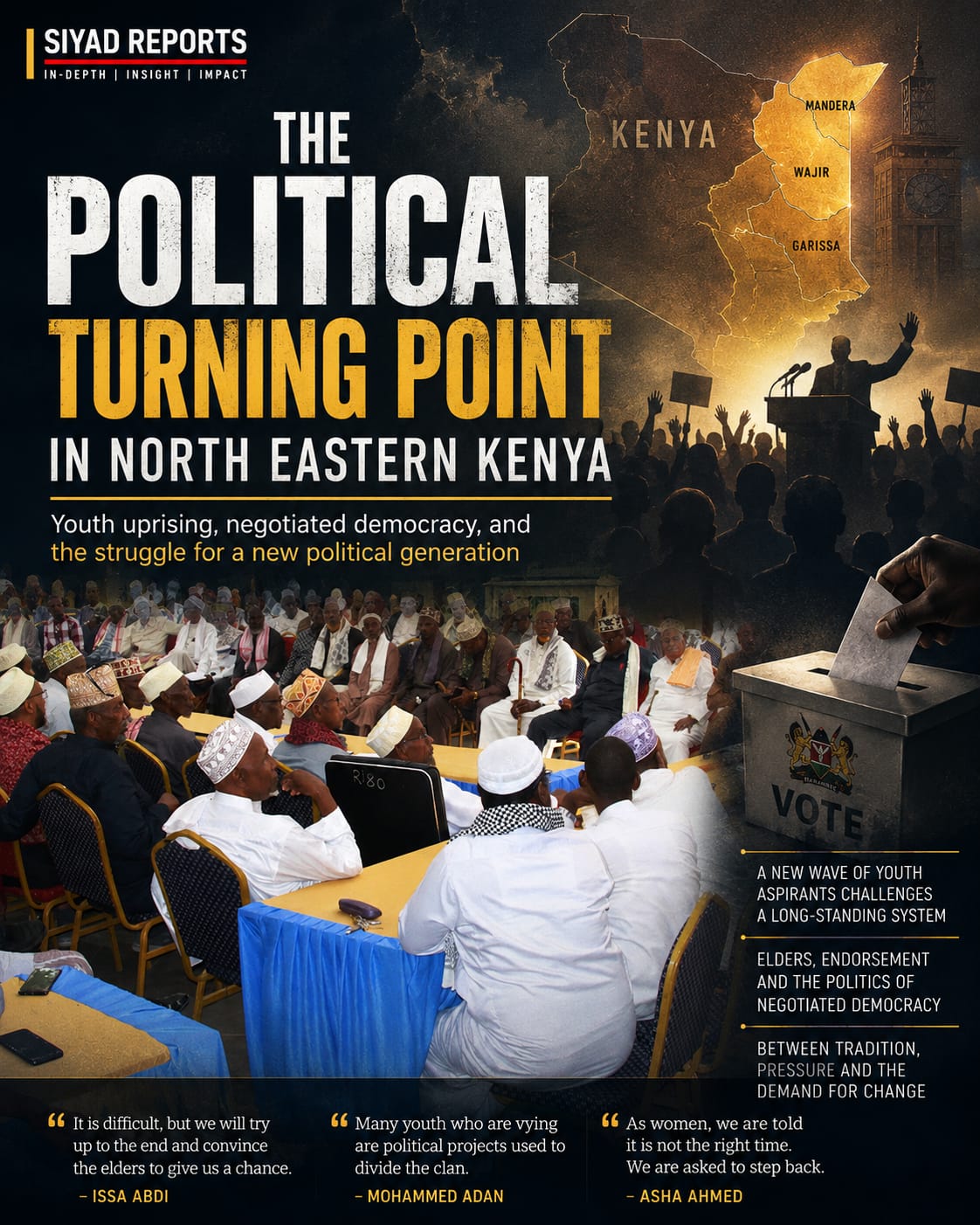
As Kenya moves steadily toward another election cycle, political activity is once again building momentum across the country. Campaign networks are forming, alliances are being tested, and aspirants are positioning themselves for the next phase of national and county leadership contests.
Yet in North Eastern Kenya, the political atmosphere carries a deeper and more complex meaning than routine electoral preparation. Beneath the surface of campaign mobilization lies a quiet but significant transformation one that political observers are increasingly describing as a generational awakening in regional leadership politics.
For decades, political leadership in Wajir, Garissa, and Mandera counties has been shaped by a system commonly referred to as negotiated democracy. In this arrangement, clan elders and influential community figures meet before elections to agree on candidates who will represent the community in various elective positions. The intention behind this system has always been stability, unity, and the prevention of intra-clan electoral conflict.
However, a new reality is emerging. A growing number of young aspirants are now stepping forward to challenge not just individual incumbents, but the very structure of political selection itself. They are not waiting for endorsement. They are seeking legitimacy directly from the people.
One young aspirant, Issa Abdi, expressed both the struggle and determination behind this shift:
“It is difficult, but we will try up to the end. We will continue convincing the elders that youth also deserve a chance to lead.”
His statement reflects a broader political mood among young candidates who feel that the gates of leadership remain partially closed, even in a democratic system that constitutionally guarantees equal political participation.
This emerging tension raises a fundamental question that now defines the region’s political discourse:
Is North Eastern Kenya experiencing a democratic expansion or a controlled transition where access to power remains tightly regulated?
To understand this, one must examine the deep structure of negotiated democracy and its evolving impact on youth political participation.
Negotiated democracy, while often praised for reducing electoral conflict, has gradually developed into a powerful gatekeeping system that shapes not only who runs for office, but who is considered politically legitimate in the first place. In many cases, electoral competition does not begin at the ballot box it begins in closed-door meetings where clan elders deliberate and decide preferred candidates.
Supporters of this system argue that it prevents political fragmentation and protects communities from costly internal divisions. In regions with sensitive clan dynamics, they see it as a stabilizing mechanism that ensures unity of representation.
However, critics now argue that the system has evolved beyond its original purpose. Instead of merely preventing conflict, it increasingly determines political outcomes in advance, limiting open competition and narrowing democratic space.
The most vocal concerns are coming from the youth.
Many young aspirants argue that despite their education, exposure, and political awareness, they are often sidelined in favor of older candidates who have longer-standing relationships within clan negotiation structures. In practice, experience and age are frequently prioritized over innovation and generational change.
Mohammed Adan, a young political voice from the region, described this concern in strong terms:
“Many youths who are vying are political projects. They are being used by elites to divide clan opinion and influence negotiations.”
This statement introduces a more complicated layer to the debate. It suggests that not all youth participation is organic or independent. Instead, some young candidates may be strategically supported by established political actors who seek to influence clan negotiations indirectly.
If this is accurate, then youth politics in the region is not only a story of resistance it is also a story of manipulation, where emerging leaders risk becoming instruments in a larger political strategy controlled by established elites.
This dual reality complicates the idea of a clean generational shift. It suggests that while youth ambition is rising, political structures are simultaneously adapting to absorb and redirect that ambition.
At the same time, the financial dimension of politics continues to shape outcomes in ways that further disadvantage young aspirants. Campaign financing, logistical mobilization, and influence networks require significant resources, often beyond the reach of first-time candidates.
This financial gap reinforces dependency on political sponsors, who may provide support in exchange for loyalty or strategic alignment. In such circumstances, independence becomes difficult to maintain, and political identity can become blurred.
The result is a political environment where three forces interact simultaneously: clan negotiation systems, financial influence, and rising youth ambition. These forces do not operate separately they overlap, compete, and sometimes reinforce each other.
A REGION CAUGHT BETWEEN POLITICAL TRADITION AND EMERGING GENERATIONAL PRESSURE
Within this evolving environment, women and youth face additional structural barriers that extend beyond political endorsement. Cultural expectations, historical leadership patterns, and institutional norms continue to shape who is considered “ready” for leadership.
Asha Ahmed, a young female aspirant, described her experience with quiet frustration:
“As women, when we show interest in leadership, we are told it is not the right time. We are asked to step back.”
Her experience reflects a broader pattern of delayed inclusion, where women are often encouraged to participate in politics symbolically but discouraged from competing for leadership positions at equal footing with men.
This creates a layered exclusion system: youth face resistance due to age, women face resistance due to gender, and both face structural limitations within negotiated democracy frameworks that prioritize consensus over competition.
The question that arises from this reality is not simply whether youth are ready for leadership, but whether the political system itself is ready to accommodate them.
Because readiness is not only about ambition it is also about access.
And access, in this context, is controlled through negotiation, endorsement, financial influence, and long-standing clan arrangements that have become deeply embedded in the region’s political identity.
As the election season approaches, these tensions are becoming more visible. Youth candidates are increasingly vocal, more organized, and more willing to challenge traditional authority structures. However, they are also operating within a system that remains largely unchanged in its core functioning.
This creates a political contradiction: a rising generation seeking entry into leadership, and an established system that determines the conditions of entry.
The result is not immediate conflict, but gradual friction subtle, persistent, and increasingly difficult to ignore.
What is unfolding in North Eastern Kenya is therefore not a simple electoral contest. It is a structural negotiation over the future of political authority itself.
On one side stands tradition, arguing for stability, unity, and continuity. On the other stands a generation arguing for inclusion, representation, and transformation.
Neither side is entirely wrong. But both are now forced into confrontation by demographic change, rising political awareness, and evolving expectations of governance.
The outcome of this confrontation will not be determined in speeches or manifestos alone. It will be determined in how effectively the political system responds to pressure for inclusion without destabilizing existing social structures.
Because if youth participation continues to grow without meaningful pathways to leadership, frustration may deepen. But if negotiated democracy is dismantled without careful transition, political fragmentation could increase.
This is why the current moment is so delicate.
It is not a moment of collapse it is a moment of transition.
And transitions, by nature, are uncertain.
What remains clear is that North Eastern Kenya is no longer politically static. The conversation has shifted. The assumptions of past election cycles are being questioned. And a new political consciousness is emerging among young people who increasingly see leadership not as inheritance, but as a right that must be actively claimed.
Whether this momentum leads to transformation or remains contained within existing structures will define the next chapter of the region’s political history.
For now, one reality stands above all others: the silence that once defined youth political participation in North Eastern Kenya is fading and in its place, a louder, more determined voice is beginning to emerge.