

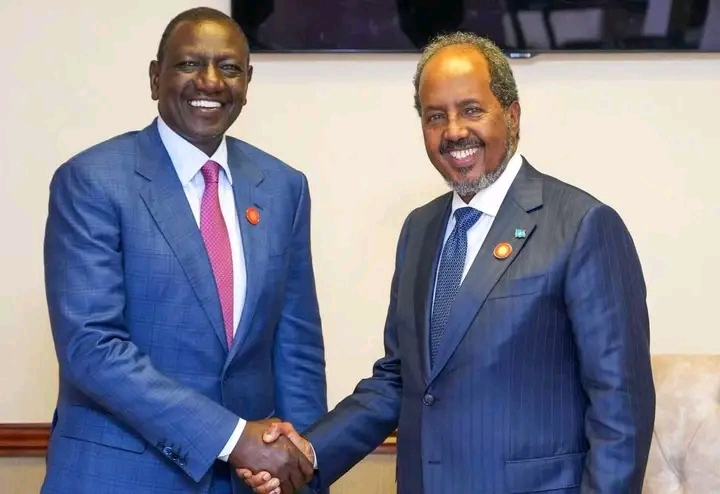
A quietly conducted diplomatic engagement between Somalia’s President Hassan Sheikh Mohamud and Kenyan President William Ruto in Narok has drawn attention across the Horn of Africa, as new details suggest the discussions were less about political tensions and more focused on a significant emerging economic opportunity: The expansion of Somalia’s fisheries trade into the Kenyan market.
According to informed sources cited by Siyad Reports, the meeting reportedly prioritized commercial cooperation, particularly the development of a structured fish export channel from Somalia to Kenya, in what could become one of the most practical and transformative bilateral trade arrangements between the two neighboring states in recent years.
The meeting, which was held away from public scrutiny, has been described as part of ongoing efforts to strengthen bilateral relations between Somalia and Kenya under the leadership of President Hassan Sheikh Mohamud and President William Ruto.
While early speculation had linked the engagement to Somalia’s internal political situation and regional security dynamics, emerging details indicate that the primary focus was economic cooperation, particularly in the fisheries sector, which both countries view as underdeveloped but highly strategic.
At the center of the discussions is Somalia’s vast and largely untapped marine resource base. With one of the longest coastlines in Africa, Somalia possesses significant potential in fisheries, yet the sector has remained underexploited due to years of instability, weak infrastructure, and limited access to international markets.
Kenya, on the other hand, has a growing demand for fish and seafood products, driven by urban consumption patterns, tourism, and a gradual shift toward healthier protein sources.
The convergence of Somalia’s supply potential and Kenya’s market demand appears to have created a mutually beneficial economic opportunity that both governments are now exploring at a high level.
Sources familiar with the discussions indicate that the proposed arrangement would structure Somalia’s fish exports in a manner similar to the established informal khat trade between Kenya and Somalia.
In that system, cross-border trade flows are supported by networks of traders, transport logistics, and regulatory flexibility that allow goods to move relatively efficiently between the two countries.
The fisheries model under consideration is expected to adopt a similar framework, potentially involving Kenyan traders and business intermediaries who would participate in distribution, logistics, and market integration.
This proposed model reflects a broader trend in East African regional trade, where informal and semi-formal cross-border systems often evolve into structured economic channels.
If implemented effectively, the Somalia–Kenya fisheries arrangement could become a significant source of revenue for Somali coastal communities while also supplying Kenya’s domestic markets with fresh fish products.
It could also stimulate investment in cold chain logistics, port infrastructure, and fisheries processing facilities, particularly along Somalia’s southern and central coastal regions.
The discussions also highlight Kenya’s growing interest in diversifying its food supply chains through regional partnerships.
Over the past decade, Kenya has increasingly relied on imports to supplement domestic fish production, especially in urban centers such as Nairobi and Mombasa.
Rising demand, coupled with fluctuating supply from Lake Victoria fisheries, has created gaps in the market that imported seafood could help fill.
Somalia’s proximity and marine abundance make it a natural partner in this regard, particularly if logistical and security challenges can be managed effectively.
Historically, trade relations between Somalia and Kenya have been shaped by both cooperation and tension.
While the two countries share deep cultural, economic, and social ties, particularly among border communities, their diplomatic relationship has at times been strained by disputes over maritime boundaries, security concerns, and political disagreements.
However, in recent years, both governments have taken steps to normalize relations, focusing on shared economic interests and regional stability.
One of the key turning points in bilateral relations was the gradual reopening of diplomatic channels and the restoration of ambassadorial engagement after periods of tension. This reset created space for new discussions on trade, infrastructure, and security cooperation.
The fisheries proposal appears to be part of this broader recalibration, where economic integration is being used as a foundation for long-term diplomatic stability.
The Narok meeting also reflects a shift in the tone of Kenya’s regional engagement under President Ruto. His administration has increasingly emphasized economic diplomacy, particularly with neighboring states in the Horn of Africa.
By focusing on trade-driven partnerships, Kenya aims to strengthen regional interdependence while also addressing domestic economic needs. Fisheries trade with Somalia fits within this broader strategy, offering both economic benefits and opportunities for regional integration.
From the Somali perspective, the initiative aligns with President Hassan Sheikh Mohamud’s broader agenda of economic recovery and resource mobilization. Somalia has been seeking to rebuild its economy through strategic sectors such as agriculture, livestock, energy, and fisheries.
Expanding fish exports to Kenya could provide immediate economic benefits, particularly for coastal communities that rely heavily on maritime livelihoods. It could also attract private investment into Somalia’s fisheries sector, which has long been hindered by limited market access.
The involvement of Kenyan traders, as suggested in the proposed framework, could also play a critical role in bridging logistical and regulatory gaps. Kenya’s more developed commercial networks and transport infrastructure could help facilitate distribution channels, ensuring that Somali fish products reach urban markets efficiently.
This kind of cross-border value chain integration is increasingly seen as essential for unlocking the economic potential of the Horn of Africa region.
However, despite the optimism surrounding the proposal, significant challenges remain. Somalia’s fisheries sector still faces infrastructure limitations, including inadequate cold storage facilities, limited processing capacity, and weak regulatory enforcement.
Additionally, maritime security concerns in certain coastal areas could affect production and export consistency.
On the Kenyan side, regulatory frameworks would need to be adapted to accommodate increased imports while ensuring food safety and quality standards are maintained.
There are also broader questions about how such a trade arrangement would be governed. While informal trade systems have historically been effective in the region, scaling up fisheries exports would likely require more structured agreements, including bilateral trade protocols, licensing systems, and quality control mechanisms. Without these safeguards, there is a risk that the initiative could remain fragmented or fail to achieve its full economic potential.
Notably, the meeting reportedly did not focus on Somalia’s internal political situation or electoral disputes, despite earlier speculation that the agenda might include governance issues.
Instead, the emphasis appears to have been firmly placed on economic cooperation and sector-specific development. This suggests a deliberate effort to separate trade and economic discussions from political tensions, allowing for more pragmatic engagement between the two governments.
If the reported discussions translate into formal agreements, the Somalia–Kenya fisheries trade initiative could mark a significant milestone in bilateral relations.
It would represent a shift from security-centered diplomacy toward a more economically driven partnership, potentially reshaping how the two countries interact in the coming years.
Ultimately, the Narok Diplomatic Meeting underscores a broader transformation in East African diplomacy, where economic necessity is increasingly shaping political engagement.
For Somalia, it offers a pathway toward leveraging its natural resources for national recovery.
For Kenya, it presents an opportunity to strengthen food security and deepen regional trade integration.
And for both countries, it signals a willingness to move beyond past tensions and toward a more cooperative and economically interdependent future.