

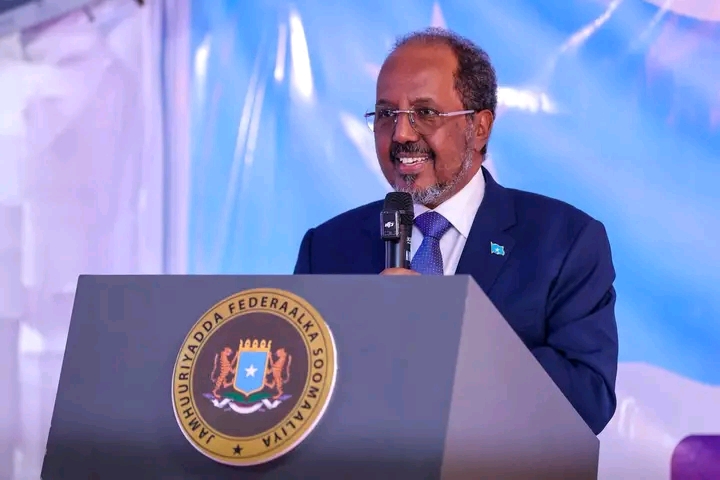
In what appears to be one of the most significant shifts in rhetoric from Somalia’s Federal Government in recent years, President Hassan Sheikh Mohamud has publicly softened his stance toward Somaliland, offering an apology for hostile remarks directed at the self-declared republic and signaling a willingness to reassess Mogadishu’s entire approach toward the northern regions.
Speaking during Somalia’s 66th Independence Day celebrations in Mogadishu, President Hassan Sheikh delivered a message that contrasted sharply with the confrontational tone that had characterized recent exchanges between Villa Somalia and Somaliland authorities.
The President acknowledged the historical contribution of Somaliland to Somalia’s independence struggle and emphasized that dialogue, rather than confrontation, should define future engagement between the two sides.
“We are reviewing our policy toward Somaliland and all the northern regions. We also apologize for those on our side who have used offensive language,” President Hassan Sheikh said, appearing to distance himself from previous remarks and political attacks that had escalated tensions between Mogadishu and Hargeisa.
The statement is being interpreted by political observers as a major diplomatic overture aimed at easing growing tensions at a time when relations between the Federal Government and Somaliland have reached one of their most fragile moments in years.
President Hassan Sheikh further stated that his administration is prepared to facilitate anything that the people of Somaliland are rightfully entitled to and stressed that Somalia remains committed to seeking peaceful solutions to long-standing disagreements through dialogue.
“We regret the negative remarks made by some among us about Somaliland. We will not abandon Somaliland. We will reassess our approach to engaging with Somaliland in pursuit of unity and a successful outcome,” the President declared.
The remarks come amid reports that the Federal Government had considered measures targeting businesspeople originating from Somaliland, a move that generated criticism from politicians, business leaders and members of the Somaliland public.
While those reports remain politically sensitive, Hassan Sheikh’s latest comments appear designed to reassure northern communities that Mogadishu is seeking engagement rather than isolation.
Addressing Somaliland residents directly, the President argued that the current global trend favors cooperation and integration rather than separation.
He said that while previous efforts aimed at preserving Somali unity may not have achieved their intended goals, his government is willing to rethink its strategy and develop an approach that takes into account the concerns and aspirations of the people in the north.
In a notable acknowledgment of past failures, Hassan Sheikh stated that if earlier attempts at fostering unity were unsuccessful, the government would “go back to the drawing board” and develop new ideas capable of building trust and creating a framework for meaningful dialogue.
He insisted that whatever grievances emerged following the 1960 union between British Somaliland and the former Trust Territory of Somalia can be addressed through discussions and negotiations rather than political hostility.
The speech represents one of the strongest public appeals to Somaliland from a sitting Somali president in recent years and comes at a particularly sensitive geopolitical moment.
Only days before Hassan Sheikh’s address, Somaliland President Abdirahman Mohamed Abdullahi “Cirro” made a controversial and closely watched visit to Israel.
During the visit, Cirro met Israeli officials and opened a Somaliland diplomatic and representative office in Israel, a move widely viewed as part of Somaliland’s broader campaign to expand its international partnerships and strengthen its quest for international recognition.
The visit attracted considerable attention across the Horn of Africa and the Middle East, with supporters describing it as a bold diplomatic step while critics argued that it could further complicate already strained relations between Somaliland and Somalia’s Federal Government.
For Somaliland, international recognition remains the central objective of its foreign policy. Since declaring the restoration of its sovereignty in 1991 following the collapse of Somalia’s central government, Somaliland has built its own institutions, conducted multiple elections and maintained relative stability compared to many parts of Somalia.
However, despite these achievements, no country has formally recognized Somaliland as an independent state.The timing of Cirro’s Israel visit and Hassan Sheikh’s conciliatory message has fueled speculation about whether Mogadishu is attempting to open a new chapter in its relationship with Somaliland before diplomatic divisions deepen further.
Analysts say the Federal Government faces increasing pressure to formulate a coherent strategy toward Somaliland amid shifting regional alliances, growing foreign interest in the strategic Red Sea corridor and Somaliland’s expanding international engagement.
Recent months have seen heightened diplomatic activity involving Somaliland, including agreements and discussions with regional and international actors seeking economic, security and maritime partnerships in the Horn of Africa.
These developments have placed renewed focus on the unresolved political relationship between Mogadishu and Hargeisa.For years, dialogue efforts between the two sides have experienced repeated setbacks.
Multiple rounds of talks hosted by regional and international partners have failed to produce a lasting breakthrough, with disagreements persisting over sovereignty, governance and the future political status of Somaliland.
Nevertheless, Hassan Sheikh’s latest remarks suggest that his administration may be preparing to pursue a different path.
By acknowledging the concerns of Somaliland residents, apologizing for inflammatory language and publicly committing to a review of government policy, the Somali President appears to be signaling a shift from confrontation toward engagement.
Whether that message will be welcomed by Somaliland leaders remains uncertain.Authorities in Hargeisa have consistently maintained that Somaliland’s sovereignty is non-negotiable and that any dialogue with Mogadishu must recognize the distinct political reality that has existed in Somaliland for more than three decades.
Yet even among supporters of Somaliland’s independence, there has long been recognition that communication between the two sides remains necessary on issues ranging from security and trade to airspace management and regional stability.
As Somalia marked 66 years since independence, Hassan Sheikh’s address introduced a rare moment of reflection into one of the Horn of Africa’s most enduring political disputes.
By combining an apology, a promise to reassess policy and a renewed call for dialogue, the President sought to project a more conciliatory vision for relations with Somaliland.
Whether that vision leads to meaningful political engagement or remains a symbolic gesture will likely depend on the response from Hargeisa and the willingness of both sides to move beyond decades of mistrust.
For now, however, the speech has altered the political conversation, raising fresh questions about whether a new phase in Somaliland-Somalia relations may be beginning.