

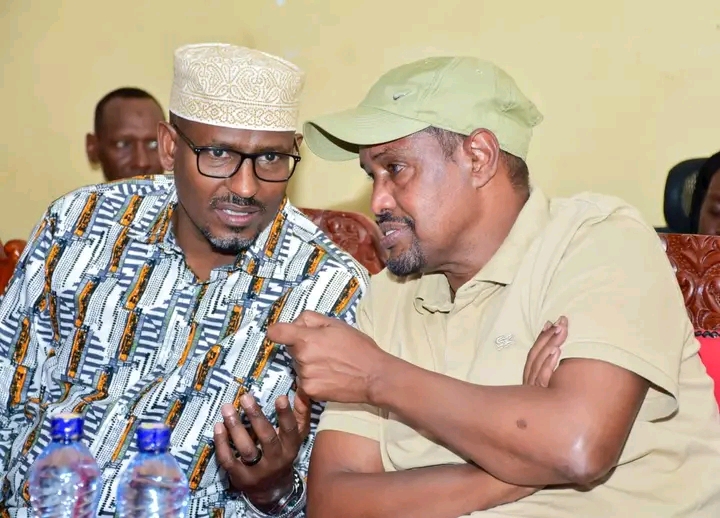
Politics in Wajir County has entered a new and increasingly competitive phase following a public exchange between Governor Ahmed Abdullahi and Wajir East MP Adan Daud Mohamed, a dispute that on the surface appears to be about development projects but beneath it reveals a deeper struggle over political influence, public perception, and the future direction of leadership in the county.
What began as a disagreement over governance responsibilities has rapidly evolved into one of the most significant political conversations currently shaping Wajir’s landscape.
At the center of the debate is a fundamental question that resonates across many devolved counties in Kenya: who deserves credit for development projects the national government, county governments, or the leaders who lobby for them?
The latest chapter of this unfolding political contest played out during the 3rd Graduation Ceremony of Wajir Polytechnic, where Governor Ahmed Abdullahi used the occasion to showcase his administration’s achievements and outline what he described as a transformative development agenda for the county.
His appearance came shortly after remarks by Wajir East MP Adan Daud, who publicly challenged county leaders to remain within their constitutional mandates and questioned the Governor’s involvement in matters relating to security.
The MP argued that elected leaders have distinct responsibilities and should avoid encroaching on functions assigned to other offices.While Governor Ahmed did not directly engage in a verbal confrontation with the MP, his speech was widely interpreted as a calculated response.
Rather than focusing on the criticism, he redirected attention to development achievements, highlighting investments in education, healthcare, water projects, infrastructure, and youth empowerment.
For observers of Wajir politics, the Governor’s message was clear, his administration wanted the public conversation to revolve around service delivery and measurable results rather than political accusations.
Education featured prominently in the Governor’s remarks. He pointed to the growth and expansion of Wajir Polytechnic as an example of his government’s commitment to empowering young people through skills development and technical training.
By choosing a graduation ceremony as the venue for his response, the Governor strategically aligned himself with a success story that directly affects the aspirations of thousands of young people seeking employment and economic opportunities.
However, the broader political argument extends far beyond a single institution.
According to statements attributed to MP Adan Daud, the Wajir East legislator believes that many projects currently being celebrated within the county are funded and implemented by the national government and should therefore not be presented as achievements of the county administration.
His argument reflects a position increasingly adopted by Members of Parliament across the country. MPs often contend that they play a significant role in lobbying ministries, state agencies, and national government departments to bring projects to their constituencies.
In their view, failing to acknowledge that role creates a misleading narrative about how development is delivered.Adan Daud has reportedly questioned who should take credit for road projects, electrification programs, and other initiatives financed through national government budgets.
From his perspective, county governments should receive recognition for projects funded and implemented through county resources, while national government projects should be credited to the institutions and leaders responsible for securing them.
The MP’s position is rooted in a constitutional argument.Kenya’s devolved system of government created distinct functions for national and county governments.
County governments oversee sectors such as health services, county roads, agriculture, water distribution, and local development planning.
The national government retains responsibility for areas including national security, major infrastructure, foreign affairs, and national policy.
Supporters of Adan Daud argue that maintaining these distinctions is essential for transparency and accountability. They believe citizens deserve to know which level of government is responsible for specific projects so that leaders can be evaluated fairly.
Yet supporters of Governor Ahmed Abdullahi offer a different interpretation.They argue that development is rarely the result of one office acting alone.
Large-scale projects often require collaboration between county administrations, national government agencies, development partners, and elected representatives.
In this view, focusing solely on who receives credit risks overshadowing the ultimate objective of improving people’s lives.
Many of the Governor’s allies point to his administration’s efforts in expanding access to education, improving healthcare facilities, addressing water shortages, supporting youth programs, and strengthening county infrastructure.
They maintain that these achievements demonstrate active leadership and justify the Governor’s emphasis on his administration’s record.
Beyond the debate over development projects lies another important dimension, political influence.Wajir County has long been shaped by complex political alliances involving governors, Members of Parliament, Members of County Assembly, and influential community leaders.
As the county’s political environment evolves, competition for visibility and influence has intensified.Political analysts note that public disagreements between governors and MPs are rarely confined to technical questions about budgets or constitutional mandates.
More often, they reflect broader contests over leadership, public support, and political positioning.
This appears to be the case in Wajir.The exchange between Ahmed Abdullahi and Adan Daud is unfolding at a time when attention is gradually shifting toward the 2027 General Election.
Although the election remains some distance away, political calculations are already becoming evident across many parts of Kenya.
For ambitious leaders, visibility matters.Development projects serve not only as tools for improving livelihoods but also as powerful political assets.
Leaders naturally seek to associate themselves with successful initiatives because voters often judge performance through visible outcomes such as roads, schools, hospitals, water projects, and employment opportunities.
Consequently, disputes over development credit are often about more than recognition; they are about shaping political narratives.
Who delivered the project?Who initiated it?Who lobbied for funding?Who supervised implementation?Who deserves public appreciation?
These questions carry significant political weight because they influence how voters evaluate leadership.
The emerging tension between the Governor and the MP therefore reflects competing narratives about development and governance.
Governor Ahmed Abdullahi appears determined to present himself as a leader focused on transformation and service delivery. His recent public engagements have consistently highlighted development achievements and long-term planning for the county.
Adan Daud, on the other hand, appears focused on reinforcing the importance of constitutional roles and ensuring that national government contributions receive proper recognition.
His interventions suggest a desire to hold county leaders accountable for accurately representing the source of development projects.Neither position is without merit.
Citizens benefit from transparency regarding funding sources and project ownership. At the same time, they also expect leaders to work together rather than engage in prolonged political disputes.
For many residents of Wajir, the central concern is unlikely to be who claims credit. Instead, the public is more interested in whether roads are constructed, water reaches communities, healthcare services improve, schools perform better, and young people gain access to opportunities.Indeed, conversations across the county increasingly reveal a public desire for cooperation between leaders.
Many residents believe that development challenges are too significant to be addressed through political rivalry.
Wajir continues to face pressing issues including access to water, unemployment, healthcare delivery, infrastructure gaps, and economic empowerment. Addressing these challenges requires coordinated efforts between county and national institutions.
That reality may ultimately determine how this political contest is judged.If the dispute remains focused on constitutional accountability and development outcomes, it could contribute to healthier public debate.
However, if it escalates into a prolonged struggle over political ownership and electoral positioning, it risks diverting attention from the very issues citizens expect leaders to address.
For now, Governor Ahmed Abdullahi and MP Adan Daud have each laid out their positions before the public.
One emphasizes development achievements and transformation.
The other stresses constitutional boundaries and recognition of national government contributions.
The clash has exposed deeper questions about governance, accountability, and political leadership in Wajir County.
It has also offered an early glimpse into the alliances, rivalries, and narratives that could shape the county’s political future as 2027 draws closer.
Whether this disagreement evolves into reconciliation, collaboration, or a larger political confrontation remains to be seen.
What is certain, however, is that the debate has already become one of the defining political stories in Wajir, placing both leaders under intense public scrutiny as residents watch closely to see who can best translate promises, influence, and authority into tangible development for the people they serve.