

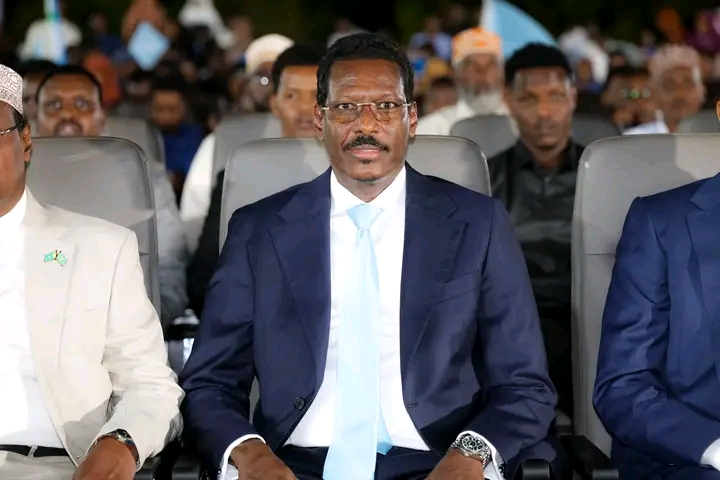
Galmudug President Ahmed Abdi Kaariye, popularly known as Qoor Qoor, has officially withdrawn from the race for the presidency of Galmudug, ending weeks of political uncertainty and paving the way for a new leadership transition in the federal member state.
The announcement came after a series of high-level meetings in Dhuusamareeb involving Somalia’s Prime Minister Hamza Abdi Barre and National Intelligence and Security Agency (NISA) Director Mahad Mohamed Salad, discussions that political observers say played a decisive role in shaping the outcome of the state’s electoral process.
In a statement announcing his decision, President Qoor Qoor said he had chosen to step aside from the ongoing election, emphasizing the importance of respecting democratic transitions and avoiding the temptation to cling to power.
“I have decided to withdraw from the ongoing electoral process. You should never cling to power always reflect on the lessons of the past,” he said.
His withdrawal effectively clears the path for Liban Mohamed Hassan to assume the presidency without facing a major challenger, bringing an end to months of speculation surrounding Galmudug’s political future.
The development follows intense political consultations between Villa Somalia and the Galmudug leadership amid growing disagreements over the state’s electoral process and succession arrangements.
Prime Minister Hamza Abdi Barre arrived in Dhuusamareeb earlier this week to join ongoing negotiations aimed at securing a political consensus over the transition of power.
Before the Prime Minister’s arrival, NISA Director Mahad Salad had held several rounds of talks with President Qoor Qoor, meetings widely viewed as efforts to narrow differences between federal authorities and regional leaders.
Sources familiar with the discussions indicated that the talks focused on the future political direction of Galmudug, leadership succession, and the state’s role within the broader federal political landscape.
Although neither the Federal Government nor the Galmudug administration publicly disclosed details of the negotiations, political insiders suggest that significant pressure was exerted on the outgoing president to facilitate a smooth transition and avoid a potentially divisive contest.
Despite stepping away from the race, President Qoor Qoor delivered what many interpreted as a pointed political message directed at Somalia’s national leadership, particularly President Hassan Sheikh Mohamud.
Speaking during his announcement, Qoor Qoor warned against attempts by leaders to hold onto power indefinitely, drawing on Somalia’s political history as a lesson for current officeholders.
“Prime Minister Hamza, power should not be clung to. Anyone who tries to hold onto power indefinitely will be removed from it peacefully,” he said.
The remarks have generated significant political discussion, with analysts viewing them as a broader commentary on leadership, democratic transitions, and the importance of respecting constitutional processes.
Others interpreted the statement as an indirect message to national leaders as Somalia continues to debate its future electoral model and governance reforms.
Qoor Qoor also sought to reassure Galmudug residents that the transition would be conducted peacefully and responsibly.
“I will continue serving in office, and whoever is elected next will be handed over a stable and healthy Galmudug administration,” he stated.
His comments were widely seen as an attempt to project stability and preserve unity within the state at a time when political tensions could easily have escalated into a prolonged dispute.
During his tenure, Qoor Qoor emerged as one of Somalia’s most influential regional leaders, playing a prominent role in federal-state negotiations, security cooperation, and national political discussions.
His administration oversaw major efforts aimed at strengthening governance institutions and supporting military operations against extremist groups operating in central Somalia.
The decision to withdraw from the race therefore marks the end of a significant political chapter in Galmudug’s history and opens the door for a new generation of leadership.
For Prime Minister Hamza Abdi Barre and the Federal Government, the development represents a major breakthrough in efforts to secure a consensus-based transition in one of the country’s strategically important federal member states.
Federal officials have repeatedly stressed the importance of dialogue and political compromise in resolving disputes between Mogadishu and regional administrations.
Attention is now shifting toward the formal conclusion of the electoral process and the expected elevation of Liban Mohamed Hassan to the presidency.
Political observers say the coming days will be crucial in determining how the new administration positions itself within Somalia’s evolving political environment and how it manages relations with the Federal Government.
While questions remain about the long-term political implications of Qoor Qoor’s departure from the race, his decision has significantly altered the political landscape in Galmudug.
The withdrawal not only removes the possibility of a contested election but also signals the growing influence of federal-level negotiations in shaping regional political outcomes.
As Galmudug prepares for a new administration, many Somalis will be watching closely to see whether the peaceful transition advocated by Qoor Qoor becomes a model for future political handovers across the country.