

Somalia once again finds itself at a familiar and dangerous crossroads where political mistrust, contested authority, and security anxieties collide at the very heart of the state. The federal government’s decision to turn back aircraft carrying security personnel for the presidents of Puntland and Jubbaland has triggered one of the most serious political standoffs in recent years, pushing an already fragile national dialogue process to what several actors have described as “ground zero.”
What makes this episode particularly consequential is not only the dramatic nature of the events planes ordered to return mid-air, accusations of assassination attempts, and emergency statements but the deeper constitutional, political, and psychological fault lines it exposes within Somalia’s federal system.
At stake is not just a consultative meeting, but the unresolved question of who controls security, who sets the rules of engagement, and whether Somalia’s leaders can still sit together without fear, force, or foreign mediation.
SECURITY OR POLITICAL LEVERAGE? THE ADEN ADDE AIRPORT SHOWDOWN
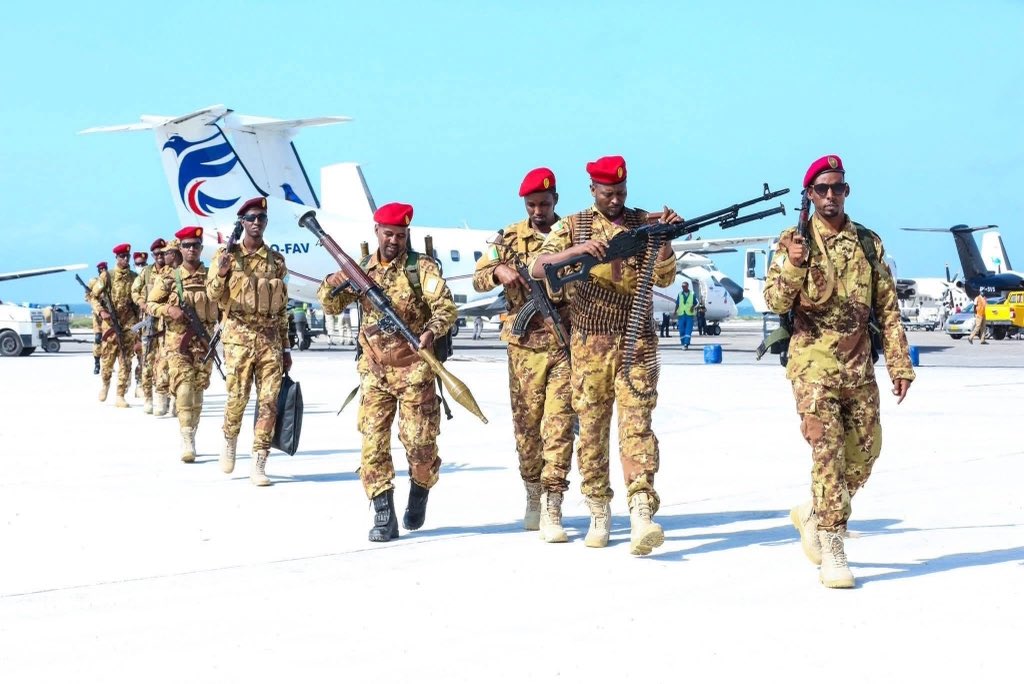
The immediate trigger of the crisis was the Federal Government of Somalia’s refusal to allow aircraft carrying security teams linked to Puntland President Said Abdullahi Deni and Jubbaland President Ahmed Mohamed Islam (Ahmed Madobe) to land at Mogadishu’s Aden Adde International Airport. According to federal authorities, the flights were carrying unregistered, heavily armed personnel and weapons, a move they said violated established security protocols governing Somalia’s capital and its most sensitive infrastructure.
The Ministry of Internal Security and senior federal officials argued that the presence of armed units not coordinated with federal command structures posed a direct risk to national security. Aden Adde Airport is not merely a civilian transport hub; it sits adjacent to key diplomatic missions, international organizations, and critical state institutions. In the federal government’s view, allowing armed forces loyal to regional administrations to land and deploy in this environment without explicit clearance would create parallel chains of command and potentially destabilize the capital.
Defence Minister Ahmed Moalim Fiqi articulated this position bluntly, drawing a sharp contrast between how Somali regional leaders travel abroad and how they approached travel to their own capital,
“When they travel to Addis Ababa, Nairobi, and Dubai they travel in disguise, carrying bags, and go through immigration queues. But when they travel to their capital, they arm themselves as if they are going to the last war. Are they going for talks or war, or a military show of force which is a message they are sending to others?”
Fiqi went further, emphasizing that the security of Mogadishu even for visiting leaders is the responsibility of the federal government. He argued that world leaders who visit Mogadishu entrust their safety to Somali national forces, and Somali leaders should do the same. According to him, bringing unknown armed units to hotels within the airport complex a highly sensitive zone was “unseemly” and unacceptable.
Yet Puntland and Jubbaland offered a sharply different account. Jubbaland authorities said a plane carrying an advance team for the planned national consultative forum had prior clearance from aviation authorities and federal security agencies, only to be ordered back mid-air. They described the decision as reckless and dangerous, arguing that it endangered the lives of those on board, particularly given concerns over fuel and flight safety.
Puntland’s response was even more explosive. In an emergency statement, President Said Abdullahi Deni declared,
“This was an attempted assassination and a criminal act that will be held to account.”
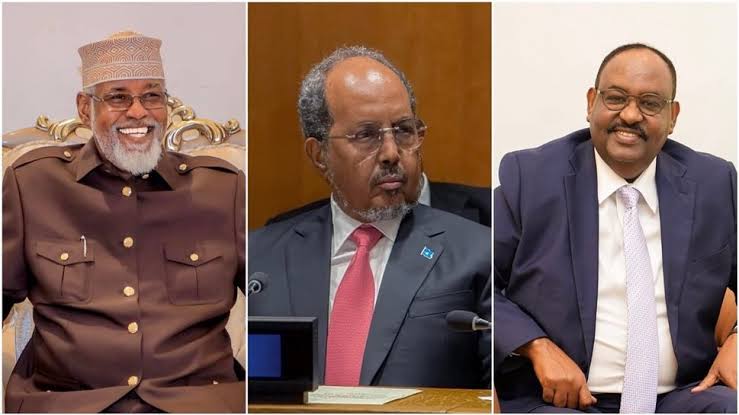
Deni framed the incident not as a technical security dispute, but as a deliberate and hostile act aimed at intimidating or eliminating political opponents. He insisted that he would not be cowed, adding that Puntland would not retreat from what he described as its role in determining Somalia’s political future.
Behind the rhetoric lies a deeper dispute over intent. The federal government says it acted to prevent an unauthorized influx of armed forces into the capital. Puntland and Jubbaland say the move was designed to undermine dialogue, embarrass their leaders, and tilt the political process in Mogadishu’s favor before talks even began.
This interpretation was echoed by the Somali Future Council (SFC), which issued a strongly worded press statement condemning the federal government’s actions. The council said that an agreement had already been reached on “all fundamental points” for the national dialogue, including approval of special security personnel for participating officials. Turning back the flights, the SFC argued, was a reckless decision that obstructed the realization of the conference and endangered lives.
The council accused President Hassan Sheikh Mohamud’s administration of acting in bad faith, pointing to what it described as a pattern of contradictory moves: constitutional amendments, meetings and statements at odds with the spirit of dialogue, and now the blocking of flights meant to facilitate talks. While reaffirming its readiness for “sincere dialogue,” the SFC said it would review the entire course of negotiations.
International actors were quick to express concern. The United Nations Assistance Mission in Somalia (UNTMIS) said it regretted that advance teams from Puntland and Jubbaland could not arrive in Mogadishu and urged all sides to prioritize dialogue on elections and national issues, particularly with constitutional mandates nearing expiry. The European Union’s Ambassador to Somalia, Francesca Di Mauro, described the situation as a “shame,” calling on all parties to resolve misunderstandings and create a conducive environment for substantive discussions leading to a way forward on elections.
Despite these appeals, the damage was already done.
Puntland’s Interior Minister announced that the process had returned to “ground zero,” a phrase heavy with historical resonance in Somali politics—a reset not toward reform, but toward paralysis.
CONSTITUTIONAL AUTHORITY, FEDERALISM, AND SOMALIA’S RECURRING POLITICAL ZERO
Beyond the immediate drama of turned-back flights lies a fundamental constitutional question: who has the authority over security and armed forces in Somalia, particularly in Mogadishu?
Articles 53 and 54 of Somalia’s Provisional Constitution provide the legal backbone of the federal government’s argument. Article 53 assigns the Federal Government exclusive authority over national defense, foreign affairs, citizenship, and other sovereign matters. Article 54 reinforces this by clarifying that while some powers may be negotiated between the federal center and member states, national defense is not among them. It remains solely a federal responsibility.
In practical terms, this means that security in Mogadishu the national capital is under federal jurisdiction, and any movement of armed forces into the city must be coordinated and approved by the Federal Government. Federal Member States may maintain their own security forces within their territories, but the constitution restricts their operations beyond regional boundaries in ways that affect national security.
From this perspective, the federal government’s decision to block the flights was not merely political, but constitutional. Allowing regional armed units to land in Mogadishu without clear federal oversight could set a precedent that erodes the very idea of a unified national defense.
However, constitutional clarity on paper does not automatically translate into political legitimacy in practice especially in Somalia’s highly personalized and distrust-driven political environment. Puntland and Jubbaland argue that their leaders face real security threats and cannot rely solely on federal protection, particularly when trust between the parties is so low. For them, bringing security details is not a challenge to federal authority, but a precaution rooted in lived experience.
This tension between legal authority and political trust has haunted Somalia’s federal experiment since its inception. Federalism was meant to balance unity and autonomy, but instead it has often produced overlapping claims of power, competing security structures, and zero-sum politics.
Horn of Africa analyst Abdiwahab Sheikh Abdisamad captured this dilemma with a scathing assessment that resonated widely:
“34 years on, Somali leaders still can’t meet, agree, or govern without foreign pressure. If every political move needs an external referee, the question isn’t national pride, it’s the governance IQ of those in charge.”
His words cut to the core of Somalia’s predicament. Time and again, internal disputes escalate until international actors UN missions, foreign embassies, regional organizations step in to urge restraint and dialogue. While such interventions often prevent immediate crises, they also reinforce a troubling dependency that undermines sovereignty and institutional credibility.
This latest standoff fits a familiar pattern. Disagreements between Mogadishu and federal member states intensify, progress stalls, and the country edges toward political paralysis. Eventually, external partners intervene, coaxing leaders back to the table. The cycle repeats, leaving underlying issues unresolved.
What makes the current crisis particularly alarming is its timing. Somalia is grappling with contested constitutional amendments, unresolved election frameworks, and expiring mandates. The national consultative forum was meant to address precisely these issues. Instead, the manner in which it has unraveled risks deepening polarization and eroding whatever goodwill remained.
The federal government insists the invitation to talks remains open and the dialogue framework unchanged. Yet for Puntland and Jubbaland, actions speak louder than words. Turning back flights, especially after alleged prior clearances, sends a signal intentional or not that Mogadishu is willing to use control over security and airspace as a political tool.
At the same time, images circulating on social media of heavily armed security personnel linked to regional delegations have reinforced federal concerns. To many in Mogadishu, these visuals evoke memories of militia politics and reinforce fears that political negotiations are being militarized.
The tragedy is that both sides may be acting rationally within their own frames of reference and yet collectively steering the country toward another deadlock.
DIALOGUE WITHOUT TRUST IS JUST A STAGING AREA FOR THE NEXT CRISIS
Somalia’s current impasse is not merely about planes, guards, or airport protocols. It is about the absence of trust in a political system where authority is contested, institutions are weak, and history weighs heavily on every decision.
The federal government’s reliance on constitutional authority is legally defensible, but politically brittle in a context where federal member states do not fully trust Mogadishu to guarantee their leaders’ safety or respect negotiated agreements. Puntland and Jubbaland’s insistence on bringing their own security reflects that mistrust, but also risks normalizing the idea that political dialogue requires armed displays of power.
International partners from the UN to the EU
have called for restraint and dialogue. Yet as Abdiwahab Sheikh Abdisamad warned, a nation that cannot govern without external referees must confront uncomfortable questions about its political maturity.
If Somalia is to move beyond its recurring “ground zero” moments, its leaders must do more than invoke constitutions or issue condemnations. They must rebuild trust through consistent actions, transparent agreements, and a shared commitment to resolving disputes within Somali institutions not foreign mediation rooms.
Until then, every consultative forum risks becoming another battleground, every dialogue another prelude to collapse, and every crisis another reminder that Somalia’s greatest challenge is not just insecurity but the inability of its leaders to trust the very state they claim to lead.