

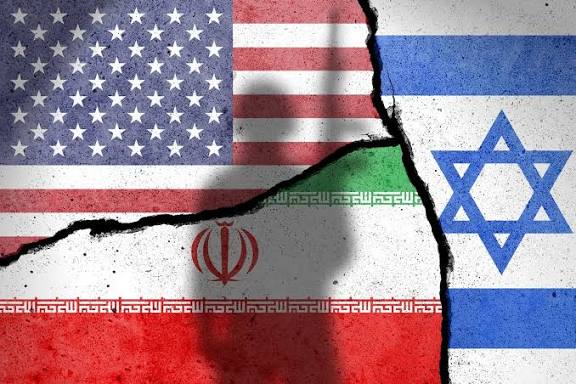
The Middle East has entered one of its most dangerous military escalations in decades after joint United States and Israeli strikes on Iran triggered a sweeping retaliation campaign across the Gulf, Israel, and beyond. What began as what Israel described as a “preemptive strike” has rapidly spiraled into a region-wide confrontation involving missile attacks, airspace closures, threats against US bases, and warnings that the conflict could reshape the geopolitical order of the region.
The crisis intensified after US President Donald Trump publicly called on the Iranian people to “take over” their government once US military operations conclude. In remarks that are likely to inflame tensions further, Trump framed the moment as a “rare generational opportunity,” pledging American backing for any internal uprising. His comments have been interpreted in Tehran as direct interference and regime-change rhetoric, hardening Iran’s position.
On the Israeli side, Prime Minister Benjamin Netanyahu declared that the coordinated US-Israel strikes were aimed at removing what he described as an “existential threat.” Netanyahu praised Washington’s partnership and said the military action could empower Iranians to “shape their own future.” Israeli officials have maintained that the operation targeted high-value military and strategic assets tied to Iran’s defense and nuclear infrastructure.
According to multiple regional reports, Israeli and US air and sea attacks struck a wide range of sites in and around Tehran, including facilities linked to the Intelligence Ministry, the Defense Ministry, and the Iranian Atomic Energy Organization.
Explosions were also reported near compounds associated with Supreme Leader Ali Khamenei and President Masoud Pezeshkian. Israeli sources speaking to Axios indicated that senior Iranian leadership was among the intended targets in what they described as a decisive phase of the campaign.
Iran’s response was swift and expansive. The Islamic Revolutionary Guard Corps announced the beginning of its retaliation, launching what it described as dozens later hundreds of ballistic missiles and drones toward Israeli territory and US military installations across the Gulf. Sirens reportedly sounded in more than 300 locations across Israel as air defenses were activated. Violent explosions were heard in several cities, marking one of the largest coordinated missile barrages in recent memory.
Simultaneously, Iranian forces expanded the scope of their retaliation to American bases in Qatar, Bahrain, Kuwait, and the United Arab Emirates. The US Navy’s Fifth Fleet base in Manama, Bahrain, was reportedly among the sites targeted.
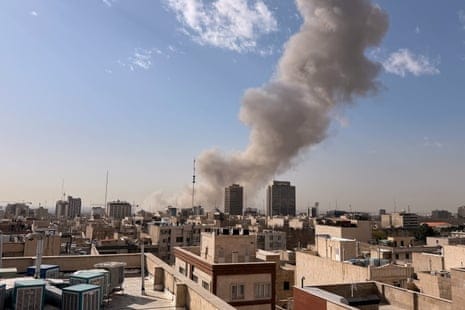
Explosions were heard in Manama, and footage circulating online showed what appeared to be missile impacts in multiple locations. In Abu Dhabi, authorities confirmed that several missiles were intercepted, though at least one casualty was reported.
In Qatar, missiles were directed at Al Udeid Air Base, a key US military hub in the region. Doha announced that its Patriot air defense systems successfully intercepted incoming projectiles, preventing significant damage. Nevertheless, the symbolic targeting of such a critical installation underscores how directly the conflict now involves Gulf states.
The United Arab Emirates declared a state of alert as air defenses were activated around Al Dhafra Air Base. Saudi Arabia also reported that Iranian missiles reached the vicinity of Riyadh, signaling the widening geographic scope of the confrontation. Airspace over Jordan, Qatar, the UAE, Iraq, and Bahrain was temporarily closed, severely disrupting commercial aviation. Qatar Airways suspended flights due to the closures, and Turkish Airlines canceled services to Lebanon, Syria, Iraq, Iran, and Jordan until early March.
Tehran has declared that the entire region could become a theater of war, warning that “all American and Israeli assets and interests in the Middle East have become legitimate targets.” A senior Iranian official told Al Jazeera that there were “no red lines” and that Iran’s response would be complex, prolonged, and not bound by time limits. Iranian leaders rejected any calls to contain the escalation, describing such appeals as unrealistic.
Beyond state actors, regional armed groups have also entered the fray. Yemen’s Houthi movement announced that it had blocked US and Israeli-linked vessels in the Red Sea, adding another layer of maritime risk to an already volatile security environment. If sustained, such actions could threaten global shipping lanes and energy markets, particularly through the Bab el-Mandeb Strait and the Strait of Hormuz.
Russia has also weighed in rhetorically. Dmitri Medvedev, deputy chair of Russia’s Security Council and former president, posted on X that the United States was only 249 years old compared to the 2,500-year history of the Persian Empire, suggesting that history favors Iranian resilience. Such comments reflect broader global polarization, with major powers
closely watching the unfolding conflict.
Strategically, the conflict represents a direct and open confrontation between Israel and Iran, something that for years had largely remained in the shadows through proxy battles in Syria, Lebanon, and Gaza. The overt targeting of senior Iranian leadership compounds, nuclear-linked institutions, and Gulf-based US military infrastructure signals a new phase in regional warfare one that blurs the lines between deterrence, retaliation, and outright war.
Security analysts warn that continued missile exchanges could push the conflict into a prolonged regional war involving Lebanon’s Hezbollah, Iraqi militias, and potentially wider international intervention.
Oil prices are expected to surge amid fears of disruption in the Gulf. Global markets are already reacting to the uncertainty surrounding energy supplies and shipping routes.
Diplomatic channels appear strained. No immediate ceasefire framework has been announced. Western governments are urging de-escalation, while regional states are bracing for further fallout. The closure of multiple airspaces suggests governments fear additional waves of strikes.
The human cost remains unclear. Casualty numbers are still emerging, with reports of at least one fatality in Abu Dhabi and injuries in several impacted locations. In Israel and Iran, emergency services have been mobilized amid ongoing sirens and explosions. Civil defense systems across the region remain on high alert.
Politically, Trump’s call for Iranians to “seize control” of their government adds another volatile dimension. Tehran is likely to interpret such rhetoric as confirmation that regime change is the ultimate goal of the US-Israel operation. That perception could solidify domestic unity in Iran rather than weaken it, at least in the short term.
As of now, the situation remains fluid. Iran has signaled that its retaliation has only begun, while Israeli officials suggest operations could continue until the perceived threat is neutralized. The United States has not indicated any withdrawal from the joint campaign.
What is clear is that the Middle East stands at a historic crossroads. The scale of missile exchanges, the targeting of leadership compounds, the involvement of Gulf states, and the explicit rhetoric about regime change mark a dramatic escalation beyond previous confrontations. Whether this confrontation evolves into a prolonged regional war or is contained through urgent diplomacy will shape not only the Middle East but global security for years to come.
The coming hours and days will determine whether this conflict can be contained or whether the region is witnessing the opening chapter of a far broader war.