

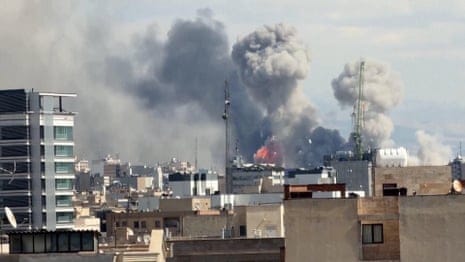
The Middle East woke up to one of the most dangerous military escalations in modern history, as the confrontation between the Islamic Republic of Iran, the United States, and Israel rapidly expanded beyond isolated strikes into what increasingly resembles a region-wide war.
Over the past 48 hours, events have unfolded at a speed that has shocked diplomats, military analysts, and global markets alike. What began as targeted operations has now morphed into a complex, multi-theater conflict stretching from the Persian Gulf to the Eastern Mediterranean.
Iran’s Foreign Minister, Abbas Araghchi, in an interview with Al Jazeera, signaled that Tehran is neither disorganized nor reactive, but instead operating under a pre-designed military doctrine. He stated that the events in Oman “were not our choice,” emphasizing that Iranian forces had previously been instructed to exercise caution in selecting their targets. More significantly, he revealed that Iran’s military units are now operating in a partially decentralized manner, guided by general directives rather than direct command for each action.
This concept aligns with what Iranian strategists refer to as “decentralized mosaic defense” a structure designed to allow flexibility and survivability under heavy attack.
This messaging is not accidental. It suggests that Iran anticipated large-scale strikes and prepared its command-and-control systems to function even if top leadership were targeted. In fact, U.S.
Central Command (CENTCOM) claimed it struck senior IRGC leadership facilities inside Iran, declaring that no operational command center remained intact. Tehran, however, projected continuity, with state television emphasizing unity within a newly formed leadership council.
The situation intensified further when a U.S. official confirmed to Al Jazeera that Iran launched missiles toward the USS Abraham Lincoln carrier strike group.
According to the official, the missiles did not cause damage to the vessel. Even so, the symbolic weight of targeting a U.S. aircraft carrier one of America’s most powerful symbols of force projection cannot be overstated. An attack on such a platform marks a dramatic threshold in escalation, even if intercepted or unsuccessful.
Reports also emerged that three U.S. soldiers were killed in Kuwait during an Iranian strike, though Washington has not yet issued a detailed casualty breakdown. If confirmed, this would represent a direct lethal exchange between U.S. and Iranian forces, a scenario long feared but carefully avoided in previous crises.
Meanwhile, Israel announced it had opened an aerial corridor toward Tehran roughly 24 hours into its operations. This development indicates a shift from limited “decapitation” strikes toward sustained air operations.
Rather than exclusively targeting senior leadership, Israeli strikes reportedly expanded to IRGC bases, Basij facilities, and internal security infrastructure. Prime Minister Benjamin Netanyahu simultaneously called on Iranians to protest their leadership, suggesting a dual-track strategy, weaken the regime’s coercive capabilities while encouraging internal unrest.
Iranian analysts close to the security establishment interpret this as a phased campaign designed not just to punish but to destabilize the state structure itself. Notably, Iran has not rushed to appoint a new Supreme Leader following reports of the killing of Ali Khamenei. Announcing a successor during active conflict could create an immediate targeting vulnerability, potentially compounding instability.
The conflict has not remained confined to Iran and Israel. It has spread geographically at alarming speed. French President Emmanuel Macron authorized the deployment of France’s most powerful warship, the aircraft carrier Charles de Gaulle, toward the Eastern Mediterranean.
This move signals that European powers are preparing for potential wider involvement, even if officially framed as defensive positioning.
The United Kingdom also moved closer to operational engagement. Prime Minister Keir Starmer approved expanded U.S. access to British bases for strikes against Iranian missile infrastructure. Britain’s decision reflects both alliance commitments and deep concern about Iranian drone and missile capabilities, particularly given lessons learned from the Ukraine conflict.
The European Union reinforced naval deployments across the Red Sea, Indian Ocean, and Persian Gulf. Maritime escalation is already underway, with reports of oil tankers and port infrastructure near Oman being targeted.
The Strait of Hormuz through which a significant portion of the world’s oil supply passes now sits at the center of global anxiety. Any sustained disruption could trigger economic consequences far beyond the region.
The United Arab Emirates announced the closure of its embassy in Tehran and the withdrawal of its ambassador, signaling deepening diplomatic rupture. Within 48 hours, the UAE reported economic losses exceeding $5 billion, underscoring how rapidly conflict translates into financial shock.
In Washington, President Donald Trump presented mixed messaging. On one hand, U.S. officials initially envisioned a short four-to-five-day operation aimed at weakening Tehran and forcing negotiations. Reports indicate that, through a mediator believed to be Italy, Washington proposed an immediate ceasefire. Tehran reportedly rejected it outright.
Trump later stated that the war could last up to four weeks, acknowledging expected casualties while arguing the outcome would ultimately be “a great deal.” Senator Tom Cotton countered that operations are now expected to last “weeks, not days,” reflecting growing recognition that the conflict may not be quickly contained.
Iran, for its part, dismissed U.S. timelines. Araghchi asserted that Tehran would decide when and how the war ends. He pointed to two decades of studying U.S. military campaigns in Iraq and Afghanistan, arguing that Iran had incorporated lessons from those conflicts. The implication is clear: Iran believes it understands American political tolerance for prolonged casualties and intends to test it.
Further complicating matters, reports suggest Hezbollah launched rockets toward Israel from Lebanon, though the group has not officially claimed responsibility. If Hezbollah formally joins the conflict, it would open a powerful northern front against Israel, dramatically widening the battlefield.
Iraq has also become a pressure point. The U.S. base in Erbil was reportedly attacked by drones believed linked to Iran, igniting fires in weapons storage areas and triggering explosions. Erbil is a strategic hub for U.S. operations; any sustained targeting there would significantly alter Iraq’s internal security dynamics.
Protests in Bahrain where more than 60 percent of the population is Shia indicate the war’s sectarian undercurrents. Demonstrations supporting Iran risk inflaming tensions in Gulf monarchies already on edge.
In a joint statement released by the U.S., Bahrain, Jordan, Kuwait, Qatar, Saudi Arabia, and the UAE, the coalition condemned Iran’s missile and drone attacks as reckless violations of sovereignty. They reaffirmed collective self-defense, highlighting growing regional polarization.
The most striking aspect of this conflict is its transformation from a bilateral confrontation into a multi-front, multi-actor confrontation. Iranian missiles reportedly targeted or threatened assets linked to 15 different countries within 24 hours.
Whether directly or via allied militias, Tehran appears to be pursuing a strategy of imposing costs across multiple theaters simultaneously, stretching adversaries’ defenses.
Russia and China have not intervened directly, but neither appear to be restraining Iran diplomatically. Their silence suggests cautious calculation rather than overt support, yet their posture contributes to the sense that global power dynamics are being tested.
As Day Two closes, the war resembles less a traditional battlefield confrontation and more a contest of endurance and political will. Israel seeks to degrade Iran’s military and internal security structures. The United States aims to compel Tehran back to negotiations from a position of weakness.
Iran appears focused on survival, resilience, and cost imposition betting that decentralized defense and regional leverage will prevent decisive defeat.
The central question now is whether escalation remains controlled. With aircraft carriers moving, embassies closing, missile exchanges crossing borders, and global energy routes under threat, the margin for miscalculation is shrinking.
The situation continues to unfold hour by hour. What is certain is that the Middle East stands at a crossroads: either a negotiated de-escalation emerges from the chaos, or the region enters a prolonged, unpredictable war with consequences that could reverberate far beyond its borders.
Siyad Reports will continue to analyze every development as this historic and dangerous confrontation evolves.