

The political temperature in Hassan Sheikh Mohamud’s Somalia is steadily rising again, but not in the chaotic, unpredictable manner that has defined previous cycles of confrontation. Instead, what is unfolding now appears to be a calculated, deeply strategic contest between a presidency that insists it is operating within a redefined constitutional order and an opposition bloc that is equally convinced the political clock is being manipulated in real time.
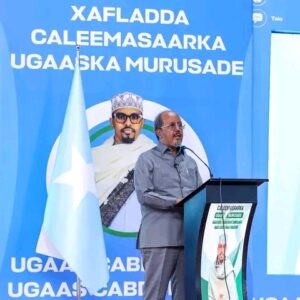
What made the president’s appearance at the inauguration of Ugaas Abdirisak Ugas Abdullahi Ugas Hashi Ugas Faracadde in Mogadishu particularly significant was not just the symbolism of unity he projected in front of traditional elders and opposition heavyweights, but the subtle layering of political messaging embedded in his remarks. While publicly framing political disputes as normal even inevitable in governance systems worldwide, the president simultaneously signaled confidence that the current standoff would resolve in his favor.
His statement that “the political disputes currently being contested will be resolved” was not merely a reassurance it was a projection of control. When he added that elders from across the five Somali regions would “return with good news,” it hinted at a process already underway behind closed doors, one that may not necessarily align with the expectations of the opposition.
At the heart of the dispute lies a fundamental disagreement over legitimacy, when exactly does the president’s mandate expire, and under what constitutional framework should Somalia proceed toward the 2026 elections? The opposition maintains that May 15 marks the end of Hassan Sheikh Mohamud’s tenure based on the previous electoral arrangement. The administration, however, has anchored its position on constitutional changes that effectively reset the timeline, extending the mandate to next year while transitioning the country toward a one-person, one-vote electoral system.
This is not a minor procedural disagreement. It is an existential political battle over the rules of the game itself.
The opposition’s argument is rooted in continuity they view the current administration as bound by the terms under which it was elected. Any attempt to extend that mandate, in their view, constitutes a breach of political trust and a dangerous precedent that could erode institutional credibility. From their perspective, the constitutional amendments appear less like reform and more like strategic timing designed to consolidate power.
Yet, dismissing the administration’s position as purely opportunistic would be an oversimplification. The push toward universal suffrage long seen as a critical step in Somalia’s democratic evolution has been a consistent demand from both domestic actors and international partners. By embedding this transition within the constitutional framework, the president’s camp argues that they are not extending power arbitrarily, but rather aligning the country with a more legitimate and inclusive electoral system.
This is where the political chessboard becomes particularly complex.
Hassan Sheikh Mohamud is not approaching this confrontation as a newcomer. He is one of the few Somali political figures who has operated on both sides of the divide government and opposition and that experience is now shaping how he navigates the current crisis. During previous electoral cycles, he was part of the very opposition machinery that is now challenging him. He understands their tactics, their pressure points, and perhaps most importantly, their limitations.
This dual perspective explains why the president appears unusually calm in the face of mounting criticism. To his supporters, this calmness reflects confidence rooted in legal and political preparedness. To his critics, it signals a calculated effort to outmaneuver the opposition while maintaining a public image of openness and dialogue.
But the truth likely lies somewhere in between.
By inviting elders to remain in Mogadishu and engage in consultations on national issues, the president is effectively shifting part of the political negotiation away from formal opposition channels and into traditional structures of authority. In Somalia’s political ecosystem, clan elders carry significant influence, often acting as intermediaries in moments of crisis. Their involvement introduces an additional layer of legitimacy to any eventual outcome but it also complicates the opposition’s strategy.
If the elders endorse or even partially validate the government’s position, the opposition risks losing not just the argument, but the narrative.
At the same time, the reliance on elder mediation raises its own set of questions. Should traditional leaders play a formalized role in constitutional and electoral negotiations? While their involvement can facilitate consensus, it can also blur the lines between modern state institutions and customary authority, potentially undermining efforts to build a more structured political system.
The president himself alluded to this debate, acknowledging the ongoing discussion about whether elder mediation should be institutionalized in handling sensitive national issues. This is not a trivial matter it touches on the very nature of governance in Somalia and how power is negotiated, distributed, and legitimized.
Meanwhile, the opposition faces a strategic dilemma.
Pushing too aggressively against the administration’s position risks alienating the very elders whose support they may need. Yet, adopting a more conciliatory approach could be interpreted as weakness, especially among their political base. The clock whether real or perceived is also working against them. If the administration succeeds in normalizing the extended timeline, the urgency of their argument may gradually diminish.
There is also the question of public perception.
Somalia’s population, particularly younger voters, has increasingly shown interest in a more direct electoral system. The promise of one-person, one-vote carries significant appeal, even if the process of getting there is contested. If the administration successfully frames the constitutional changes as a necessary step toward that goal, the opposition could find itself on the defensive, appearing to resist progress rather than defend legality.
This is where Hassan Sheikh Mohamud’s political instincts come into play.
By emphasizing unity during the inauguration ceremony and framing disputes as temporary, he is attempting to control the tone of the conversation. Instead of allowing the narrative to be dominated by accusations of illegitimacy, he is positioning himself as a stabilizing figure someone who acknowledges differences but remains confident in eventual resolution.
It is a subtle but powerful reframing.
Rather than engaging in direct confrontation, the president is allowing the process dialogue with elders, constitutional interpretation, and gradual normalization to work in his favor. This approach reduces the risk of escalation while buying time for his administration to consolidate its position.
But time, in politics, is never neutral.
For the opposition, every passing day without a decisive resolution strengthens the administration’s argument. The longer the status quo holds, the more it begins to resemble the new normal. This is why their insistence on the May 15 deadline is so critical it is not just a date, but a symbolic line in the sand.
The coming weeks will likely determine whether that line holds or fades.
At the center of it all is a broader question about Somalia’s political trajectory. Is the country moving toward a more institutionalized, rules-based system, or are the rules themselves still subject to negotiation depending on who holds power? The answer may not be clear in the immediate term, but the current standoff is undoubtedly shaping the contours of that future.
Trending
- Drone Diplomacy: How Turkey’s Bayraktars Are Reshaping Somalia and Africa’s New Wars
- Ethiopia’s Somalia Ambassador Leaves Mogadishu After Just Over a Year, Raising Fresh Questions Over Diplomatic Ties
- Somalia and Qatar Move to Deepen Strategic Ties as Hamza Holds Talks in Doha
- “I Want to Declare Equalisation as Dead”: Keynan’s Explosive Attack Collides With Ahmed Abdullahi’s Case for More Resources to Kenya’s Periphery
- WHEN SOMALIA’S SUPREME COURT MOVES, POLITICS SHIFTS: The Galmudug Ruling and the Return of an Old Constitutional Fault Line
- WHEN THE WATCHDOG BECOMES THE CAMPAIGN MACHINE: THE QUIET COLLAPSE OF JOURNALISM IN NORTH EASTERN KENYA
- MOGADISHU’S EVICTION CRISIS: WHEN THE STATE TURNS ITS GUNS ON ITS OWN PEOPLE
- “THE KING OF THE NORTH?” THE WAR OVER ADEN DUALE’S POLITICAL EMPIRE AND WHY RUTO SHOULD BE WATCHING
POWER, TIME, AND THE RULES OF THE GAME: INSIDE SOMALIA’S HIGH-STAKES POLITICAL STANDOFF AS HASSAN SHEIKH OUTMANEUVERS AN OPPOSITION RACING AGAINST THE CLOCK
Keep Reading
Add A Comment
Siyad Reports
Quick Links
Subscribe to Updates
Get the latest news from Siyad Reports about world, sports and technology.
© 2026 Siyad Reports. Designed by Okumu Collince.