

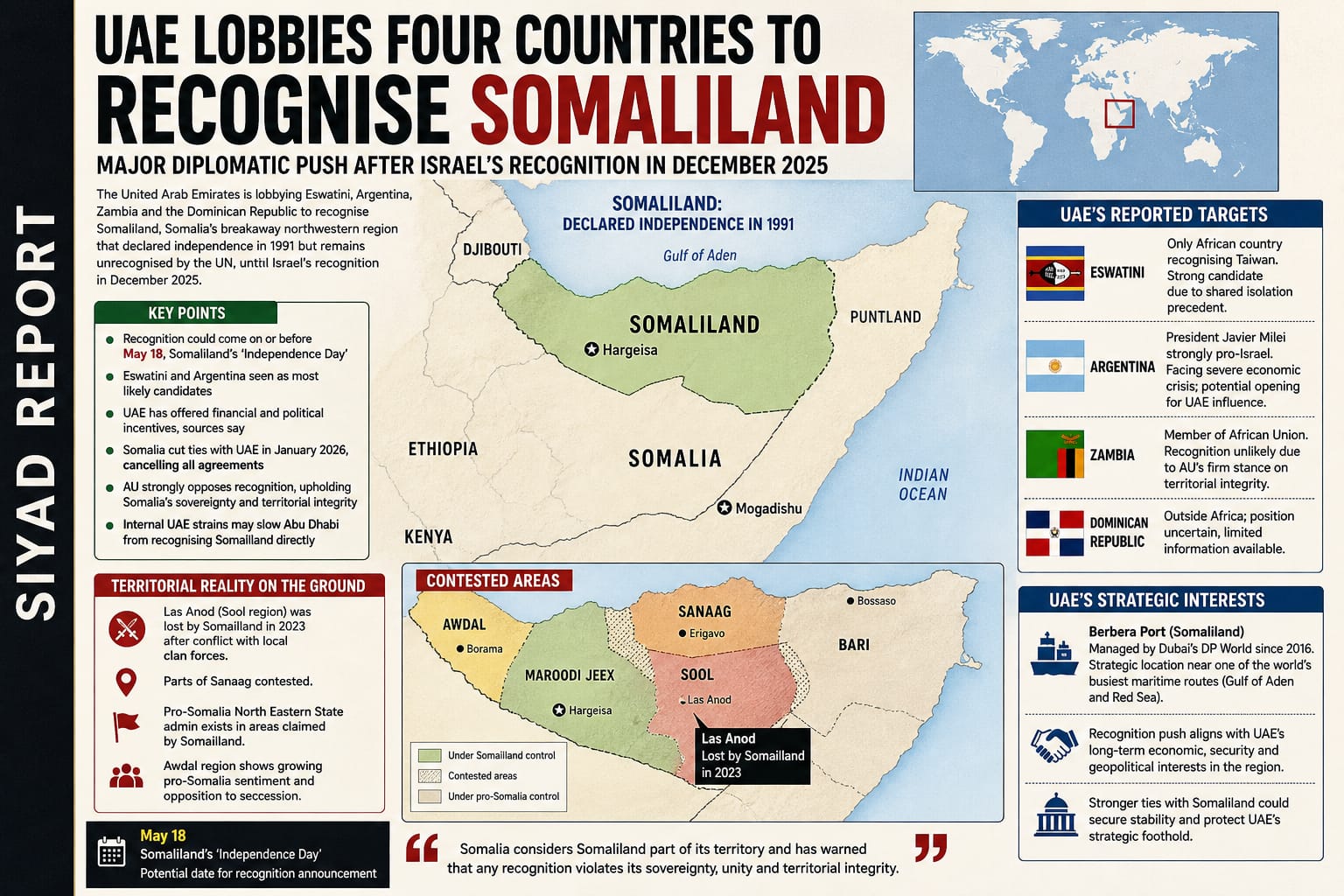
A new and potentially consequential diplomatic contest is unfolding around Somaliland, as reports indicate that the United Arab Emirates is actively lobbying a group of countries to formally recognise the self-declared republic an effort that, if successful, could fundamentally alter the political, legal, and strategic landscape of the Horn of Africa.
According to Somali diplomatic and intelligence sources, Abu Dhabi is pushing at least four states Eswatini, Argentina, Zambia, and Dominican Republic to take the unprecedented step of recognising Somaliland, a region that declared independence from Somalia in 1991 but has remained largely unrecognised by the international community for more than three decades.
This reported lobbying effort comes in the wake of a major diplomatic breakthrough for Somaliland in December 2025, when Israel became the first United Nations member state to formally recognise it.
That move alone disrupted long-standing international consensus around Somalia’s territorial integrity, but what is now emerging suggests something far more coordinated and strategic: a broader recognition campaign that could transform Somaliland from a de facto state into a partially recognised one, thereby opening the door to new diplomatic, economic, and military relationships.
At the center of this evolving situation is Somaliland’s current president, Abdirahman Mohamed Abdullahi Irro, whose recent visit to Abu Dhabi in April 2026 is now being viewed through a more strategic lens. While officially described as a diplomatic engagement, Somali officials believe the trip was part of a wider coordination effort with Emirati leadership to accelerate international recognition.
The symbolism of timing also matters. Somaliland marks May 18 as the day it “restored” its independence, and sources suggest that any recognition announcements could be deliberately aligned with that date to maximise political and symbolic impact.
The countries reportedly being targeted by the UAE are not random selections; each presents a unique diplomatic opportunity shaped by its own geopolitical positioning. Eswatini, for example, stands out because of its long-standing recognition of Taiwan a position that already places it outside the mainstream of global diplomatic alignment.
Somaliland and Taiwan have themselves built a relationship rooted in shared diplomatic isolation, having established representative offices in each other’s capitals in 2020. For Abu Dhabi, leveraging this precedent could be a strategic pathway: if Eswatini is willing to defy larger geopolitical pressures in one case, it might be persuaded to do so again.
Argentina, on the other hand, represents a different kind of opportunity. Under President Javier Milei, Buenos Aires has adopted a more unconventional and ideologically driven foreign policy, particularly in its strong alignment with Israel.
Milei’s willingness to challenge traditional diplomatic norms combined with Argentina’s ongoing economic crisis makes it a potentially receptive target for Emirati influence, whether through political alignment, economic incentives, or strategic partnerships. Somali officials suspect that coordination between Abu Dhabi and Tel Aviv may be playing a role in efforts to bring Argentina on board.
Zambia and the Dominican Republic present more uncertain prospects. Zambia, as a member of the African Union, is bound by a long-standing continental consensus that strongly opposes the recognition of breakaway regions, largely due to fears of setting precedents that could destabilise African borders.
The African Union has consistently reaffirmed its support for Somalia’s sovereignty and territorial integrity, making any deviation by a member state both politically sensitive and diplomatically costly. The Dominican Republic, meanwhile, sits outside the African political framework, making its calculations less constrained by continental norms but still influenced by broader international dynamics.
Beyond the diplomatic maneuvering lies a deeper strategic logic tied to the UAE’s long-term interests in the region. One of the most critical assets in this equation is the port of Berbera, developed and managed by DP World, a Dubai-based global ports operator.
Located along the Gulf of Aden, Berbera sits near one of the world’s most vital maritime corridors, connecting the Red Sea to the Indian Ocean. Control and stability in this area are of immense importance not just for commercial shipping but also for military and geopolitical positioning. For Abu Dhabi, ensuring that Somaliland remains a stable and cooperative partner is not just a diplomatic preference it is a strategic necessity.
Recognition of Somaliland by multiple states could help solidify that stability by granting Hargeisa greater international legitimacy, potentially unlocking access to international financial systems, development aid, and security partnerships. It would also reduce the legal and political risks associated with operating in a territory that is not widely recognised.
In this sense, the UAE’s lobbying efforts can be seen not merely as diplomatic activism but as a calculated investment in protecting and expanding its influence along a critical global trade route.
However, this strategy is not without risks, both externally and internally. Somalia has already taken a hardline stance, severing diplomatic ties with the UAE in January 2026 and cancelling all bilateral agreements, including those related to defence and port operations.
Mogadishu views any recognition of Somaliland as a direct violation of its sovereignty and has signaled that it will respond strongly to any country that takes such a step. This raises the possibility of escalating diplomatic tensions not only between Somalia and the UAE but also between Somalia and any new states that recognise Somaliland.
Internally, the UAE itself may not be entirely unified on this issue. Reports though unverified suggest growing unease among some leaders in Dubai and Sharjah regarding the foreign policy direction set by President Mohammed bin Zayed Al Nahyan.
Concerns reportedly center on the costs and risks of extensive foreign engagements, as well as the centralisation of power in Abu Dhabi. A cryptic public comment by Dubai ruler Mohammed bin Rashid Al Maktoum, criticising officials “obsessed with personal success,” has been interpreted by some analysts as a subtle signal of internal tension. While such interpretations remain speculative, they highlight the possibility that internal dynamics could influence the pace and scope of any Emirati move on Somaliland.
Even if the UAE succeeds in securing additional recognitions, a fundamental question remains unresolved: territory. Somaliland’s claim to independence is based on the borders of the former British Somaliland protectorate, but its control over those areas is increasingly contested.
The loss of Las Anod in 2023 following conflict in the Sool region exposed the fragility of its territorial grip, while ongoing disputes in Sanaag and emerging pro-Somalia administrations in parts of the region further complicate the picture. In Awdal, rising opposition to secession adds another layer of internal challenge.
These realities underscore a critical point: international recognition, while symbolically powerful, does not automatically translate into effective statehood. A recognised Somaliland would still face the practical challenge of governing disputed territories and managing internal divisions.
For the international community, this raises complex questions about what exactly would be recognised a clearly defined and controlled state, or a political entity with unresolved internal boundaries.
What is unfolding, therefore, is not just a diplomatic campaign but a multi-layered geopolitical contest involving questions of sovereignty, strategic interests, regional stability, and international law.
The UAE’s reported lobbying efforts signal a willingness to challenge established norms in pursuit of long-term strategic gains, while Somalia’s firm opposition reflects the enduring importance of territorial integrity in international relations.
As May 18 approaches, attention will be focused not only on whether any new recognitions are announced, but also on how the broader international system responds.
Will other countries follow Israel’s lead, creating a cascade effect that gradually normalises Somaliland’s status? Or will resistance from Somalia and the African Union hold the line, preserving the current status quo?
The answer to that question will shape not only the future of Somaliland but also the balance of power in the Horn of Africa a region where local conflicts and global interests are increasingly intertwined.