

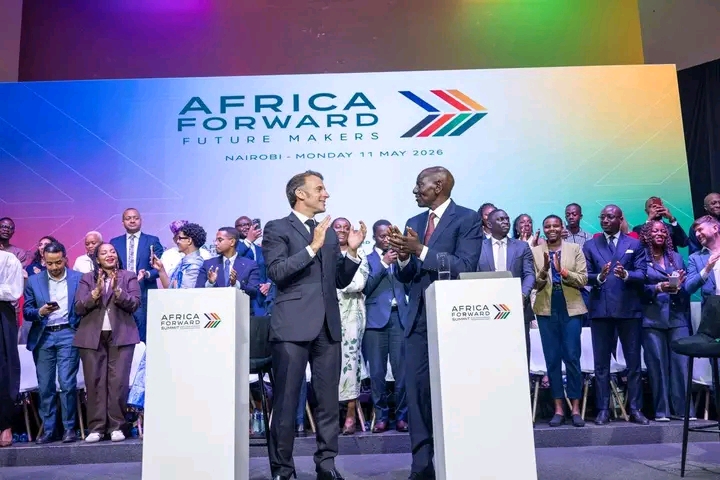
Kenya has this week positioned itself at the center of Africa’s economic and diplomatic conversations after President William Ruto and French President Emmanuel Macron officially launched the Africa Forward Summit in Nairobi, a high-level continental gathering aimed at shaping Africa’s economic future through investment, innovation, and global cooperation.
The two-day summit, taking place on May 11 and 12 in Nairobi, has brought together more than 30 heads of state and government alongside over 4,000 delegates drawn from Africa, Europe, Asia, and other parts of the world. Among those attending are business executives, investors, innovators, diplomats, policymakers, and development partners seeking to forge new partnerships and accelerate Africa’s economic transformation.
The summit marks a historic milestone as it becomes the first edition of the forum to be hosted in an English-speaking African country, reflecting Kenya’s growing diplomatic and economic influence on the continent. The gathering is being viewed as a strategic platform where African leaders and global partners can jointly explore sustainable growth opportunities while addressing some of the most urgent challenges facing the continent.
Speaking during the opening ceremony, President Ruto described the summit as a turning point for Africa’s economic ambitions, saying the continent must move beyond dependency and instead focus on partnerships that create value, jobs, innovation, and industrial growth.
“As part of the strengthening of the strategic partnership between Kenya and France, our two countries today signed right here 11 instruments aimed at deepening cooperation across strategic sectors of our economies,” Ruto said during the summit.
The event has heavily focused on issues shaping Africa’s long-term development agenda, including reforms in the global financial system, climate action, clean energy transition, digital transformation, artificial intelligence, resilient healthcare systems, food security, peace and security, green industrialization, and the blue economy.
One of the summit’s key highlights has been a major business forum that attracted around 1,500 corporate leaders, financiers, innovators, and investors. Organizers say the forum is expected to unlock billions of shillings in investment opportunities, partnerships, financing arrangements, and technology transfer agreements across strategic sectors.
At the center of the summit discussions was the growing economic cooperation between Kenya and France, with the two governments unveiling several major agreements expected to reshape Kenya’s infrastructure, transportation, energy, logistics, and employment sectors.
Among the most significant announcements made during the summit was a new agreement under which France will support Kenya in the rehabilitation and expansion of the Nairobi Commuter Rail System, a project expected to modernize urban transportation within the capital and ease chronic traffic congestion.
The KSh12.5 billion railway modernization project, equivalent to approximately £83 million, forms part of Kenya’s wider urban transport modernization program aimed at improving mobility and reducing pressure on Nairobi’s roads.
“Among the key instruments signed today is the rehabilitation and modernisation of the £83 million or KSh12.5 billion Nairobi commuter rail, which will serve as a central pillar of our urban transport modernisation program,” President Ruto announced.
The government plans to rehabilitate and construct approximately 165 kilometers of commuter rail network across Nairobi and surrounding areas by 2030. Once completed, the upgraded system is expected to transport nearly 30,000 passengers every hour, significantly improving public transport efficiency in one of Africa’s fastest-growing cities.
The commuter rail project will also expand railway connectivity to major satellite towns and urban centers including Embakasi, Ruiru, Siokimau, and Kikuyu, helping thousands of daily commuters access Nairobi more efficiently.
The agreement is further expected to accelerate the implementation of the planned 30.5-kilometer Riruta–Ngong–Kiserian–Ongata Rongai railway corridor, which has long been viewed as critical to decongesting the rapidly expanding southern Nairobi metropolitan region.
The rail expansion project complements broader efforts by Kenya and its international partners to modernize Nairobi’s transport infrastructure. Earlier this year, members of the G7 nations, including Canada, France, Germany, Italy, Japan, the United Kingdom, and the United States, pledged support for additional flagship transport initiatives in Nairobi, including Bus Rapid Transit (BRT) systems and non-motorized transport infrastructure.
Beyond transport infrastructure, Kenya and France also signed agreements targeting climate resilience, agriculture, maritime logistics, energy development, and overseas employment opportunities for Kenyan workers.
Part of the agreements includes enhanced support for the Kenya Meteorological Service Authority to strengthen weather forecasting and climate prediction systems, a move expected to improve agricultural planning and food security in a country heavily dependent on rain-fed farming.
France also pledged support for Kenya’s ambitious nuclear energy development plans as the East African nation seeks to increase its electricity generation capacity from approximately 3,000 megawatts to 10,000 megawatts in the coming years.
The cooperation in the energy sector is expected to play a key role in Kenya’s long-term industrialization ambitions and clean energy transition agenda, particularly as African countries continue seeking alternative and sustainable sources of power to support manufacturing and economic growth.
Another major area of cooperation announced during the summit concerns overseas employment opportunities for Kenyan workers, with France agreeing to expand labor mobility partnerships that could allow more Kenyan professionals and skilled workers access to employment opportunities abroad.
At the same time, Kenya is expected to increase exports of premium Kenyan tea to France as part of broader efforts to strengthen trade relations between the two countries.
“Our priority is clear: to step up investments and strengthen our cooperation programmes in healthcare, education, food, digital technology, energy, and infrastructure,” President Macron said following the signing of the agreements.
Macron further emphasized the importance of building balanced partnerships with African countries based on shared economic growth, innovation, sustainability, and mutual respect.
The summit also witnessed the signing of a major logistics agreement worth approximately $806 million aimed at developing and expanding the Mombasa Deep-Water Port, one of the largest infrastructure investments announced during the forum.
The expansion project is expected to significantly boost trade capacity and logistics services not only for Kenya but also for the wider East African region, which relies heavily on the Port of Mombasa as a gateway for imports and exports.
The modernization of the port infrastructure is anticipated to increase cargo handling efficiency, improve maritime operations, reduce shipping delays, and strengthen Kenya’s position as a regional trade and logistics hub.
Analysts say the investment could have far-reaching economic implications for East Africa by enhancing regional connectivity, lowering transport costs, and attracting more global shipping and manufacturing companies into the region.
The agreements signed during the Africa Forward Summit come at a time when African countries are increasingly seeking diversified global partnerships capable of supporting infrastructure development, industrialization, technology transfer, and climate adaptation efforts.
For Kenya, the summit represents a major diplomatic and economic achievement as the country continues positioning itself as one of Africa’s leading financial, logistical, and innovation hubs.
Nairobi’s successful hosting of the summit also reinforces Kenya’s growing reputation as a preferred destination for major international conferences and high-level diplomatic engagements.
Observers note that the scale of participation at the summit reflects increasing international interest in Africa’s economic potential, particularly in sectors such as renewable energy, digital innovation, transport infrastructure, healthcare, agriculture, and manufacturing.
The forum has also highlighted Africa’s growing demand for reforms within the global financial system, with several leaders calling for fairer financing structures, debt reforms, climate financing support, and stronger representation for African economies in global decision-making institutions.
As discussions continue, the Africa Forward Summit is already being viewed as one of the most significant diplomatic and economic gatherings hosted on the continent this year.
The agreements announced between Kenya and France are expected to deepen bilateral relations while accelerating Kenya’s infrastructure modernization agenda and creating new economic opportunities for businesses, investors, and ordinary citizens alike.
For President Ruto’s administration, the summit offers an opportunity to showcase Kenya’s ambitions as a regional economic powerhouse and a gateway for international investment into Africa.
For Africa more broadly, the summit represents an attempt to redefine the continent’s place within the global economy not merely as a recipient of aid, but as a strategic partner in shaping the future of trade, technology, climate solutions, and sustainable development.