

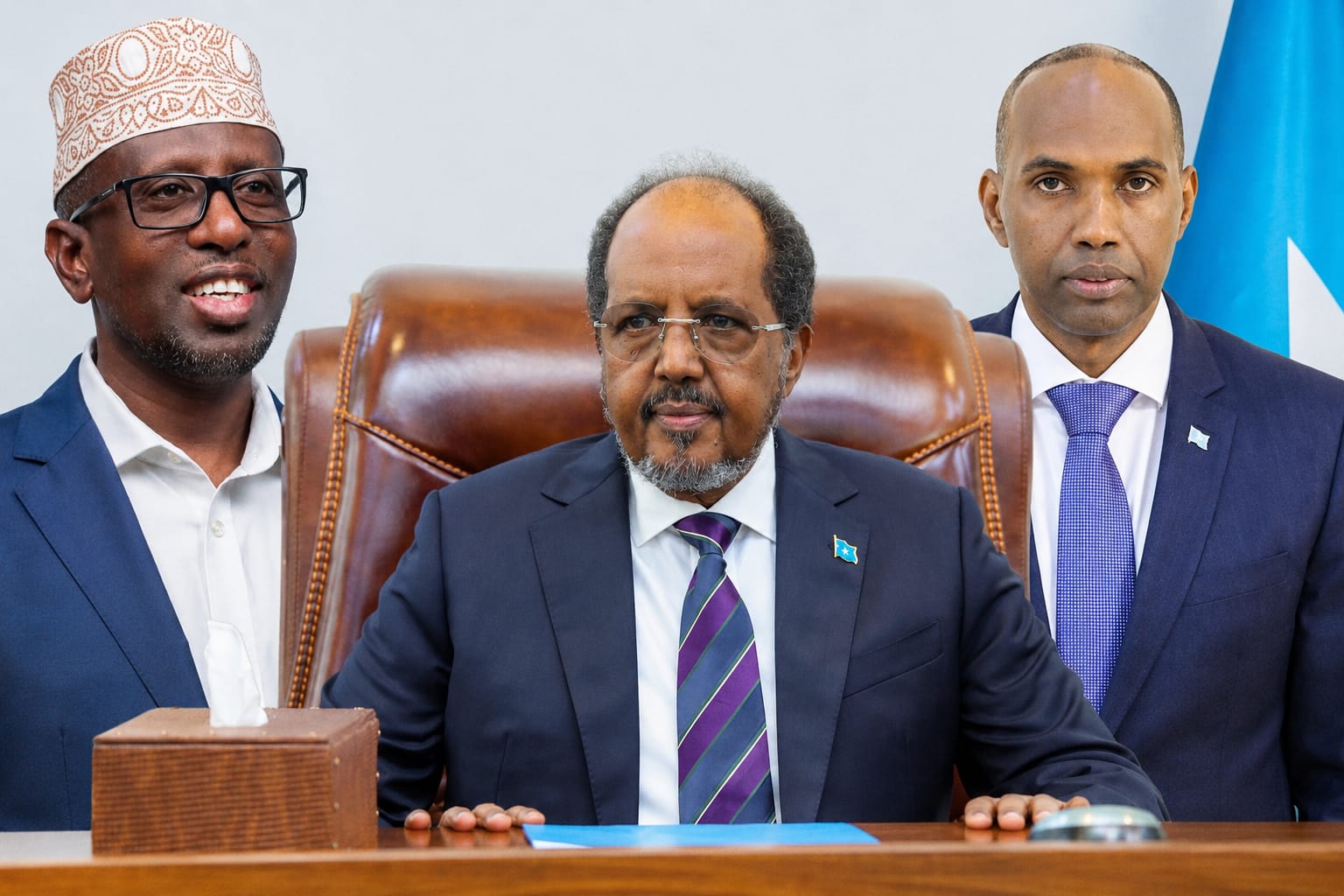
Mogadishu has experienced one of its most intense political-military crises in recent years after heavy gunfire and armed clashes erupted across multiple districts of the capital, involving government forces and armed groups linked to opposition leaders during a high-stakes period of political tension. What began as a reported attack on a mediation meeting involving traditional elders quickly escalated into citywide fighting, leaving parts of the capital paralyzed for over 20 hours before finally calming down following mediation efforts and international pressure.
The crisis reportedly began on Wednesday afternoon when heavy gunfire broke out at a residence where traditional elders and political leaders were holding a critical reconciliation meeting involving former Somali Prime Minister Hassan Ali Khaire and a delegation of elders led by Ugaas Mohamud Ali Ugaas. The meeting, according to sources, was part of ongoing efforts to mediate Somalia’s deepening political standoff. Witnesses said gunfire erupted suddenly while the discussions were ongoing, forcing those present to take cover as the situation deteriorated rapidly.
The targeted delegation reportedly included senior figures such as Senator Abdi Hassan Dhuhulow (Dhagdheer), MP Ugaas Dhagay, and Muhiyadiin Saabay, all of whom were participating in what was described as a sensitive reconciliation dialogue. The abrupt outbreak of violence immediately raised alarm across the city, with conflicting claims emerging about responsibility.
Shortly after, reports emerged that the residence of former President Sheikh Sharif Sheikh Ahmed had also been targeted by armed forces, further escalating tensions. These developments fueled accusations from opposition figures who claimed that state security forces were being used to suppress political dissent and disrupt peaceful gatherings. In a strongly worded statement, Hassan Ali Khaire alleged that the attacks were carried out by forces acting under orders from President Hassan Sheikh Mohamud, claims that the government has not independently verified in the public domain.
As the situation intensified, additional incidents were reported in different parts of Mogadishu, including Howlwadaag district where Somali Police Force checkpoints came under attack. The police later confirmed that armed men targeted a security checkpoint and a tax protection unit, accusing the attackers of damaging facilities, civilian property, and endangering residents. Authorities described the attackers as masked gunmen and said investigations had been launched through the Criminal Investigation Department.
The Federal Government of Somalia responded by issuing a strong statement condemning the violence, alleging that armed militias linked to opposition political figures had carried out coordinated attacks against security installations. Officials said the attackers had disguised themselves and used heavy weaponry, damaging infrastructure and threatening civilian safety. The government also vowed that those responsible would face legal consequences and reiterated its commitment to restoring order in the capital.
Opposition figures rejected these accusations, instead alleging that government forces had launched coordinated assaults on political meetings and residential areas. Khaire claimed that for more than 20 hours, heavy weaponry including drones and anti-tank arms had been used against him and other opposition leaders, including former President Sheikh Sharif Sheikh Ahmed, as well as traditional elders involved in mediation efforts. He described the situation as politically motivated repression and called on international partners to intervene and uphold constitutional order.
As gunfire spread, multiple districts including Hodan, Howlwadaag, Abdiaziz, Karaan, and areas near Bakara Market were engulfed in clashes. Residents reported hearing explosions, including rocket-propelled grenades, with some describing mortar shelling in densely populated neighborhoods. Witnesses said panic spread quickly, with families fleeing their homes as heavy fighting intensified near strategic junctions such as Sayidka and Dabka.
Military movements increased across the capital as both sides deployed armed personnel to key locations, including roads leading toward Villa Somalia, the presidential palace. Armored vehicles were seen along Maka Al-Mukarama road, while reports indicated that both government-aligned and opposition-aligned forces took up positions in multiple districts. The violence disrupted daily life, with electricity outages reported in several neighborhoods and widespread fear among civilians.
By late Wednesday night, the fighting had escalated into a full-scale urban confrontation. Reports suggested that opposition-aligned forces and government troops exchanged heavy fire for more than 15 hours, with intermittent clashes continuing into the early hours of Thursday. The violence also led to the closure of Aden Adde International Airport and the Port of Mogadishu, reflecting the severity of the security breakdown.
The Somali Police Force later confirmed that masked attackers had targeted security checkpoints and public infrastructure in Howlwadaag, while government officials accused opposition-linked militias of attempting to destabilize the capital. In contrast, opposition leaders maintained that they were preparing for peaceful demonstrations and accused the government of attempting to block public gatherings and silence dissent.
The political dimension of the crisis became more pronounced as both sides exchanged accusations over Somalia’s constitutional and electoral future. Opposition leaders argued that the president’s mandate had expired and rejected claims of legitimacy under recent constitutional changes extending the presidential term. The Federal Government, however, insisted it remained committed to transitioning toward a one-person, one-vote electoral system, replacing the traditional clan-based selection model.
Amid the escalating violence, international concern quickly grew. The United States Embassy in Mogadishu warned that the situation could have lasting consequences for Somalia’s unity and stability if not resolved peacefully. The United Kingdom Embassy also issued a statement calling for restraint and urging all parties to engage in dialogue. A broader joint statement from the international community emphasized the need to avoid further escalation and protect civilians.
Regional diplomatic involvement also emerged during the crisis. Reports confirmed that a senior official from Turkey’s National Intelligence Organization (MİT) was expected to arrive in Mogadishu to assist in mediation efforts between the conflicting parties. Turkey reportedly expressed strong opposition to the fighting and sought to facilitate de-escalation through dialogue.
As the clashes continued into their 20th hour, uncertainty gripped the capital. Mortar fire was reported in multiple districts, while armed groups maintained positions near key political and security sites. Civilian casualties were feared, though exact figures remained unconfirmed amid the chaos. Many residents spent the night in fear, unable to move freely due to roadblocks, gunfire, and military presence.
By Thursday morning, however, a significant shift occurred. After sustained pressure from international partners and local mediation efforts led by elders and officials, reports confirmed that active fighting had largely stopped. Eyewitnesses in affected districts reported that gunfire had subsided, and security forces began repositioning as discussions continued between the conflicting sides.
Officials indicated that the cessation of hostilities followed negotiations aimed at calming tensions, with both sides reportedly agreeing to pause direct confrontation while broader political discussions continued. The government was said to be insisting on withdrawal from contested areas, while also expressing willingness to engage in dialogue regarding the wider political crisis.
Although the situation has stabilized for now, Mogadishu remains deeply tense, with fears that the underlying political dispute has not been resolved. The crisis has highlighted the fragility of Somalia’s security environment and the high stakes surrounding its ongoing constitutional and electoral disagreements.
For now, the capital is quiet again but the events of the past 20 hours have left a city shaken, politically divided, and watching closely to see whether this fragile calm will hold or collapse once more into violence.