

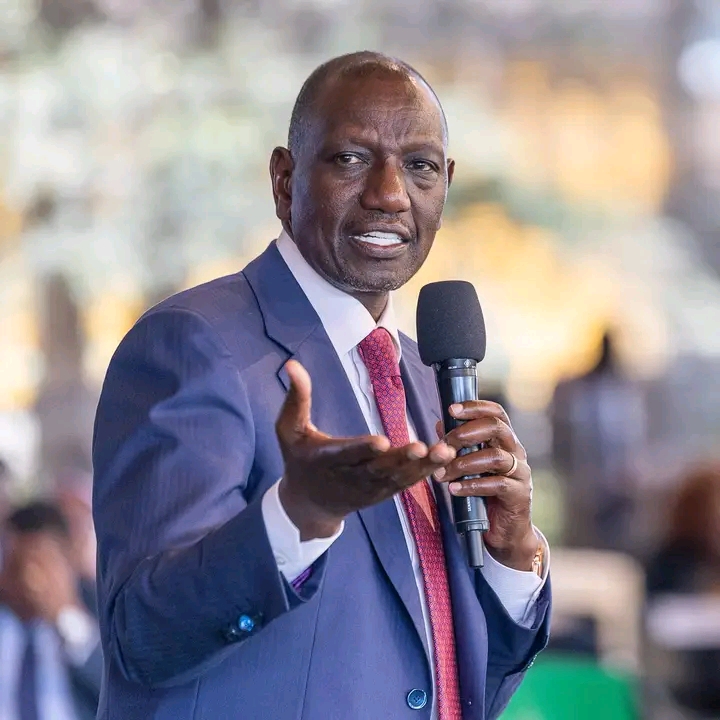
President William Ruto has launched a national dialogue on Kenya’s long-term future, calling for a new development blueprint that will look beyond Vision 2030 and position the country among the world’s wealthy and developed nations.
Speaking in Nairobi during the Beyond 2030 Vision Dialogue, Ruto proposed the establishment of a technical committee to help steer the process, arguing that Kenya must now develop a long-term national plan that survives changes in government, political cycles and economic uncertainties.
Ruto said the conversation had become necessary because Vision 2030 is approaching its conclusion, while the world has undergone profound changes driven by technology, artificial intelligence and climate change.
He also noted that Vision 2030 was developed before the promulgation of the 2010 Constitution, which created a different institutional and governance framework for long-term national planning.
“Beyond 2030 is our collective responsibility,” Ruto said, insisting that no individual or political group has a monopoly on ideas about Kenya’s future.
The President said Kenya must take advantage of Africa’s changing position in the global economy, arguing that the continent is becoming an increasingly important centre of global growth because of its youthful population, renewable energy potential, emerging markets and large reserves of uncultivated arable land.
“Therefore, as the centre of gravity of global growth moves to Africa, we must position Kenya appropriately so that we become that epicentre,” he said.
Ruto said Kenya should not allow electoral politics to dictate the country’s development priorities, warning that successive governments have often made decisions with the next election in mind rather than considering the needs of future generations.
“For far too long, we have made elections seem like a matter of life and death,” he said, arguing that Kenya must begin thinking beyond electoral cycles and focus on the next generation.
The President said the long-term plan should not be treated as a government initiative, but as a national undertaking that brings together farmers, entrepreneurs, students, professionals, technocrats and other Kenyans.
“This is not a government project. This is a people’s project,” Ruto said.
He said Kenya already had a foundation on which to build, pointing to progress in infrastructure, electricity connectivity, education and transport.
According to the President, Kenya now has about 20,000 kilometres of paved roads, an operational Standard Gauge Railway, the Nairobi Expressway and expanded electricity connectivity, with about 10 million households connected and the figure expected to rise to 11 million.
Ruto said these achievements should form part of the foundation for the next phase of national development.
The dialogue also brought together political leaders, governors, academics and other stakeholders, with speakers emphasizing that the country’s long-term development must remain protected from political disruption.
Deputy President Kithure Kindiki urged Kenyans to separate political competition from the question of national development, saying political disagreements should not be allowed to derail the country’s economic progress.
“We can politicize everything else, but let us not politicize the development of this country,” Kindiki said.
The Deputy President defended the government’s record, saying the administration had worked to stabilize the economy while addressing infrastructure, agriculture, education and sports.
Kindiki said the government inherited stalled road projects and had to mobilize resources to pay contractors before construction could resume. He argued that road construction had since expanded to counties and regions that had previously been left behind.
He also pointed to the development of sports infrastructure, including the Raila Odinga Talanta Stadium, as part of what he described as the government’s investment in Kenya’s sporting future ahead of the 2027 Africa Cup of Nations, which Kenya will co-host with Uganda and Tanzania.
In agriculture, Kindiki said the government had registered farmers, strengthened agricultural value chains and introduced measures aimed at improving farmers’ earnings.
He cited changes in the coffee sector, claiming that efforts to dismantle cartels had enabled more farmers to benefit from the industry. He also said the government had moderated maize flour prices.
Kindiki further defended the administration’s economic record, saying that Kenya had made progress in stabilizing the economy and supporting economic development during Ruto’s first four years in office.
“I am proud to report that in the last four years, under the leadership of President Ruto, we have been able to take this country forward through the stabilization of the economy and economic development,” he said.
Education was another area highlighted by the Deputy President, who said uncertainty surrounding the transition to the Competency-Based Curriculum had been addressed and that the government had increased funding for education, including at university level.
Kindiki said Kenya had the potential to join the ranks of wealthy and developed nations, but argued that this would require consistent leadership and a national commitment that extends beyond political contests.
“I believe that Kenya is able to get into the league of wealthy and developed countries. We only need good leadership. It is possible,” he said.
Professor Hiroyuki Hino of Duke University, however, placed the ambition in a wider economic context, acknowledging the scale of the challenge facing Kenya.
Hino said some Kenyans were skeptical about the idea of using Singapore as a development benchmark because of the enormous gap between the two economies.
He noted that Singapore’s income per person had exceeded $80,000 in the previous year, compared with just over $2,000 in Kenya.
But Hino argued that Kenya possesses important human qualities that could support rapid economic transformation, particularly among young people.
He said Kenyan children demonstrate high levels of optimism, perseverance, hope and confidence in the future, alongside strong engagement, connectedness and happiness.
The Singapore comparison was also raised by ODM leader Oburu Odinga, who said Kenya could achieve similar levels of development if it confronted corruption, invested heavily in education and research and eliminated wastage in government.
“Education is the only equalizer, and there is no shortcut to education,” Oburu said, calling for greater investment in universities and research institutions to build the capacity required to drive innovation and international competitiveness.
He also said Kenya would need to build a society that is intolerant of corruption if it hopes to replicate the development trajectory of countries such as Singapore.
Kisumu Governor Anyang’ Nyong’o cautioned against allowing the approaching 2027 General Election to overshadow the national conversation.
Nyong’o said long-term development objectives should not be repeatedly disrupted by electoral cycles and changes in political leadership.
He called for sufficient time to be given to the process so that Kenyans can participate in an inclusive discussion about the future of the country.
The President similarly argued that Kenya needs a framework that future administrations cannot easily abandon.
Ruto said legislation should be considered to guide the country towards agreed long-term objectives, regardless of who occupies State House.
“It is important we agree on legislation that is going to guide this country towards where we want to go,” he said, arguing that no future president should be able to sabotage the collective national direction agreed upon by Kenyans.
The President acknowledged that he has ideas about Kenya’s next phase of development but said the country should collectively determine what comes next.
“I have ideas on what next, but let us agree on what comes next together,” Ruto said.
National Assembly Majority Leader Kimani Ichung’wah added another dimension to the discussion, warning that Kenya must carefully manage the relationship between population growth and economic expansion.
He said population can be a major national asset but can also place pressure on the economy if economic growth fails to keep pace.
The Beyond 2030 dialogue therefore opens a much larger national debate: what kind of country should Kenya become after Vision 2030, and what institutional framework can ensure that its development ambitions survive elections and changes in political leadership?
Ruto wants the answer to be built collectively, with a long-term vision extending well beyond the immediate political horizon.
The central challenge now will be turning the ambition of becoming a first-world country into a credible, measurable and nationally owned development strategy one capable of surviving successive administrations and translating Kenya’s demographic, agricultural, technological and economic potential into sustained prosperity.