

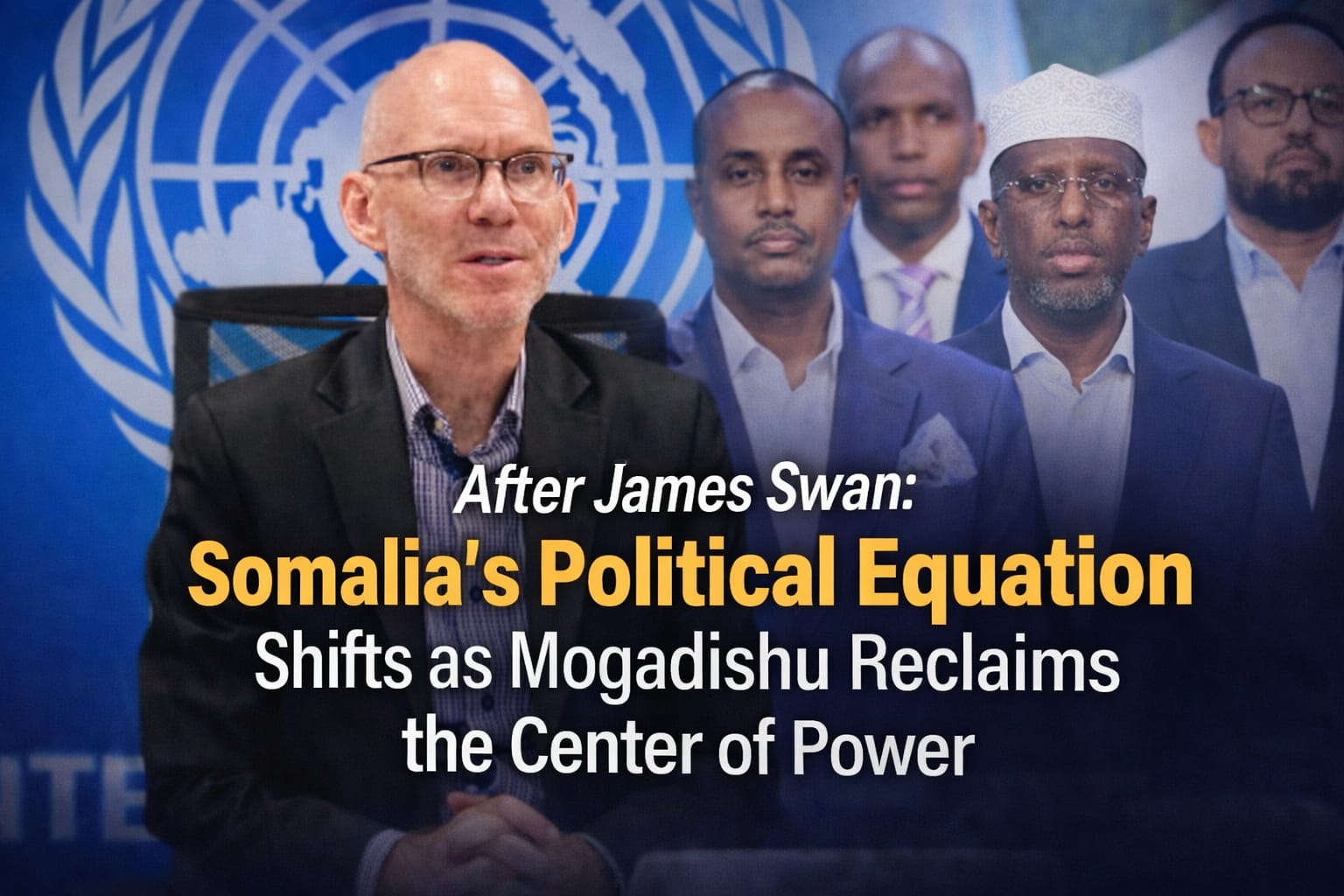
The departure of James Swan from his role in Somalia represents more than a routine diplomatic reassignment. In the context of Somalia’s fragile and often contested political environment, his exit marks the end of a chapter in which international mediation played a central role in shaping the country’s internal political disputes.
For years, Swan stood at the intersection of Somali politics, diplomacy, and power negotiations, serving as the head of the United Nations Assistance Mission in Somalia and acting as a key intermediary during some of the most sensitive political moments in recent Somali history.
His departure now raises a fundamental question for Somalia’s political future: what happens when one of the most influential external actors in the country’s political arena is suddenly no longer present?
For many years, Somalia’s political system has operated within a complex structure where domestic political actors and international stakeholders often share influence over critical decisions. Following the collapse of the Somali state in 1991, international organizations gradually became deeply embedded in the country’s political reconstruction process. Diplomats, foreign governments, and multilateral institutions helped mediate disputes, facilitate elections, and shape the constitutional frameworks that underpin the modern Somali federal system.
In this environment, the role of the UN’s Special Representative became exceptionally influential. As head of the UN mission in Somalia, James Swan was not merely a diplomat observing events from the sidelines. He often functioned as a mediator, facilitator, and in some cases a quiet political actor navigating the tensions between Somalia’s federal government and its often fractious opposition.
Over the past several months, Swan became particularly visible in the political standoff surrounding Somalia’s constitutional reform process. The federal government under Hassan Sheikh Mohamud moved forward with efforts to finalize and implement a revised constitutional framework aimed at consolidating federal authority and advancing institutional reforms.
This process, however, quickly became one of the most contentious political debates in the country.
Opposition leaders argued that the constitutional changes required broader consensus and additional consultations. Many of them warned that pushing forward without full political agreement could deepen divisions within the Somali political class.
At the same time, the government maintained that constitutional reform was essential for strengthening the state and clarifying the institutional structure of Somalia’s federal system. For President Hassan Sheikh Mohamud and his allies, the constitutional process represented a necessary step in completing Somalia’s long and unfinished state-building project.
It was in this highly charged political environment that James Swan played a central role.
As the UN’s top envoy, he engaged repeatedly with both the federal government and opposition figures, attempting to bridge the gap between competing political positions. Diplomatic pressure, quiet negotiations, and public statements from international partners often reflected the broader international community’s concern about maintaining political stability during the constitutional process.
Yet despite these pressures, the Somali government ultimately moved forward with its constitutional agenda.
President Hassan Sheikh Mohamud did not halt the process. Instead, he continued to push ahead with the reforms and eventually signed the new constitutional changes into effect.
This decision represented a significant assertion of political authority by the Somali government. It demonstrated that Mogadishu was prepared to move forward with major national decisions even in the face of international caution and opposition criticism.
Now, with James Swan no longer in his role, the political landscape surrounding that decision appears to be shifting.
For the Somali opposition, Swan’s presence had represented an important diplomatic channel. International envoys often serve as platforms through which opposition figures can raise concerns, seek mediation, and apply pressure on governments through international networks.
In Somalia, this dynamic has often played out in the diplomatic enclave known as Halane Base Camp, where many international organizations and foreign missions are based.
Halane has long functioned as a hub of international engagement in Somalia. Diplomats, security officials, development agencies, and political mediators operate from the compound, making it one of the most important centers of international influence in the country.
Opposition politicians frequently engage with diplomats and international representatives there, seeking support or raising concerns about government policies.
With Swan gone, however, the dynamics of that engagement may change.
While the international community remains deeply involved in Somalia, the absence of a diplomat who had developed extensive relationships across the Somali political spectrum inevitably alters the balance of influence.
For opposition leaders who had relied on Swan’s mediation, the immediate question becomes one of strategy. Without a familiar international intermediary, their ability to mobilize diplomatic pressure against the government may become more complicated.
This does not mean that the opposition has lost its political relevance. Somalia’s political system remains pluralistic, with multiple actors competing for influence within the federal structure.
But the political tools available to opposition figures may evolve.
Rather than relying heavily on international mediation, opposition leaders may increasingly need to engage directly with Somali institutions and political constituencies to advance their agendas.
For the federal government, the situation presents both an opportunity and a responsibility.
The opportunity lies in the possibility of consolidating greater control over Somalia’s internal political processes. If external mediation becomes less central, the government may have greater freedom to pursue its policy agenda and institutional reforms.
But that freedom also comes with expectations.
If Mogadishu asserts greater sovereignty over political decision-making, it must also demonstrate that Somali institutions can effectively manage political disagreements without external intervention.
This means strengthening parliamentary debate, enhancing judicial independence, and ensuring that political competition occurs within democratic frameworks.
Somalia’s political maturity will increasingly be judged by its ability to resolve disputes internally.
The broader geopolitical context also matters.
Somalia’s international partners remain deeply invested in the country’s stability. Security cooperation, economic support, and humanitarian assistance continue to depend on constructive relationships between Mogadishu and the international community.
The removal of one envoy does not signal the end of international engagement. Rather, it represents a shift in how that engagement may evolve.
Future UN representatives will likely continue to support Somalia’s state-building efforts, but the nature of their involvement may gradually change as Somali institutions gain confidence and capacity.
In many ways, the moment reflects a broader transition in Somalia’s political development.
Countries emerging from prolonged instability often move through stages in their relationship with international actors.
Early phases involve heavy international oversight and mediation. Later phases see domestic institutions gradually taking the lead in governance and political negotiation.
Somalia appears to be navigating this transition.
President Hassan Sheikh Mohamud’s decision to proceed with constitutional reforms despite international caution suggests a leadership willing to assert national authority. Whether that authority leads to stronger institutions or deeper political divisions will depend on how the government manages its relationship with
opposition actors.
For the opposition, the challenge now is to redefine its role within this changing environment.
Political influence cannot rely solely on international channels. It must also be rooted in domestic political legitimacy, public support, and institutional engagement.
Ultimately, the departure of James Swan should not be viewed simply as the end of a diplomatic assignment.
It represents a moment of political recalibration.
The balance between international influence and Somali sovereignty is being renegotiated. Opposition strategies are being reassessed. Government authority is being tested.
Somalia’s political future will depend on how these forces interact in the months and years ahead.
If Somali leaders both in government and opposition can navigate this transition with maturity and respect for democratic institutions, the country could emerge stronger and more politically self-confident.
If not, the cycle of political crisis and external mediation could easily return.
For now, however, one thing is clear.
The departure of James Swan has altered the political equation in Mogadishu.
And Somalia’s next chapter will increasingly be written not in diplomatic compounds or international negotiation rooms, but within the country’s own political institutions.