

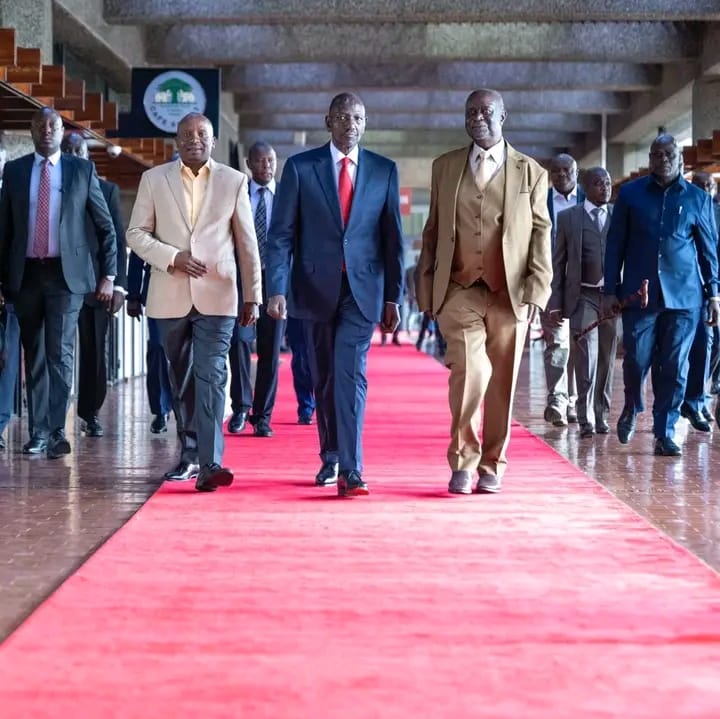
Kenya’s political landscape may be entering one of its most consequential phases since the 2022 general election, following a high-level parliamentary group meeting that brought together Members of Parliament and Senators from the ruling United Democratic Alliance (UDA) and the Orange Democratic Movement (ODM).
The meeting, held at the Kenyatta International Convention Centre in the capital Nairobi, was officially framed around discussions on a ten-point reform agenda involving lawmakers from both sides of the political divide. Yet beneath the surface of legislative consultations and reform rhetoric lies a deeper political dynamic that is gradually reshaping Kenya’s political future.
For seasoned observers of Kenyan politics, the significance of such a gathering goes far beyond parliamentary coordination. Meetings that bring together ruling party legislators and a substantial bloc of opposition lawmakers are rarely only about policy. They are often about power the negotiation of influence, the formation of new alliances, and the long-term calculations that define the next electoral cycle.
At the center of this evolving political moment is William Ruto, whose presidency has increasingly relied on building broader political coalitions beyond his original electoral alliance. Standing across the negotiating table but increasingly appearing on the same political platform are influential leaders within ODM, including veteran politician Oburu Odinga.
While the official narrative focuses on the ten-point reform agenda, the deeper story is the quiet construction of what could become the foundation of Kenya’s next governing arrangement.
Kenyan politics has historically been shaped by coalition building. From the National Rainbow Coalition in 2002 to the Jubilee alliance and later the Kenya Kwanza coalition, political power in the country has rarely been exercised by a single party acting alone. Instead, alliances between major political blocs have repeatedly determined who governs and how power is distributed.
The emerging cooperation between UDA and elements of ODM therefore signals more than temporary collaboration. It suggests the possible birth of a new political architecture one that could influence governance during the remainder of the current administration while simultaneously setting the stage for the next general election.
The parliamentary meeting at KICC is one of the clearest indications yet that the relationship between the two political camps is evolving from tactical engagement into something more strategic.
For President Ruto, the logic of expanding his political base is clear. Governing a diverse and politically dynamic country like Kenya often requires more than the numerical majority obtained during an election. It requires sustained parliamentary support, regional political balance, and alliances that can stabilize governance during periods of economic or political pressure.
By drawing influential ODM leaders into discussions about national policy, Ruto effectively broadens the coalition supporting his administration. This not only strengthens his legislative position in parliament but also reduces the likelihood of prolonged political confrontation between the government and the opposition.
For ODM leaders, participation in such discussions carries its own political advantages. Engaging in national policy debates allows the party to maintain relevance within the political system while influencing decisions that affect its constituencies. It also provides a platform for negotiating political leverage within Kenya’s evolving power structure.
This is where the question of power sharing begins to emerge as a central theme.
Although the current discussions revolve around parliamentary cooperation and policy reforms, alliances in Kenyan politics often evolve into broader governing arrangements. Such arrangements may involve the distribution of key political roles, influence over policy decisions, and strategic cooperation during future elections.
The concept of a “broad-based government” has increasingly entered Kenya’s political vocabulary in recent months. In practical terms, this idea refers to a governing structure in which major political actors from different parties participate in shaping the direction of the state.
While such arrangements are sometimes controversial, they are not new to Kenya’s political history. The coalition government formed after the 2007-2008 post-election crisis, for example, brought together rival political leaders in a power-sharing agreement designed to stabilize the country.
Today’s situation is different in its context but similar in its underlying political logic: stability through cooperation.
The meeting at KICC therefore represents more than a routine political consultation. It reflects a gradual recalibration of power relations within Kenya’s political system.
From a strategic perspective, both sides appear to be testing the possibilities of long-term collaboration. For President Ruto, the inclusion of ODM leaders in discussions about national reform could create a political environment in which opposition resistance becomes less confrontational and more collaborative.
For ODM figures, engagement with the government may offer a pathway to influence policy outcomes while positioning themselves within the broader national leadership framework.
The implications of such cooperation extend beyond immediate governance.
Kenya’s political cycles are deeply shaped by long-term electoral calculations. Alliances formed during one electoral period often become the foundations of the next political contest.
If the current cooperation between UDA and ODM evolves into a more structured political partnership, it could dramatically reshape the country’s political landscape ahead of future elections.
Such a partnership could potentially create one of the most formidable political coalitions in Kenya’s modern history, combining the political networks of the ruling coalition with the grassroots support base traditionally associated with ODM.
This possibility explains why the developments at KICC are being watched closely by political observers across the country.
In many ways, Kenyan politics operates through signals symbolic gestures that indicate deeper political shifts before formal announcements are made. Joint meetings, shared policy discussions, and coordinated parliamentary strategies often precede the formalization of political alliances.
The parliamentary group meeting between UDA and ODM lawmakers may therefore represent an early stage in the evolution of a broader political understanding between the two sides.
If that understanding deepens, the consequences for Kenya’s political future could be profound.
The emergence of a cooperative framework between the ruling party and a major opposition bloc would alter the traditional structure of political competition in the country. Instead of a clear divide between government and opposition, Kenya could move toward a political environment characterized by negotiated power arrangements among multiple influential actors.
Such an environment could produce greater political stability, particularly during periods of economic reform or institutional change. However, it could also redefine the role of opposition politics in Kenya’s democratic system.
Ultimately, the events unfolding at the Kenyatta International Convention Centre are part of a larger story about how political power evolves in Kenya.
Behind the formal language of reform agendas and parliamentary consultations lies a complex process of alliance building, strategic negotiation, and long-term political planning.
As leaders from UDA and ODM continue their consultations, the shape of Kenya’s future political landscape is slowly taking form.
Whether this cooperation remains limited to parliamentary coordination or expands into a broader governing alliance remains to be seen.
What is clear, however, is that the political conversations now taking place in Nairobi are not merely about policy discussions.
They are about the construction of the next chapter of Kenyan political power.
And as history has repeatedly shown, the alliances formed in moments like these often determine who governs the country in the years ahead.