

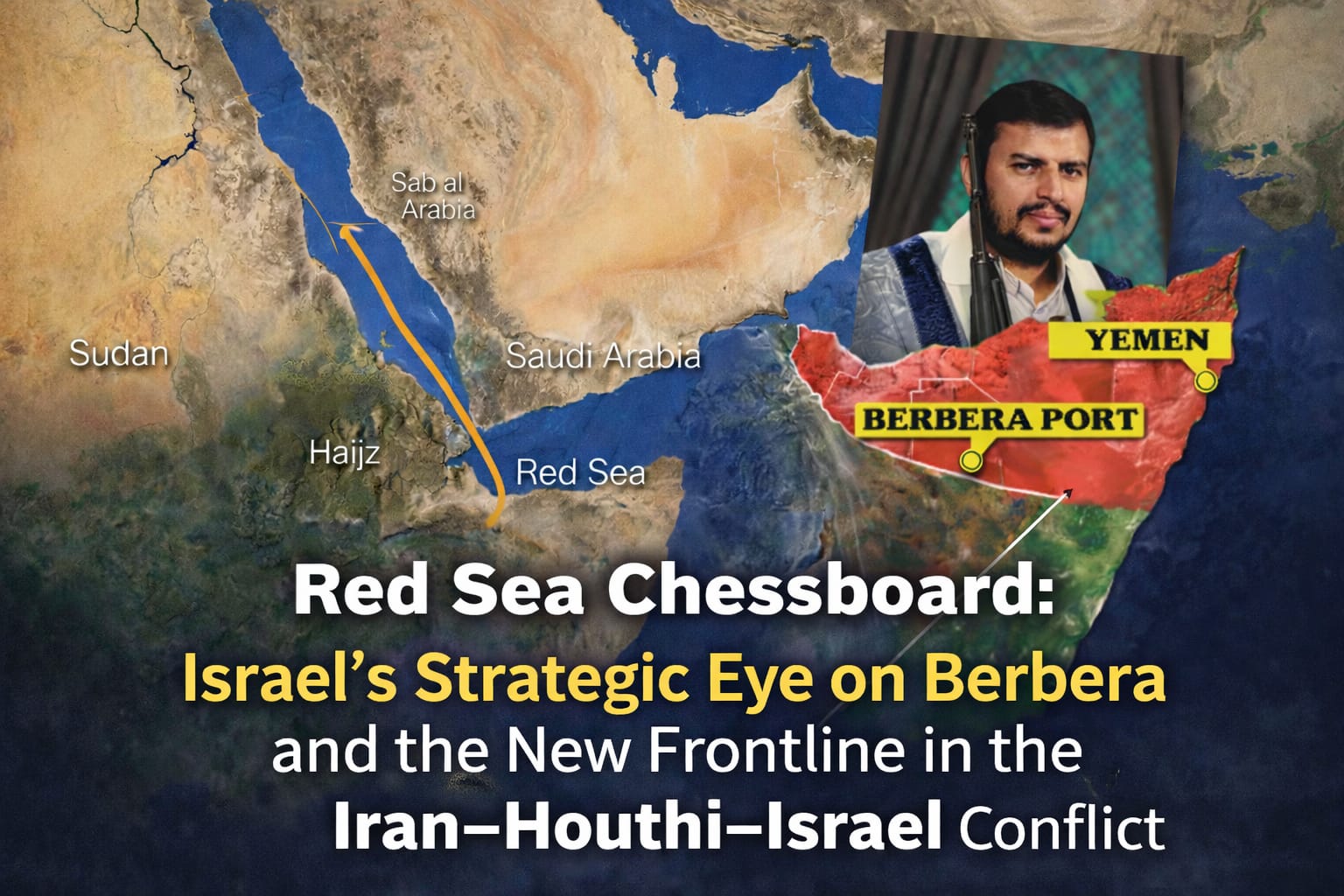
The Red Sea has once again emerged as one of the most critical geopolitical arenas in the world. For centuries, this narrow maritime corridor linking the Mediterranean Sea to the Indian Ocean has served as a bridge between continents, civilizations, and global trade routes.
Today, however, it is becoming something else entirely, a strategic battlefield where the interests of regional powers, global shipping networks, and ideological conflicts converge.
In recent months, growing attention has been directed toward the Horn of Africa, particularly the coastal territory of Somaliland and its strategic port city of Berbera. The interest stems from a broader regional security dynamic shaped by the confrontation between Israel and Iran and the activities of the Iran-aligned Houthi movement operating from neighboring Yemen.
At the center of this emerging geopolitical story lies a simple but powerful strategic calculation: proximity. The distance between the Horn of Africa and Yemen is short, separated only by the Gulf of Aden.
This proximity offers an opportunity for states seeking to monitor or counter the military capabilities of the Houthi movement, which has increasingly expanded its operations beyond Yemen’s borders and into the Red Sea shipping lanes.
The idea of establishing a strategic
foothold along the Red Sea coast of Somaliland reflects the evolving nature of modern warfare, where geography, surveillance technology, maritime security, and political alliances intersect. It also highlights the growing significance of the Horn of Africa in global strategic planning.
To understand why this region has become so important, it is necessary to examine the dynamics of the broader conflict shaping the Middle East and the Red Sea.
The conflict between Israel and Iran has gradually expanded beyond direct confrontation and into a network of regional alliances and proxy groups. Iran has built influence across several countries through partnerships with non-state actors who share political and ideological objectives. Among these groups are Hezbollah in Lebanon, Hamas in Gaza, and the Houthi movement in Yemen.
While these groups operate in different contexts and political environments, they are linked by a broader strategic alignment that challenges Israel and its regional allies.
The Houthis, formally known as Ansar Allah, emerged in northern Yemen in the 1990s as a political and religious movement representing segments of the Zaydi Shia community. Initially, their focus was domestic: opposition to the Yemeni government and demands for greater political representation.
Over time, however, the movement transformed into a powerful armed organization capable of controlling territory, governing large populations, and deploying increasingly sophisticated weapons systems.
The turning point came during Yemen’s civil war, when the Houthis seized the capital city of Sana’a in 2014. Their rise triggered a complex regional conflict involving Saudi Arabia, the United Arab Emirates, and various international actors.
Within this environment, the Houthis expanded their military capabilities dramatically. They developed or acquired ballistic missiles, long-range drones, anti-ship missiles, and naval explosives capable of threatening vessels in the Red Sea and Gulf of Aden.
These developments transformed the Houthis from a domestic insurgent movement into a regional military actor with the capacity to influence international trade routes.
The Red Sea shipping corridor is one of the most important economic arteries in the world. Approximately ten percent of global trade passes through the narrow passage known as the Bab el-Mandeb Strait, which connects the Red Sea to the Gulf of Aden.
This chokepoint is only about 30 kilometers wide at its narrowest point. Because of this geographic constraint, any disruption in the area can have immediate consequences for global trade, energy markets, and international logistics.
Over the past few years, attacks on commercial shipping vessels have increased significantly. These incidents have forced shipping companies to reroute vessels around the Cape of Good Hope, adding thousands of kilometers to maritime journeys and increasing transportation costs.
For countries whose economies depend on secure maritime trade routes, the instability of the Red Sea has become a major strategic concern.
In this context, the coastline of Somaliland particularly the port of Berbera has taken on new importance. Berbera sits along the Gulf of Aden directly across from Yemen.
From a military perspective, the location offers several advantages.
First, it provides proximity to the Bab el-Mandeb Strait and the Red Sea shipping corridor. Surveillance systems positioned along this coast could monitor maritime traffic across a wide area.
Second, the distance between Berbera and the Yemeni coast is relatively short. This proximity reduces operational response times for surveillance drones, aircraft, or naval patrols.
Third, the infrastructure in Berbera has expanded significantly in recent years. The port has undergone modernization projects, and the airport features a long runway capable of handling large aircraft.
These developments have already attracted interest from multiple international actors seeking strategic partnerships in the region.
However, the implications of potential military cooperation in Somaliland extend far beyond infrastructure or geography. They touch upon deeper political questions surrounding sovereignty, recognition, and regional stability.
Somaliland declared independence from Somalia in 1991 following the collapse of the Somali central government. Since then, it has operated as a self-governing entity with its own institutions, security forces, and democratic processes.
Despite this internal stability, Somaliland has not received widespread international recognition as an independent state. Most countries continue to recognize Somalia’s territorial integrity and consider Somaliland part of the Somali federal framework.
This political ambiguity creates a complex diplomatic landscape. Any foreign military presence or strategic agreement in Somaliland inevitably raises questions about how such arrangements intersect with Somalia’s sovereignty.
For the federal government in Mogadishu, the issue is sensitive. Somalia has consistently maintained that international agreements involving Somaliland should occur within the framework of Somalia’s sovereignty.
From Somaliland’s perspective, however, strategic partnerships with international actors are seen as opportunities to strengthen its security, economic development, and diplomatic standing.
These differing perspectives highlight the broader geopolitical complexity surrounding the Horn of Africa.
The Houthis and the Expanding Red Sea Conflict
To fully understand the significance of developments in the Red Sea, it is essential to examine the role of the Houthi movement and how it has transformed the security environment of the region.
The Houthis have evolved into one of the most influential armed groups in the Middle East. Their military capabilities include ballistic missiles capable of reaching hundreds of kilometers, unmanned aerial vehicles designed for reconnaissance and attack missions, and anti-ship weapons that can target vessels navigating the Red Sea.
These capabilities have allowed the group to project power beyond Yemen’s borders.
In recent confrontations across the Middle East, the Houthis have launched missiles and drones toward regional targets and commercial shipping routes. These actions have positioned the group as a central actor in the broader regional conflict involving Iran and Israel.
From a strategic standpoint, the Houthis serve as a southern component of a larger geopolitical network aligned with Iran’s regional ambitions.
Their control over parts of Yemen provides them with direct access to the Red Sea coastline, enabling them to threaten vessels passing through the Bab el-Mandeb Strait.
This capacity has drawn international attention because disruptions to shipping lanes affect not only regional actors but the global economy.
Countries in Europe, Asia, and Africa rely on the Red Sea corridor for energy shipments, manufactured goods, and agricultural exports.
Consequently, the security of this maritime passage has become a priority for multiple governments.
The possibility of establishing surveillance or defensive infrastructure along the Horn of Africa is therefore linked to the broader goal of protecting international shipping routes from attacks.
At the same time, such moves risk escalating tensions within the already fragile political environment of the region.
The Middle East is currently experiencing one of its most volatile periods in decades. Conflicts in Gaza, Lebanon, Syria, and Yemen are interconnected through a web of alliances and rivalries.
Iran’s influence across these theaters has expanded through support for various armed groups. Israel, in response, has pursued strategies designed to counter these networks and prevent the emergence of coordinated threats across multiple fronts.
Within this environment, the Red Sea represents a strategic flank. Control of maritime routes, intelligence capabilities, and rapid response options all contribute to the broader balance of power.
For Israel, monitoring the southern maritime corridor could provide early warning against missile launches or maritime threats originating from Yemen.
For the Houthis and their allies, maintaining the ability to disrupt shipping routes provides leverage in regional negotiations and conflicts.
The Horn of Africa therefore sits at the intersection of these competing strategic objectives.
For Somalia, the situation presents both opportunities and challenges. On one hand, the increasing strategic importance of the region could attract investment, infrastructure development, and international attention.
On the other hand, the presence of competing military interests in nearby waters risks drawing the country into broader geopolitical rivalries.
Somalia’s long coastline already places it at the center of maritime security discussions. Piracy, illegal fishing, and trafficking networks have historically affected the region.
Now, the emergence of a larger geopolitical contest around the Red Sea adds another layer of complexity.
For Somaliland, the situation is similarly multifaceted. Strategic partnerships could enhance economic prospects and strengthen security infrastructure.
However, they also carry political implications that extend beyond Somaliland’s borders, particularly in relation to Somalia’s federal government and regional diplomatic dynamics.
Ultimately, the developments unfolding around the Red Sea highlight a broader transformation in global geopolitics.
The world’s strategic focus is gradually shifting toward maritime corridors and logistical chokepoints that sustain international trade.
From the South China Sea to the Strait of Hormuz and the Bab el-Mandeb, control over narrow waterways is becoming increasingly important.
The Horn of Africa, positioned between Africa, the Middle East, and Asia, occupies a central place within this emerging geopolitical map.
What happens along its coastline will likely influence not only regional stability but also the broader balance of power in the Middle East and beyond.
As tensions continue to evolve, the Red Sea may become one of the defining strategic theaters of the coming decade, where diplomacy, military strategy, and economic interests converge in a complex and constantly shifting landscape.