

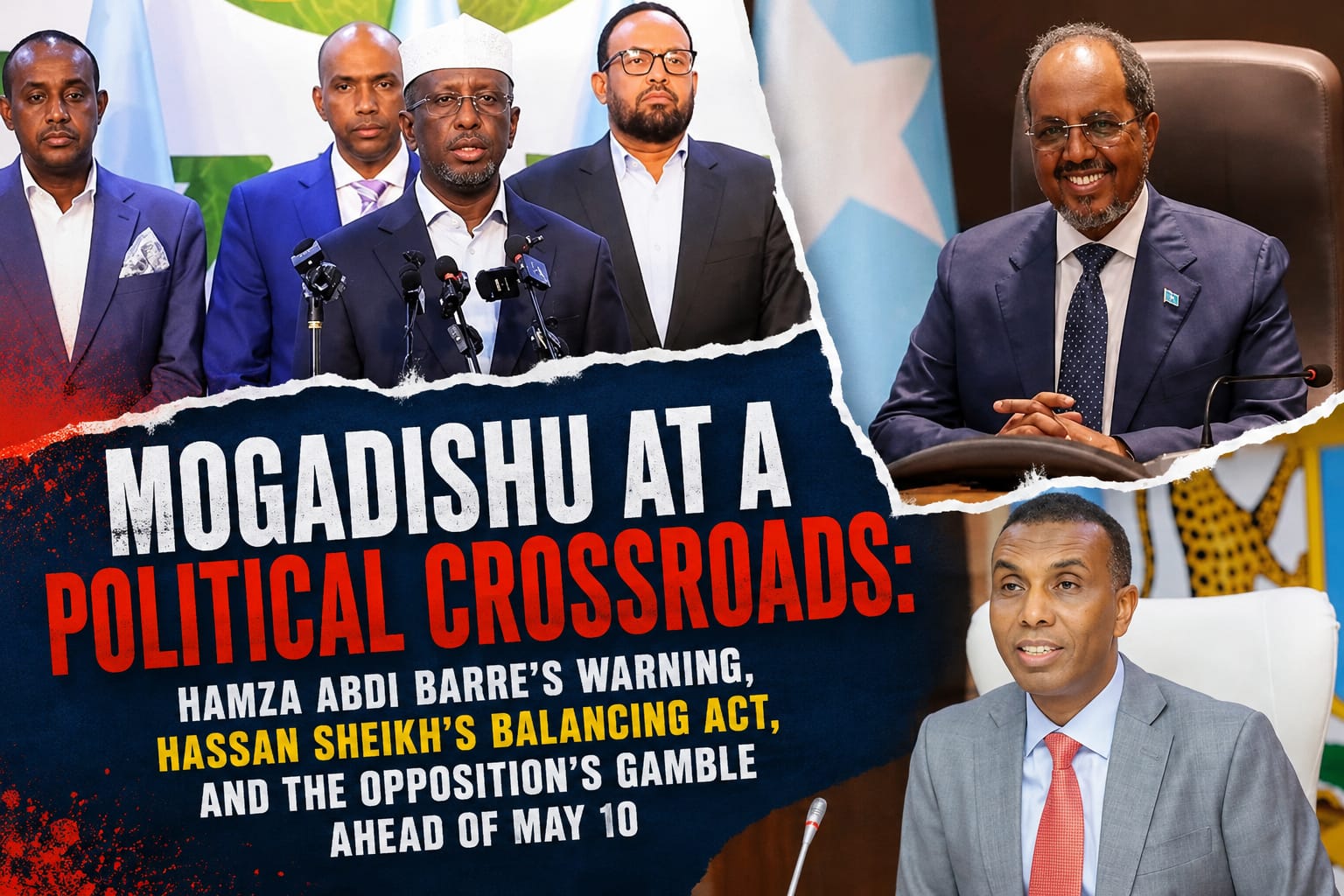
For months, Somalia’s political temperature has been steadily rising beneath the surface of official statements, diplomatic meetings, and carefully managed public appearances.
But this week, the fragile balance that has held together the country’s political order appears to have entered a more dangerous phase after Prime Minister Hamza Abdi Barre delivered one of the strongest warnings yet directed at the opposition, accusing unnamed political actors of risking instability in Mogadishu at a moment when the capital remains deeply sensitive to political confrontation, security uncertainty, and unresolved disputes over Somalia’s electoral future.
The Prime Minister’s remarks did not emerge in isolation. They came amid mounting tensions surrounding planned anti-government protests expected on May 10, growing criticism over the federal government’s handling of the electoral process, public anger linked to forced evictions in Mogadishu, and intensifying political maneuvering ahead of the expiration of President Hassan Sheikh Mohamud’s current four-year term on May 15.
What makes the moment particularly significant is not merely the existence of political disagreement Somalia has experienced repeated political disputes over the last two decades but rather the convergence of several volatile dynamics at once: an opposition coalition attempting to reassert itself politically, a federal leadership determined to maintain control over the national political agenda, fears of instability inside Mogadishu, widening distrust over election arrangements, and growing public fatigue over recurring elite-level power struggles.
In his televised address, Prime Minister Hamza Abdi Barre appeared to deliberately frame the current tensions not as a normal democratic disagreement but as a potentially dangerous challenge to national stability itself. His language was carefully calibrated yet unmistakably firm.
He insisted that the government remained open to dialogue and differing political views while simultaneously warning that “any attempts to disrupt national security, stability or state-building efforts would not be tolerated.”
The statement was more than a routine political response. It was effectively a signal that Villa Somalia views the emerging opposition mobilization not simply as criticism but as a direct test of the government’s authority and legitimacy at a highly delicate moment.
The Prime Minister went even further by criticizing opposition leaders’ conduct in previous national consultations, accusing them of repeatedly participating in political talks without presenting workable alternatives or committing to consensus outcomes.
“In previous meetings, you came without bringing a plan, nor were you willing to follow one,” Hamza stated. “I am calling on you to come to the platform provided by the President, either with a clear alternative vision or a willingness to support the national direction. The methods you are currently using to seek power are not how governance is achieved.”
Politically, this was a highly strategic message.
The federal government is attempting to shape the narrative before the planned opposition rally can dominate public discourse. By portraying the opposition as politically destructive rather than constructive, the administration seeks to present itself as the guardian of stability, institutional continuity, and national state-building.
In Somalia’s political environment, where memories of insecurity and conflict remain fresh, stability is one of the most powerful political arguments any government can deploy.
The language used by Hamza Abdi Barre also suggests the federal leadership is increasingly concerned about the symbolism and momentum of street mobilization in Mogadishu. Somali governments have historically viewed large opposition demonstrations in the capital with extreme caution because protests in Mogadishu rarely exist in a purely civilian political context.
This explains why the Prime Minister repeatedly linked opposition activism to the risk of undermining peace and state-building efforts. The government understands that control of Mogadishu is not only about security but also about perception. Any visible signs of instability or political unrest immediately raise broader questions about the strength and legitimacy of the national leadership.
Yet the opposition, for its part, appears equally determined to frame the moment differently.
Opposition figures and critics of the government argue that the administration itself bears responsibility for the growing tensions because of what they describe as increasing political centralization, insufficient transparency regarding elections, and a shrinking space for genuine political consensus.
They see the May 10 mobilization not as an attempt to destabilize Somalia but as a response to what they believe is an increasingly exclusionary political process.
At the center of the dispute lies Somalia’s unresolved electoral question.
The country has struggled for years to transition toward a stable, agreed-upon electoral framework capable of balancing federal authority, regional interests, clan realities, and democratic aspirations. Every major Somali administration in recent history has promised electoral transformation, yet each has faced enormous institutional, political, and security obstacles.
The current administration entered office promising reforms and a more ambitious political direction. However, opposition groups increasingly fear that the federal government may attempt to shape electoral structures in ways that consolidate Villa Somalia’s influence while marginalizing competing political actors.
This distrust has fueled broader tensions between the government and various opposition alliances, including members of the Somali Future Council. The opposition believes critical national decisions regarding governance, constitutional issues, and elections should emerge through broad-based consensus rather than unilateral state-driven processes.
The government, meanwhile, argues that Somalia cannot remain trapped indefinitely in endless negotiations that delay institutional progress and weaken national governance.
This fundamental disagreement is now defining Somalia’s political landscape.
The Battle for Legitimacy and Control of the Political Narrative
The timing of the current crisis is especially important.
President Hassan Sheikh Mohamud’s invitation to opposition leaders for consultations on May 10 initially appeared to signal an attempt at de-escalation. The consultations were presented as part of broader efforts to create dialogue amid growing political tensions.
But the scheduling has itself generated political controversy because the same day President Hassan Sheikh is expected to travel to Djibouti for the inauguration ceremony of President Ismaïl Omar Guelleh.
This overlap has triggered speculation within political circles about whether the consultations will genuinely occur in a meaningful format before the President’s departure or whether the process risks being reduced to symbolism rather than substantive negotiation.
In Somali politics, symbolism matters enormously.
Political actors closely watch scheduling decisions, protocol arrangements, meeting formats, and public messaging because these details often reveal deeper calculations about power and political intent. For some opposition figures, the overlap between the consultations and the Djibouti trip raises concerns about whether the federal leadership is prioritizing regional diplomacy over urgent domestic reconciliation.
For the government, however, the consultations themselves may be more important politically than the exact logistics. By inviting the opposition to dialogue, Villa Somalia can position itself as the reasonable actor willing to engage, while placing pressure on opposition groups to either participate constructively or risk being portrayed as confrontational.
This is precisely why Prime Minister Hamza Abdi Barre’s speech focused heavily on the idea of “constructive participation.” The administration wants to establish a political contrast between institutional dialogue and street pressure.
The stakes are heightened further by the historical memory of Somalia’s past political crises.
Somalia’s recent political history is filled with periods where disagreements over elections and power-sharing escalated into dangerous confrontations. Because of this history, even rhetorical escalation now carries psychological weight.
When Somali leaders invoke themes such as protecting peace, defending state-building, or preventing instability, they are speaking to a population deeply aware of how quickly political disputes can spiral into security crises.
Another major factor shaping the current tensions is the growing perception battle surrounding legitimacy.
President Hassan Sheikh Mohamud’s administration still retains significant international engagement and diplomatic recognition. Somalia’s federal government continues to present itself as the central pillar of state-building and institutional reform. International partners generally prioritize continuity and stability, especially given ongoing security threats from Al-Shabaab.
However, domestic political legitimacy is more complicated.
Opposition groups are increasingly attempting to frame the current administration as politically over-centralized and insufficiently consultative. Their goal is not merely to criticize government policies but to challenge the broader narrative that the federal leadership alone represents the national interest.
This struggle over legitimacy is likely to intensify as May 15 approaches.
The symbolic importance of the end of Hassan Sheikh Mohamud’s four-year term cannot be ignored. Political opponents will inevitably use the moment to question whether the administration has delivered sufficiently on its promises regarding governance, elections, and national unity.
At the same time, the government is trying to avoid appearing politically weak.
This explains the sharper tone adopted by Prime Minister Hamza Abdi Barre. His remarks suggest the administration believes it must project confidence and authority rather than hesitation.
Yet there is also risk in excessive firmness.
If the federal government is perceived as dismissive of opposition concerns or intolerant of political dissent, it could deepen mistrust and push more actors toward confrontation rather than compromise. Somalia’s political system depends heavily on negotiated legitimacy and consensus-building.
The current crisis therefore reflects a deeper structural dilemma inside Somali politics.
On one side is the argument for strong centralized leadership capable of driving state-building and preventing fragmentation. On the other side is the demand for broader consultation and inclusive political processes in a country where mistrust between political actors remains high.
Both sides believe they are defending Somalia’s future.
The government sees itself as protecting national institutions from destabilization. The opposition sees itself as defending pluralism and preventing excessive concentration of political power.
This is why the coming days may prove politically decisive.
If the May 10 consultations succeed in reducing tensions and creating at least a temporary framework for dialogue, Somalia could avoid a more dangerous escalation.
But if the talks collapse, fail to occur meaningfully, or are overshadowed by confrontation in Mogadishu, the political atmosphere could deteriorate rapidly.
Much will depend on how both sides manage public perception.
The federal government is investing heavily in the narrative of stability and institutional legitimacy. Prime Minister Hamza’s speech was designed not only for domestic audiences but also for regional and international observers closely monitoring Somalia’s political trajectory.
The opposition, meanwhile, is attempting to harness public frustration and portray itself as the voice of accountability and political inclusiveness.
This battle over narrative may ultimately matter almost as much as the negotiations themselves.
There is also a regional dimension to the crisis that should not be overlooked.
Somalia’s neighbors and international partners closely watch political developments in Mogadishu because instability in the capital can quickly affect broader regional security calculations.
President Hassan Sheikh Mohamud’s planned attendance at Ismaïl Omar Guelleh’s inauguration reflects the importance of regional diplomacy at a moment when Somalia is simultaneously navigating domestic political tensions and external geopolitical relationships.
The broader reality is that Somalia is once again approaching a familiar but dangerous intersection where unresolved constitutional questions, elite rivalry, electoral uncertainty, and public frustration converge simultaneously.
The difference today is that the Somali political class is operating in a more complex environment than in previous years. Federal institutions are stronger than before, international engagement is deeper, and security structures while still fragile are more developed than during earlier periods of state collapse.
Yet Somalia also remains politically vulnerable because its institutions still rely heavily on negotiated consensus rather than deeply entrenched constitutional certainty.
This is why Hamza Abdi Barre’s remarks matter so much politically.
They reveal an administration increasingly determined to define the terms of political engagement before the opposition can shape the national narrative itself. At the same time, the speech reflects the government’s awareness that it cannot afford to appear entirely closed to dialogue.
The administration is trying to walk a delicate line: appearing firm without appearing authoritarian, open without appearing weak, and confident without escalating tensions beyond control.
Whether that balancing act succeeds may depend on what happens in the coming days.
If the opposition responds by engaging seriously in consultations while moderating confrontation, Somalia could enter another period of uneasy but manageable political negotiation.
But if mutual distrust continues deepening, the current tensions may evolve into a broader legitimacy struggle over who truly speaks for Somalia’s political future.
The coming May 10 moment therefore represents far more than a single protest or consultation meeting.
It is becoming a test of Somalia’s political maturity, institutional resilience, and ability to manage disagreement without sliding toward destabilization.
Prime Minister Hamza Abdi Barre’s warning has now raised the political stakes significantly.
The question is whether it will deter confrontation and force serious dialogue or instead harden divisions at precisely the moment Somalia most needs compromise.