

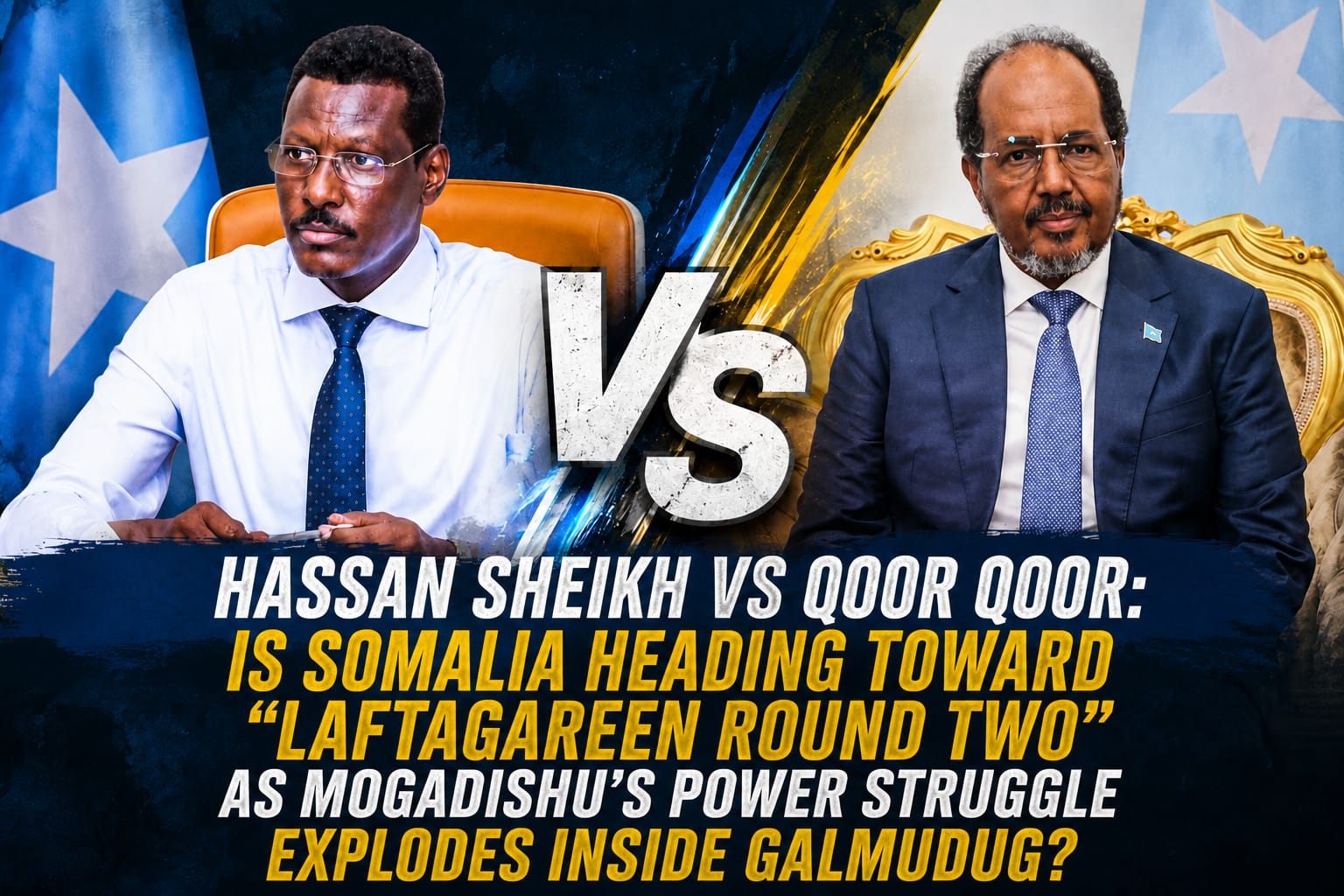
Somalia’s fragile federal system is once again facing one of its most dangerous political tests in years, after a dramatic confrontation erupted between the Federal Government in Mogadishu and the Galmudug regional administration over control of the state’s police command.
What began as a dispute over the appointment of a police commander is rapidly evolving into something far deeper a political and constitutional confrontation that exposes widening fractures between President Hassan Sheikh Mohamud and one of the country’s most influential federal member state leaders, Ahmed Abdi Kariye Qoor Qoor.
The developments are sending shockwaves across Somalia’s political landscape because they resemble a pattern many Somalis have seen before.
First came tensions with Abdiaziz Hassan Mohamed Laftagareen and Southwest State, where disagreements with Mogadishu steadily intensified until the Federal Government ultimately used military and political pressure to remove the regional leadership structure that had once been closely aligned with Villa Somalia.
Now, analysts, opposition figures, and political observers are asking whether Galmudug could become the next battlefield in President Hassan Sheikh’s expanding campaign to centralize political and security control ahead of Somalia’s uncertain electoral future.
The timing of this confrontation is not accidental.
Somalia is entering one of the most politically sensitive periods in recent history. Electoral uncertainty, disputes over constitutional reforms, tensions with federal member states, disagreements over the one-person-one-vote model, and increasing opposition criticism have all converged into a volatile national climate.
In that atmosphere, control over regional security forces becomes more than an administrative issue it becomes a direct struggle over political survival, territorial influence, electoral leverage, and state power.
The immediate trigger for the crisis came after Somalia’s Federal Government dismissed Galmudug Police Commander Col. Khaliif Abdulle and appointed Col. Mohamed Dahir Abdulle, formerly commander of the VIP and Key Institutions Protection Unit, as the new police chief for the state.
Within hours, Galmudug President Qoor Qoor rejected the federal appointment and reinstated Khaliif Ilkacase, openly defying Mogadishu’s authority.
That single act transformed what might have remained a bureaucratic disagreement into a full-scale political showdown.
The symbolism behind competing police commanders is enormous in Somalia’s political system. Security institutions are the backbone of political authority. Whoever controls the police controls intelligence gathering, checkpoints, public order, local political operations, and the balance of coercive power inside a region.
By rejecting Mogadishu’s appointment, Qoor Qoor was effectively signaling that Galmudug would not accept federal encroachment into its internal security affairs.
For Villa Somalia, however, allowing a federal member state to openly reject a presidential security appointment without consequences risks weakening the authority of the Federal Government itself.
That creates a dangerous dilemma for President Hassan Sheikh Mohamud. If he escalates aggressively, the country risks another destabilizing federal-regional confrontation. If he backs down, he risks appearing politically weak at a time when opposition criticism is already growing.
This is why many Somali observers now believe the confrontation is not simply about a police commander. It is about the future shape of Somalia’s federal system.
At the center of this growing storm is the increasingly visible political fallout between Hassan Sheikh and figures once viewed as close or cooperative allies. Among the most striking signs of that fallout was the public intervention of MP Saadaq Omar Hassan, better known as Saadaq John.
Once one of the most controversial security figures in Mogadishu politics, Saadaq John played a central role during the political tensions surrounding former President Mohamed Abdullahi Mohamed Farmaajo and the disputed term extension crisis of 2021. He emerged as one of the strongest anti-Farmaajo figures during armed standoffs in Mogadishu, becoming symbolic of resistance against centralized executive overreach.
Now, years later, Saadaq John appears to be turning similar language against Hassan Sheikh Mohamud himself.
“I swear, old man Hassan, worldly affairs are beyond you,” he wrote publicly on Facebook.
The wording of the statement was extraordinary not only because of its harshness, but because of what it politically represents.
In Somali political culture, senior leaders are rarely attacked so bluntly by figures who once operated within the same broad political camp. The phrase suggests not merely disagreement but deep frustration, disappointment, and possibly betrayal. The use of “old man Hassan” stripped away presidential formality and projected an image of a leader losing respect among segments of the political class.
More importantly, the statement reflects a broader shift underway inside Somalia’s elite political networks.
The Galmudug Confrontation May Be the Biggest Test Yet of Hassan Sheikh’s Federal Strategy
For much of Hassan Sheikh’s presidency, he attempted to portray himself as a consensus-builder capable of repairing the divisions that defined the Farmaajo era.
When he returned to office in 2022, many Somalis believed he would pursue dialogue with federal member states, reduce tensions, and stabilize Somalia’s fragile political system. Instead, critics increasingly accuse him of pursuing centralization through softer but equally assertive political methods.
That perception is becoming politically dangerous.
The dispute with Galmudug is not emerging in isolation. It follows earlier tensions with Puntland, disagreements with Jubaland, disputes surrounding constitutional amendments, growing opposition alliances in Mogadishu, and the politically explosive conflict with Southwest State.
In each case, critics argue that Villa Somalia has sought to expand federal influence over regional political structures, often at the expense of negotiated federalism.
Supporters of Hassan Sheikh reject this interpretation. They argue the President is trying to build a functioning Somali state after decades of fragmentation. From their perspective, Somalia cannot defeat Al-Shabaab, organize national elections, or establish stable institutions if federal member states operate like semi-independent political territories beyond federal authority.
This is the central contradiction shaping Somali politics today.
One side sees Hassan Sheikh as a state-builder attempting to strengthen national institutions.
The other sees him as a centralizing leader gradually undermining federal autonomy.
The Galmudug confrontation embodies that contradiction perfectly.
For Qoor Qoor, accepting Mogadishu’s unilateral appointment of a police chief would have signaled weakness and dependence. It could also damage his standing among local political elites who expect regional leaders to defend state autonomy.
In Somalia’s federal politics, perception matters enormously. A regional president viewed as unable to resist Mogadishu risks losing legitimacy internally.
Qoor Qoor therefore had powerful incentives to resist.
But the resistance itself carries immense risks.
The comparison to Laftagareen is becoming increasingly common because Somali political actors remember how quickly political disagreements in Southwest State escalated into military-backed confrontations. What begins as an administrative dispute can rapidly evolve into a broader political campaign involving parliamentary pressure, security deployments, elite defections, media warfare, and federal intervention.
Could Galmudug face a similar scenario?
That question is now dominating political conversations in Mogadishu.
Several factors make the situation potentially explosive.
First, Galmudug occupies a strategically vital position in Somalia’s political and security architecture. It sits in central Somalia, bordering areas critical to anti-Al-Shabaab operations. The region is also politically significant because it influences clan balances, parliamentary alliances, and federal security coordination.
Second, Qoor Qoor is not an isolated regional figure. He has historically maintained strong relationships with national political actors and security networks. Any attempt to politically corner him could produce wider alliances against Villa Somalia.
Third, Somalia’s broader political climate is already tense due to unresolved election questions.
President Hassan Sheikh’s push for electoral reforms and constitutional restructuring has generated suspicion among opposition figures who fear the Federal Government is attempting to reshape the political system in ways that extend executive influence. In that environment, moves against regional leaders are interpreted through a highly political lens.
The reported plans to restrict politicians aligned with Qoor Qoor from traveling to Galmudug further deepen those suspicions.
If true, such measures would indicate that the conflict is moving beyond security appointments into broader political containment strategies. Restricting movement of pro-Qoor Qoor politicians would effectively signal that Villa Somalia sees Galmudug not merely as a partner administration but as a contested political space requiring control.
That would represent a major escalation.
It would also reinforce the opposition narrative that Hassan Sheikh’s administration is increasingly intolerant of independent regional political centers.
What makes the current situation especially significant is that Hassan Sheikh’s political coalition itself appears to be under strain.
During the early phase of his presidency, Hassan Sheikh benefited from a broad anti-Farmaajo alliance. Politicians with different agendas united around removing Farmaajo from power. But governing coalitions built on opposition unity often fracture once power is achieved.
Now, signs of fragmentation are becoming visible.
Saadaq John’s criticism matters precisely because he once stood against centralized presidential power under Farmaajo. His current criticism suggests that some former allies believe Hassan Sheikh is reproducing similar political tendencies they once opposed.
That perception could become politically damaging if more figures publicly distance themselves from Villa Somalia.
The Somali political arena operates heavily through elite alignments, clan calculations, and shifting alliances rather than rigid party systems. Once perceptions of political decline begin spreading among elites, momentum can change rapidly.
This is why the Galmudug confrontation matters beyond Galmudug itself.
It may become a referendum on Hassan Sheikh’s broader governing strategy.
The President appears to believe Somalia requires stronger centralized coordination to survive its many crises. There is logic behind that argument. Somalia’s fragmented security system, divided political authority, and inconsistent regional cooperation have long undermined governance and anti-Al-Shabaab operations.
But Somalia’s federal system was also designed precisely to prevent excessive centralization after decades of dictatorship and state collapse.
Balancing those two realities has always been Somalia’s greatest constitutional challenge.
Hassan Sheikh’s critics argue he is leaning too heavily toward centralization.
His supporters argue regional leaders are using federalism as a shield against accountability and national cohesion.
Both sides contain elements of truth.
The danger is that Somalia’s unresolved constitutional ambiguities leave these disputes vulnerable to escalation through power politics rather than legal resolution.
The constitution itself remains incomplete and contested in many areas regarding division of authority between federal and regional governments. Questions over security command structures, electoral administration, resource sharing, and constitutional interpretation remain unresolved. As a result, political disputes frequently become tests of strength instead of institutional arbitration.
That institutional weakness is what makes the Galmudug dispute potentially dangerous.
If neither side backs down, Somalia could witness another cycle of federal-regional confrontation involving security mobilization, political defections, and escalating rhetoric.
Already, the language surrounding the dispute is becoming sharper.
Opposition figures increasingly frame Hassan Sheikh as pursuing domination over member states. Government supporters counter that federal states cannot act independently of national authority on core security matters.
This battle over narrative is crucial because Somali politics is deeply influenced by perception.
If the public begins viewing Villa Somalia as hostile toward federalism, regional leaders may feel encouraged to resist more aggressively.
If, however, the public views regional administrations as obstructing national stability, Hassan Sheikh could gain support for stronger federal intervention.
At the same time, international actors are watching closely.
Somalia’s international partners have invested heavily in state-building, security reform, and counterterrorism coordination. They generally prefer political stability and negotiated solutions between Mogadishu and federal member states. Another serious federal-regional confrontation could alarm donors and security partners concerned about fragmentation benefiting Al-Shabaab.
That external dimension matters because Somalia remains heavily dependent on international security and financial support.
A prolonged political crisis could weaken confidence in Somalia’s institutional trajectory.
Yet despite these risks, neither side currently appears prepared to retreat.
Qoor Qoor’s reinstatement of the dismissed police commander was an unmistakable assertion of authority. Backtracking quickly could politically weaken him inside Galmudug.
For Hassan Sheikh, tolerating open defiance could encourage similar resistance from other regional administrations.
This creates the classic conditions for escalation.
Somalia has repeatedly experienced political crises where leaders become trapped by the need to project strength. Once public confrontation begins, compromise becomes harder because concessions are interpreted as weakness.
That dynamic was visible during the Farmaajo era.
It now appears to be resurfacing under Hassan Sheikh.
The irony is striking.
Hassan Sheikh originally returned to power partly because many Somalis wanted a less confrontational style of governance after years of intense political polarization. Yet today, Somalia again finds itself discussing federal crackdowns, security disputes, opposition mobilization, and fears of political overreach.
The parallels are becoming difficult to ignore.
Still, there are also key differences between Hassan Sheikh and Farmaajo.
Hassan Sheikh tends to operate through negotiation, elite alliances, and gradual political maneuvering rather than overt populist confrontation. His approach is often more institutional and strategic.
But critics argue that the end result increasingly resembles the same concentration of authority many once feared under Farmaajo.
This is why Saadaq John’s criticism carries symbolic weight.
His statement effectively accuses Hassan Sheikh of political miscalculation and disconnect from reality. Coming from a figure associated with resistance against presidential overreach, the criticism reinforces a growing narrative that Hassan Sheikh risks alienating former allies through aggressive centralization.
Whether that narrative becomes dominant will depend heavily on what happens next in Galmudug.
If tensions de-escalate through negotiation, the crisis may remain manageable.
If security deployments increase, political restrictions expand, or competing authorities harden positions, Somalia could move toward a much more serious confrontation.
There is also the question of electoral politics.
Somalia’s future electoral model remains fiercely contested. Hassan Sheikh’s administration has promoted reforms that opponents fear could restructure political competition in ways favoring Villa Somalia. Regional leaders therefore view federal encroachment not only through a governance lens but also through an electoral survival lens.
Control over regional security institutions could influence future political contests, parliamentary mobilization, and local political influence networks.
This is why the police commander dispute matters so much.
It touches the intersection of security, federalism, elections, and political survival simultaneously.
Another critical dimension is clan politics.
Somalia’s political system cannot be fully understood without recognizing the role of clan alignments and regional balances. Disputes between Mogadishu and federal member states often intersect with broader clan calculations regarding representation, influence, and power-sharing.
While political actors publicly frame disputes institutionally, underlying clan concerns frequently shape alliances and reactions.
This means the Galmudug confrontation could ripple far beyond administrative boundaries.
If key political networks interpret the dispute as an attempt to marginalize certain regional power centers, opposition coalitions against Villa Somalia could strengthen.
That possibility may explain why the Federal Government reportedly wants to restrict politicians aligned with Qoor Qoor.
Containing alliance-building before it expands may now be part of Villa Somalia’s strategy.
But such measures also risk intensifying perceptions of authoritarian drift.
For ordinary Somalis, the situation is deeply frustrating.
The country continues facing enormous security, economic, and humanitarian challenges. Al-Shabaab remains active. Youth unemployment is severe. State institutions remain fragile. Many citizens hoped the post-Farmaajo period would bring political reconciliation and institutional focus.
Instead, elite political tensions are once again dominating national attention.
This repeated cycle of federal-regional confrontation has become one of Somalia’s defining political weaknesses.
Rather than resolving constitutional ambiguities through inclusive agreements, Somali leaders often resort to tactical power struggles that deepen mistrust.
The current crisis illustrates that Somalia’s federal experiment remains incomplete and unstable.
At its core, the Hassan Sheikh–Qoor Qoor confrontation raises a fundamental question:
Who truly controls Somalia’s political and security future Villa Somalia or the federal member states?
Until Somalia clearly resolves the balance between centralized authority and regional autonomy, similar crises are likely to continue.
For now, all eyes are on Galmudug.
If the standoff escalates, Somalia could enter another prolonged political confrontation with unpredictable consequences.
If compromise emerges, it may provide an opportunity to redefine federal-regional relations more sustainably.
But the warning signs are already visible.
Competing police chiefs.
Public insults between political figures.
Restrictions on allied politicians.
Growing elite defections.
Security tensions.
Constitutional ambiguity.
Electoral mistrust.
All the ingredients of a major Somali political crisis are beginning to align once again.
And in Mogadishu today, many are quietly asking the same question:
Is this the beginning of Laftagareen Round Two only this time with Qoor Qoor?