

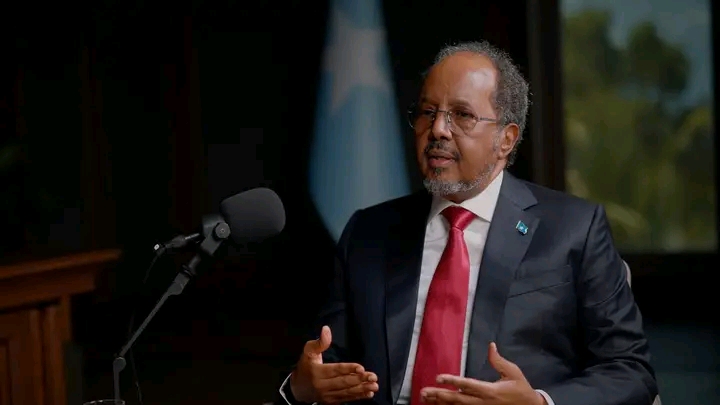
Somali President Hassan Sheikh Mohamud has strongly rejected Israel’s reported recognition of Somaliland, describing the development as a political “trap” and warning that any move undermining Somalia’s territorial integrity will be firmly opposed by his government.
Speaking in a wide-ranging interview, the president took a hard stance on recent geopolitical developments involving Somaliland and Israel, insisting that Somalia’s position on sovereignty remains unchanged and non-negotiable.
The remarks come amid growing regional debate over external engagement with Somaliland, a breakaway region that declared independence from Somalia in 1991 but has not received international recognition from most of the world.
Hassan Sheikh made it clear that Somalia views any attempt to treat Somaliland as a separate sovereign entity as a direct challenge to national unity and international law.
In one of his most forceful statements, the president said, “Somaliland did not secure recognition and will not secure recognition; what it received was not recognition at all, but a trap laid by Israel.”
The comment immediately set the tone for a broader warning that Somalia’s territorial integrity cannot be negotiated or redefined through external political arrangements.
For Mogadishu, Somaliland remains an integral part of the Federal Republic of Somalia, regardless of political realities on the ground in Hargeisa.
The president’s use of the word “trap” signaled deeper concern within the Somali leadership that foreign involvement in Somaliland’s status could be part of broader geopolitical maneuvering in the Horn of Africa.
Although he did not expand in detail on the nature of the alleged strategy, his language suggested that Somalia sees such developments not as isolated diplomatic gestures but as part of a wider contest for influence in the region.
Hassan Sheikh also emphasized that Somalia’s opposition to Israel is not limited to the Somaliland issue alone, but is rooted in broader political and humanitarian considerations.
“Our opposition to Israel is rooted in several ideological considerations. Some are based on religious convictions and fundamental principles of faith, while others arise from humanitarian concerns and issues related to human rights,” he said.
The president’s remarks placed Somalia’s position within a wider foreign policy framework that combines political principle with historical alignment on the Palestinian question.
He reiterated Somalia’s support for Palestinian statehood and framed the country’s stance as part of a consistent diplomatic position rather than a reaction to recent events.
Despite the strong language used, Hassan Sheikh maintained that Somalia is not seeking confrontation but is instead defending its sovereignty and territorial unity.
His comments were aimed at reinforcing Mogadishu’s longstanding position that Somaliland remains part of Somalia’s constitutional territory, regardless of external recognition or political engagement with separatist authorities.
The issue of Somaliland’s status has long been one of the most sensitive and complex political challenges facing Somalia.
Since declaring independence more than three decades ago, Somaliland has operated with its own government institutions, security forces, and political system.
However, it has not achieved formal recognition from the United Nations or most member states, leaving its international status unresolved.Somalia’s federal government has consistently opposed any move that could be interpreted as recognition of Somaliland as an independent state.
Hassan Sheikh’s latest remarks reinforce that position at a time when regional alliances and global interests in the Horn of Africa are becoming increasingly competitive.
The president’s reference to Israel adds a new dimension to an already complicated geopolitical issue. While Somalia did not provide additional details regarding the nature or scope of Israel’s involvement, the framing of the situation as a “trap” suggests concern that Somaliland could be used as a strategic entry point for broader influence in the region.
In Mogadishu, officials view the preservation of Somalia’s territorial integrity as central to the country’s long-term stability and state-building efforts. Any perceived external recognition of Somaliland is therefore seen not only as a diplomatic issue but also as a potential challenge to national cohesion and ongoing federal consolidation efforts.
Hassan Sheikh’s comments also reflect broader anxieties within Somali leadership about the role of external actors in domestic political matters.
His warning comes at a time when Somalia is actively seeking to strengthen its institutions, expand security control, and assert greater authority across its territory while continuing operations against the militant group Al-Shabaab.
By linking the Somaliland issue with broader questions of sovereignty and external influence, the president positioned the matter as part of a wider struggle over Somalia’s political future.
His remarks suggest that the government views any fragmentation of authority as a vulnerability that could be exploited by foreign powers or regional competitors.
Although the interview did not announce any immediate diplomatic or military response, the tone of the president’s statements made clear that Somalia intends to continue rejecting any developments that it interprets as undermining its territorial integrity.
The language used also signals that Mogadishu is prepared to respond politically and diplomatically to any perceived shifts in international engagement with Somaliland.
For now, the Somali government remains firm in its position: Somaliland is part of Somalia, and any attempt to redefine that status whether through recognition, cooperation, or political engagement is viewed as unacceptable.
As regional dynamics continue to evolve, Hassan Sheikh’s remarks underscore the sensitivity of the Somaliland question and its central place in Somalia’s national identity, foreign policy, and long-term political vision.